Deck protection
Fire pit deck protectors
A mat is the cheapest part of putting a fire pit on a deck and the part most often bought wrong. Size and air gap decide the outcome, not the number on the box.

Buy a mat wider than the pit by a real margin, and check that the pit has legs. Most deck protectors are designed to work with an air gap underneath the fire — one maker here states 5 to 6 inch legs and a 4 inch minimum. A mat handles radiant heat well and falling embers only partly, so size it for where embers land, not for the footprint of the bowl.
Two different threats, and a mat only fully solves one
Worth separating before buying anything, because the two get treated as one problem and they are not.
Radiant heat is continuous and predictable. A fire pit runs for a couple of hours and the underside of the bowl radiates downward the whole time. This is what a mat is genuinely good at: it reflects part of the heat, diffuses the rest, and spreads what is left over a wide area instead of letting it concentrate on a few boards.
Embers are instant and random. A spark clears the bowl, lands somewhere, and either goes out or does not. A mat handles the ones that land on it — that is what the temperature figures on these products describe — and does nothing whatsoever about the one that clears the mat entirely and lands on bare decking four feet away.
Which is why the size of the mat matters so much more than its rating, and why a propane pit changes the calculation completely. The Outland Firebowl 893 has no embers at all, so the mat only has the easy job. A wood fire gives it both.
The air gap nobody mentions
This is the single most useful thing on this page, and it is buried in the fine print of the products that publish any fine print at all.
These mats are designed on the assumption that the fire is raised above them. Fireproof Pros states that its mat is best for pits with 5 to 6 inch legs and recommends at least 4 inches from the heat source, and that the mat withstands roughly two minutes of extreme contact before damage reaches the surface beneath. Read those two facts together and the design intent is obvious: the mat is there to catch radiant spill and embers across a gap, not to be the only thing between a hot steel base and your decking.
So a pit that sits flat on the ground is the hard case, not the easy one. If yours has no legs or very short ones, the mat alone is being asked to do a job it was not designed for, and the answer is to raise the pit — a stand, or a layer of pavers on top of the mat — rather than to buy a thicker mat. The deck-safe page covers that whole system, of which the mat is one part.
Quick picks
Ranked for fit, not for hype. Output is the maker’s published figure; reach is computed from it or from the maker’s own radius claim, and the table says which. Tap a row for the full write-up, or go straight to the listing.
| # | Product | Best for | Output | Reach | Price |
|---|---|---|---|---|---|
| 1 | 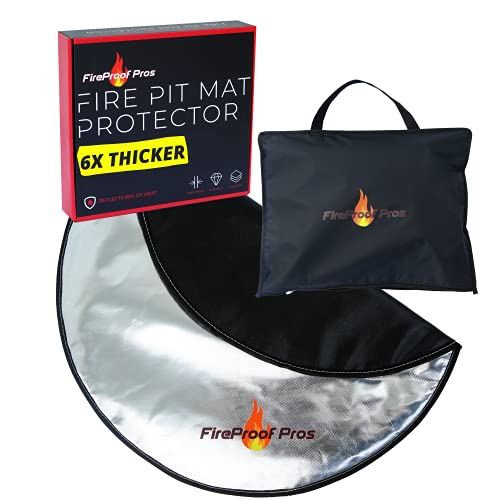 Fireproof Pros 36 inThe rare deck protector whose manufacturer states thickness, layer materials, a temperature figure and — more usefully — the limits of all three. It is the one on this page you can actually check. | A maker that publishes its build | n/a | n/a | $39.99 · Check on Amazon |
| 2 | DocSafeNo photo DocSafe 40 in mat40 x 40 in and four layers, which is the size and build that matters under anything with a real fire in it. The published dimensions are the part you can actually check. | Larger pits and generous margins | n/a | n/a | Check price on Amazon |
| 3 |  Newtex FirePad 24 inThe thing standing between a fire pit and a scorched deck board. It is not optional on timber or composite, and it is the cheapest part of the whole setup. | A fire pit on a wood deck | n/a | n/a | $39.95 · Check on Amazon |
Reach marked “claimed” is the maker’s own published figure. Reach without that label is ours, computed from published output at 20 BTU per square foot for an open patio. Neither is a measurement we took.
Top pick · A maker that publishes its build
Fireproof Pros 36 in Round Fire Pit Mat, Triple Layer
The rare deck protector whose manufacturer states thickness, layer materials, a temperature figure and — more usefully — the limits of all three. It is the one on this page you can actually check.
- Fuel
- Accessory
- Output
- Not published
- Reach (computed)
- Not published
- Cost per hour
- n/a
What works
- It publishes what it is made of, in millimeters. Thickness and layer materials are what separate a barrier from a decorative pad, and almost nobody in this category states either
- It publishes its own limits too — the maker says roughly two minutes of extreme contact before damage reaches the surface below, and that it is not for prolonged direct heat. That honesty is worth more than a bigger number
- The 5-6 in leg-height guidance tells you the thing most listings hide: these mats assume an air gap and are not designed to sit directly under a hot base — which is why a deck installation is a system rather than a single purchase
- Kevlar stitching and a non-slip base address the two ways a mat fails in service — fraying at the edge and sliding underfoot
What does not
- 36 in is a 36 in circle, and margin is the whole point. Under a 19 in bowl that leaves about eight inches all round, which is reasonable but not generous for a pit that throws embers
- The 1,800 F figure is for instant contact, not sustained heat, and the maker says so. Read it as ember protection rather than a license to sit a hot pit on it for an evening
- Round mats look wrong under square pits, and a square pit needs the corners covered
- Costs more than the thin single-layer pads it sits next to, and the difference is invisible in a photograph
| Published specification | |
|---|---|
| Size | 36 in round |
| Thickness | 6.0 mm per the maker |
| Top layer | Aluminum-fiberglass, stated to reflect 95% of heat |
| Middle layer | 5 mm fiberglass-infused cotton |
| Base layer | Silicone coated, non-slip |
| Temperature | 1,800 F for instant contact with coal or wood, per the maker |
| Stitching | Kevlar thread per the maker |
| Suits | Pits with 5-6 in legs per the maker; 4 in minimum clearance |
| Included | Carry bag; one-year warranty |
| Maker’s coverage claim | None published — the reach figure above is ours |
| Safety listing | Not applicable — a heat barrier, not an appliance |
Who it is for
Anyone putting a legged fire pit on a wood or composite deck who wants a barrier whose maker will tell them what it is made of and where it stops working.
What it is not for
A pit that sits flat on the ground with no legs, or any placement problem — [no mat fixes clearance](/fire-pits/deck-safe).
Sources for this entry
- Amazon listing — Fireproof Pros 36 in fire pit protector for deck or patio, triple layer
- Fireproof Pros — published product specification (36 in round, 6.0 mm thick, aluminum-fiberglass top layer reflecting 95% of heat, 5 mm fiberglass-infused cotton middle, silicone-coated base, 1,800 F instant contact, Kevlar thread, carry bag, one-year warranty, best for pits with 5-6 in legs and at least 4 in clearance, roughly two minutes of extreme contact before damage below)
2 · Larger pits and generous margins
DocSafe 40 x 40 in Square Fire Pit Mat, 4-Layer
40 x 40 in and four layers, which is the size and build that matters under anything with a real fire in it. The published dimensions are the part you can actually check.
- Fuel
- Accessory
- Output
- Not published
- Reach (computed)
- Not published
- Cost per hour
- n/a
What works
- A square 40 in mat gives a genuine margin around a 19 in bowl like the Solo Stove, which is where falling embers land
- Four layers rather than a single sheet — a thin one-layer pad conducts heat straight into the board it is meant to protect
- Also works under a grill, which is the other thing that quietly ruins deck boards
What does not
- No thickness figure is published, and thickness is what separates a mat that protects from one that only looks like it does. Four layers is the only build claim you get
- Bulky to store compared with a thin round pad
- Square under a round pit looks exactly as you would expect, and some people mind
- Same limit as every mat: it handles heat, not bad placement
| Published specification | |
|---|---|
| Size | 40 x 40 in square |
| Build | Four layers per the listing |
| Thickness | Not published |
| Also rated for | Under a grill, fireplace and smoker per the listing |
| Maker’s coverage claim | None published — the reach figure above is ours |
| Safety listing | Not applicable — a heat barrier, not an appliance |
Who it is for
Anyone with a larger fire pit, or with a deck they care about more than they care about the mat looking tidy.
What it is not for
Small tabletop pits, where a smaller pad is proportionate and this is overkill.
Sources for this entry
3 · A fire pit on a wood deck
Newtex FirePad Deck Protector, 24 in
The thing standing between a fire pit and a scorched deck board. It is not optional on timber or composite, and it is the cheapest part of the whole setup.
- Fuel
- Accessory
- Output
- Not published
- Reach (computed)
- Not published
- Cost per hour
- n/a
What works
- Composite decking softens and deforms at temperatures well below ignition, so a barrier matters even where nothing is going to catch fire
- 24 in covers the footprint of most portable pits with a margin — the margin is where ember damage happens
- Rolls up, which is what makes it a thing you actually use rather than store
What does not
- A mat is a barrier, not a license. It does not make it safe to put a fire pit under a roof, near a wall, or on a surface the pit overhangs
- 24 in is too small for the larger bowls — match the mat to the pit, with room to spare
- Embers that clear the mat entirely are still an ember on a deck; a mat handles radiant heat, not sparks
| Published specification | |
|---|---|
| Diameter | 24 in |
| Intended use | Under fire pits, grills, smokers, chimineas |
| Stated surfaces | Porch, patio, deck, wood, grass, stone, composite |
| Maker’s coverage claim | None published — the reach figure above is ours |
| Safety listing | Not applicable — a heat barrier, not an appliance |
Who it is for
Anyone putting any fire pit on a wood or composite deck. See [deck-safe fire pits](/fire-pits/deck-safe) for the full set of conditions.
What it is not for
Making an unsafe placement safe. If the pit is too close to a wall or under an overhang, no mat fixes that.
Sources for this entry
What we would skip
A list with no losers is a list nobody edited. These are the choices we would actively steer you away from, and why.
A thin single-layer pad
The ones that photograph identically and cost a third as much. A single sheet of coated fabric conducts heat into the board it is lying on instead of spreading and shedding it. If no thickness and no layer count are published, assume the reason is that neither is flattering.
A mat the same size as the pit
The commonest sizing mistake, and it protects the one area that was never at risk. The damage happens at the edge — radiant spill just outside the bowl and embers that clear it. Margin is the product; the bit directly under the pit is the easy part.
Any mat, as a reason to move the pit closer to the house
A barrier addresses what is underneath. It does nothing about what is beside or above, and it does not shorten a single published clearance. The clearances are unchanged by anything you put on the floor.
How to size it
Start from the pit's diameter and add margin on every side. The margin is doing the work.
| Pit footprint | Mat that leaves a real margin | Margin all round |
|---|---|---|
| 19 in bowl (a typical portable pit) | 36 in round | About 8 in |
| 19 in bowl, windy or ember-heavy wood | 40 in or larger | 10 in or more |
| 24 to 30 in pit | 40 in square or larger | 5 to 8 in |
| Square or rectangular pit | Square mat, never round | Corners must be covered |
| Tabletop pit | 24 in | Proportionate — a large mat here is just clutter |
Our sizing guidance, computed from pit footprint plus margin. Makers publish mat dimensions but not the margin they assume, so the right-hand column is ours.
Two practical notes on that table. A round mat under a square pit leaves the corners exposed, which is where the legs usually are. And if the pit is also a grill, or shares the space with one, size for whichever throws more — grease and charcoal ruin decking as reliably as embers do.
Composite decking is the harder case
Timber scorches and the damage is visible at the surface. Composite decking contains plastic binders that soften and deform at temperatures well below anything that looks like a fire risk, so the damage arrives quietly and is permanent. On composite, buy the larger mat and raise the pit — the margin for error is smaller than it looks.
What the published numbers mean, and what they do not
Temperature figures dominate these listings. They are worth less than they look.
- A temperature with no duration is half a specification. "1,800 F" describes what happens when something hot touches the mat for a moment. It says nothing about two hours of steady radiant heat, which is the actual load.
- Thickness is the figure that correlates with performance, and it is the one most often missing. Six millimeters of layered material behaves nothing like a fraction of a millimeter of coated fabric, whatever either is rated to.
- Layer count without materials is marketing. Four layers of what? A maker naming aluminum-fiberglass, fiberglass-cotton and silicone is telling you something checkable; "4-layer" alone is not.
- No certification exists here. Unlike a gas appliance, a fire pit mat carries no safety listing you can look up, so the maker's own published detail is all there is. Prefer the ones that publish more of it.
The product a lot of people are searching for
Worth saying plainly, because it explains why this page's picks are all flat mats.
There is a well-known deck-protection product built on a different principle — a tray filled with lava rock, so the fire sits above a layer of loose stone and the air gap is built into the product rather than assumed of your pit's legs. It is the design a lot of people go looking for by name.
We checked it while writing this page and it is not currently purchasable on Amazon — the listing returns no offer. Rather than feature something you cannot buy, the picks here are mats that are in stock, and the air-gap principle is covered above as something to solve with leg height or pavers instead. If that product returns, the approach is sound and we would look at it again.
Living with one
- Store it dry and rolled. A mat left out under a pit collects water, and a wet mat under a hot base is a steam problem on top of a heat problem.
- Check the edges each season. Fraying at the perimeter is how these fail, which is why stitching material is worth knowing.
- Sweep it before use. Leaf litter on top of a fireproof mat is still leaf litter next to a fire.
- Do not fold a stiff mat repeatedly along the same line. Rolling preserves the layers; creasing works them apart.
- Replace it when it stops lying flat. A mat that curls at the edge lifts away from the deck and stops doing the one thing it is for.
The short version
Buy wider than you think, prefer a maker that publishes thickness and layer materials over one quoting the biggest temperature, and check your pit has legs. If it does not, raise it. The mat is the cheapest item in this whole setup and the one that decides whether the deck underneath survives the season — but it is a barrier, not permission, and it changes nothing about where the pit is allowed to stand.
Common questions
What size fire pit mat do I need?
Wider than the pit by a real margin, because embers and radiant spill land outside the bowl rather than under it. A 19 inch portable pit wants about a 36 inch mat, and 40 inches or more if you burn wood in a windy spot. Square pits need square mats so the corners are covered.
Do fire pit mats actually protect a deck?
From radiant heat, yes - that is what they are good at, spreading and shedding the steady downward heat of a burning pit. From embers, only partly: a mat handles sparks that land on it and does nothing about one that clears it entirely, which is why size matters more than the temperature rating.
Does a fire pit need legs to use a mat?
Most of these mats are designed assuming an air gap. Fireproof Pros, for example, states its mat suits pits with 5 to 6 inch legs and recommends at least 4 inches of clearance, and that it tolerates only about two minutes of extreme direct contact. A pit sitting flat is the hard case - raise it with a stand or pavers rather than buying a thicker mat.
What temperature rating does a fire pit mat need?
The rating matters less than it appears, because a temperature quoted with no duration describes momentary contact rather than two hours of steady radiant heat. Published thickness and layer materials are better predictors, and no fire pit mat carries an independent safety listing you can look up.
Are fire pit mats safe on composite decking?
They help, and composite is the harder case. Its plastic binders soften and deform well below anything that looks like a fire risk, so damage can arrive without any sign of burning. On composite, buy a larger mat than the sizing guidance suggests and raise the pit as well.
Can a mat let me put a fire pit closer to the house?
No. A barrier addresses the surface underneath and nothing else. It does not reduce any published clearance to walls, railings or anything overhead, and no mat makes a placement acceptable that was not acceptable without it.
Read next
Deck-safe fire pits
The stand-plus-barrier combination that protects decking, and the pits that suit it.
Patio heaters on a wood deck
Heat barriers, base stability, and the composite decking problem that starts before ignition.
The best fire pits for heat
Fire pits ranked on delivered warmth rather than rated output, with runtime and cost computed.
Outland Firebowl 893 review
What 58,000 BTU really delivers from an open bowl, the cost per hour, using it on a deck, and the fire-ban claim in context.
Patio heater safety, with the published numbers
Published clearance figures, the ventilation rule, and where each heater type must never go.