Gazebos
Heating a gazebo
One question decides this: are the sides up or down? A gazebo with open sides is a covered patio. A gazebo with the curtains zipped is an enclosure, and that changes everything.

Use an electric heater, mounted. A gazebo with open sides behaves like a covered patio and a gazebo with the curtains down is an enclosure, and because anyone can close them at any time, a combustion heater is never the right choice inside one.
The sides are the whole question
A gazebo is an unusually variable structure. It might be a timber pavilion with a shingled roof and open arches, or a metal frame with a fabric canopy and zip-down curtains on four sides. The heating answer for those two is not the same, except that it is — and the reason is worth stating.
With the sides open, a gazebo is a covered patio: clearance rules apply, ventilation is adequate, and gas would be acceptable if the ceiling were high enough (it usually is not). With the sides closed, it is an enclosure, and a combustion heater in an enclosure is a carbon monoxide risk.
What makes gazebos different from covered patios is that the state changes. Someone closes the curtains because it got cold or started raining, which is exactly the evening the heater is running. A covered patio cannot be enclosed by accident; a gazebo can be, in under a minute, by anyone.
The rule that follows
Use an electric heater in a gazebo, whatever the sides are doing tonight. It removes the whole question, it costs about 28 cents an hour, and a gazebo with the sides down retains heat well enough that a single 1,500 W unit is generous.
Sizing, for both states
| Patio area | Open sky, no roof | Roof overhead, open sides | Roof plus screens or partial walls |
|---|---|---|---|
| 80 sq ft | 1,600 BTU/h | 1,040 BTU/h | 800 BTU/h |
| 100 sq ft | 2,000 BTU/h | 1,300 BTU/h | 1,000 BTU/h |
| 120 sq ft | 2,400 BTU/h | 1,560 BTU/h | 1,200 BTU/h |
| 150 sq ft | 3,000 BTU/h | 1,950 BTU/h | 1,500 BTU/h |
| 200 sq ft | 4,000 BTU/h | 2,600 BTU/h | 2,000 BTU/h |
Area x 20 BTU per square foot for an open patio, then multiplied by 0.65 for a roof and 0.5 for a roof plus screens, and by 1 for average exposure. The reconciliation of where each factor comes from is on this page, not hidden.
Most domestic gazebos are 10 x 10 or 12 x 12 feet — 100 to 144 square feet. With the sides down, read the screened column: around 1,000 to 1,440 BTU/h. That is well under a third of what one 1,500 W electric unit produces. With the sides open, read the covered column, around 1,300 to 1,870 BTU/h. Still comfortably inside one unit.
Which is the useful conclusion: a gazebo is a small, well-sheltered space and it does not need much. Nearly every gazebo on a domestic patio is a single-electric-heater problem, and the temptation to buy something bigger is the thing to resist.
Quick picks
Ranked for fit, not for hype. Output is the maker’s published figure; reach is computed from it or from the maker’s own radius claim, and the table says which. Tap a row for the full write-up, or go straight to the listing.
| # | Product | Best for | Output | Reach | Price |
|---|---|---|---|---|---|
| 1 | 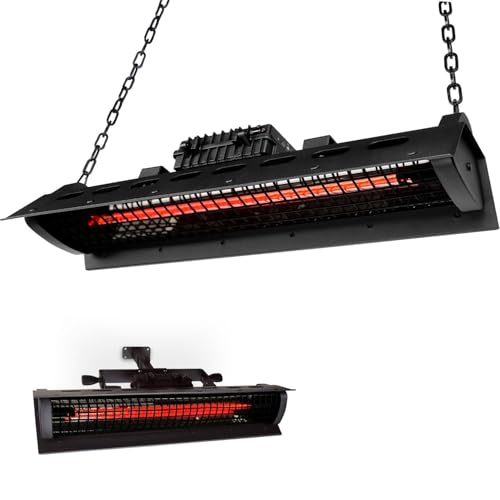 Star Patio STP2020-AOne of the very few electric units whose maker publishes a coverage area at all — 110 sq ft — and it mounts to a wall or hangs from a ceiling on chains. No ingress rating is published, so keep it somewhere sheltered. | A published coverage figure | 1,500 W | 110 sq ft claimed | $199.99 · Check on Amazon |
| 2 |  Dr Infrared 1500 WRadiant heat that a breeze cannot blow out, on a plug. 1,500 W is only 5,118 BTU/h, which sounds like nothing next to a propane tower and lands far more of itself on you. | Wind, and anywhere with a roof | 1,500 W | 256 sq ft | $148.98 · Check on Amazon |
| 3 |  Heat Storm TradesmanThe one electric unit here with a published IP rating, which is the difference between a heater that survives a wet winter mounted outdoors and one that is a warranty claim waiting to happen. | Leaving outside all year | 1,500 W | 256 sq ft | $99.99 · Check on Amazon-8% |
Reach marked “claimed” is the maker’s own published figure. Reach without that label is ours, computed from published output at 20 BTU per square foot for an open patio. Neither is a measurement we took.
Top pick · A published coverage figure
Star Patio STP2020-A-RMN2025 Wall and Ceiling Electric Infrared Patio Heater
One of the very few electric units whose maker publishes a coverage area at all — 110 sq ft — and it mounts to a wall or hangs from a ceiling on chains. No ingress rating is published, so keep it somewhere sheltered.
- Fuel
- Electric
- Output
- 1,500 W = 5,118 BTU/h
- Reach (claimed)
- 110 sq ft · 5.9 ft radius
- Cost per hour
- $0.28
What works
- It publishes a coverage figure. 110 sq ft is a real, checkable claim, and almost nobody in this category states one at all — which is the whole subject of our coverage page
- Wall bracket and ceiling chains both in the box, with 60 degrees of tilt, so the beam can actually be aimed at the chairs rather than at whatever the bracket decided
- 5,100 BTU/h published output is within a rounding error of the 5,118 our watts-to-BTU conversion gives, which is a maker doing its own arithmetic honestly
- Remote control on a unit mounted above head height is functional rather than a luxury
What does not
- No ingress rating is published for this model. Other units in this roundup publish one, and on a permanently mounted outdoor appliance that silence means you cannot price the weather risk. Treat it as a sheltered-position heater
- 110 sq ft is a small area — roughly a 10 by 11 ft patch, which is a seating group and not a patio
- 1,500 W, like everything else that plugs into a standard socket. The ceiling applies here as everywhere
- A 6 ft cord means the outlet has to be close, or an outdoor-rated extension has to be part of the plan
| Published specification | |
|---|---|
| Rated power | 1,500 W at 110 V, 60 Hz |
| Published output | 5,100 BTU/h per the maker |
| Published coverage | Up to 110 sq ft per the maker |
| Element | Golden tube |
| Mounting | Wall bracket or ceiling chains, up to 60 degrees of tilt |
| Size and weight | 27.5 x 7 x 5.7 in, 7.7 lb |
| Element life | 5,000 hours per the maker |
| Maker’s coverage claim | 110 sq ft |
| Safety listing | No ingress rating published for this model |
Who it is for
A sheltered wall or porch ceiling over a seating group, where you want a heater whose maker will tell you what area it actually covers.
What it is not for
An exposed wall where driving rain reaches it, since nothing is published about ingress protection, or any space much larger than a seating group.
2 · Wind, and anywhere with a roof
Dr Infrared Heater DR-238 Carbon Infrared Patio Heater with Kasa Outdoor Smart Plug
Radiant heat that a breeze cannot blow out, on a plug. 1,500 W is only 5,118 BTU/h, which sounds like nothing next to a propane tower and lands far more of itself on you.
- Fuel
- Electric
- Output
- 1,500 W = 5,118 BTU/h
- Reach (computed)
- 256 sq ft · 9.0 ft radius
- Cost per hour
- $0.28
What works
- Infrared warms objects, not air, so it is the only heat that survives a breeze — this is the single reason wind changes the whole buying decision
- No combustion means no flue gas, which is what makes it legal and sensible on a screened porch where propane is not
- Three settings matter more than they sound: 900 W costs a third less to run and is enough most evenings
What does not
- 1,500 W is 1,500 W. Nothing at this wattage heats faster than anything else at this wattage; the differences between electric heaters are beam shape and build, not power
- It heats what it points at. Step out of the beam and you are cold immediately — this is a fundamentally different experience from a tower
- A 120 V plug-in unit is capped by your circuit, not by the maker. See why 1,500 W is the ceiling
| Published specification | |
|---|---|
| Rated power | 1,500 W at 120 V |
| Settings | 900 W / 1,200 W / 1,500 W |
| Element | Carbon infrared lamp |
| Reflector | Mirror aluminum, 90% reflectivity per the maker |
| Housing | Anodized aluminum, rated for outdoor use |
| Mounting | Wall and ceiling brackets plus remote in the box |
| Bundle | Currently sold with a Kasa EP40 outdoor smart plug |
| Maker’s coverage claim | None published — the reach figure above is ours |
| Safety listing | ETL listed, per the maker's published product data |
Who it is for
A covered patio, pergola or screened porch where you can mount it overhead and point it at where people sit, and anywhere wind ruins a flame.
What it is not for
A big open patio with nowhere to mount it. Radiant heat needs a line of sight and a place to hang from.
3 · Leaving outside all year
Heat Storm Tradesman HS-1500-OTR-R 1500 W Weatherproof Infrared Heater
The one electric unit here with a published IP rating, which is the difference between a heater that survives a wet winter mounted outdoors and one that is a warranty claim waiting to happen.
- Fuel
- Electric
- Output
- 1,500 W = 5,118 BTU/h
- Reach (computed)
- 256 sq ft · 9.0 ft radius
- Cost per hour
- $0.28
What works
- A published IPX4 rating. Almost nobody in this category publishes an ingress rating at all, and mounting an unrated electric heater outdoors is a gamble you cannot price
- The maker publishes its own BTU figure (5,200), which is within a rounding error of the 5,118 our watts-to-BTU conversion gives — a company doing its own arithmetic honestly
- Wall or ceiling mount puts the heat above head height where a radiant beam belongs
What does not
- IPX4 rates water only — the solids digit is X, meaning none is published. It is splashing-water protection, not immersion, and it tells you nothing about dust ingress
- Fixed mounting means fixed aim. Get the position wrong and there is no adjusting it from the chair
- Same 1,500 W ceiling as every other plug-in electric heater
| Published specification | |
|---|---|
| Rated power | 1,500 W at 120 V |
| Published output | 5,200 BTU/h per the maker |
| Element | Carbon fiber infrared, per the maker |
| Weather rating | IPX4 |
| Dimensions | 27 x 8 x 6 in |
| Control | Remote included |
| Mounting | Wall or ceiling; tripod and tri-mount combos are separate SKUs |
| Maker’s coverage claim | None published — the reach figure above is ours |
| Safety listing | IPX4 weatherproof rating published by the maker |
Who it is for
A permanently mounted heater on a pergola, porch ceiling or exterior wall that you never want to take down and store.
What it is not for
Portability, and any open patio with no structure to mount to.
What we would skip
A list with no losers is a list nobody edited. These are the choices we would actively steer you away from, and why.
Any gas heater inside a gazebo
The problem is not tonight, it is next week. A gazebo's sides can be closed by anyone in under a minute, turning a ventilated space into an enclosure with a combustion appliance running in it. There is no way to manage that, so the answer is electric.
A tower under a fabric gazebo roof
Fabric plus an open flame plus the published 36-inch overhead clearance requirement is a combination with no good version. Soft-top gazebos are typically well under nine feet at the eaves too.
An unrated electric unit in a soft-top gazebo
Fabric roofs leak, sag and pool water. A mounted electric appliance underneath one needs a published ingress rating — this is the case IP55 exists for.
A gazebo frame is usually the easiest structure on this site to hang from, because the load path is visible rather than hidden behind board. The hanging heater page has the hardware comparison and the swing problem; this section covers what is particular to a gazebo.
Mounting in a gazebo
- Hard-top gazebos — treat like a covered patio. Fix to a beam or rafter, check the published 12 to 24 inches of overhead clearance for electric, and aim down at the seating.
- Soft-top gazebos — the frame is the only structure. Fix to a metal upright or the frame corner, not to fabric, and keep well clear of the canopy with the published clearance measured to the fabric.
- Fabric is the thing to watch. Canopies sag under rain and move in wind, so the clearance you set on a dry day is not the clearance you have in a storm. Leave more room than the minimum.
- A weather rating matters more here. Gazebo roofs leak and pool. IP55 is the specification to want for anything mounted under one.
If the gazebo is genuinely enclosed
With the sides zipped, insulated panels, or a solid structure with doors, you no longer have an outdoor space. It is a small building, and it should be heated like one: an indoor-rated electric heater with a thermostat is more appropriate than an outdoor patio heater, and it will control the temperature rather than just radiating at whoever is in the beam.
The ventilation rule does not soften for a solid gazebo, it hardens. The more genuinely enclosed the structure, the more absolutely a combustion appliance is out. The safety page is the reference.
How we picked
- Electric only. A gazebo's sides can be closed in seconds by anyone, at any time, which makes a combustion heater inside one an unmanaged risk regardless of how it is used tonight.
- Weather rating weighted heavily, because a gazebo roof is often fabric and rain finds its way in.
- Ceiling and wall mounting both considered, since gazebo structures vary enormously in what they offer to fix to.
- Sized against a well-retained space, closer to the screened-porch figure than the open-patio one when the sides are down.
What we did not do
Everyone in this category says they tested twenty heaters. We have not tested any, and we say so. What we do instead: compile the published specs, compute the electrical and gas load from them, cite the maker’s own manual, and show the arithmetic so you can check it. The full method, including how to challenge a figure.
Common questions
Can you put a patio heater under a gazebo?
An electric one, mounted, yes. A gas one is not appropriate, because a gazebo's sides can be closed at any time by anyone, turning a ventilated space into an enclosure while a combustion appliance is running in it.
What size heater do I need for a gazebo?
Less than you think. A 12 x 12 ft gazebo with the sides down needs around 1,440 BTU/h on our sizing model, and a single 1,500 W electric unit produces 5,118. Nearly every domestic gazebo is a one-heater problem.
Are gazebo heaters safe?
Electric ones are, with the published clearance to the roof observed and a suitable weather rating. Gas heaters are not appropriate under a gazebo, and the risk is specifically that the space can become enclosed while the heater is running.
Can I hang a heater from a soft-top gazebo?
From the metal frame, yes. From the fabric canopy, no. And leave more clearance than the published minimum, because a fabric roof sags and moves — the gap on a dry still day is not the gap you have in rain and wind.
Sources
Read next
Patio heater safety, with the published numbers
Published clearance figures, the ventilation rule, and where each heater type must never go.
Heating a screened porch
Why a screened porch is electric-only, and the mounted units that suit it.
Wall mounted patio heaters, and the rating that decides
Wall and ceiling mounted electric heaters, ranked on published weather rating and mounting.
Patio heater BTU calculator
Your patio's BTU requirement with every multiplication shown, plus why the published rules disagree.
Hanging patio heaters
Ceiling and chain-hung heaters judged on what they hang from, how they behave in wind, and the weather rating most listings omit.