Head to head
Carbon vs quartz infrared elements
Two ways of making the same 1,500 watts into radiant heat. The difference is real, smaller than the marketing suggests, and worth understanding before you pay extra for either.
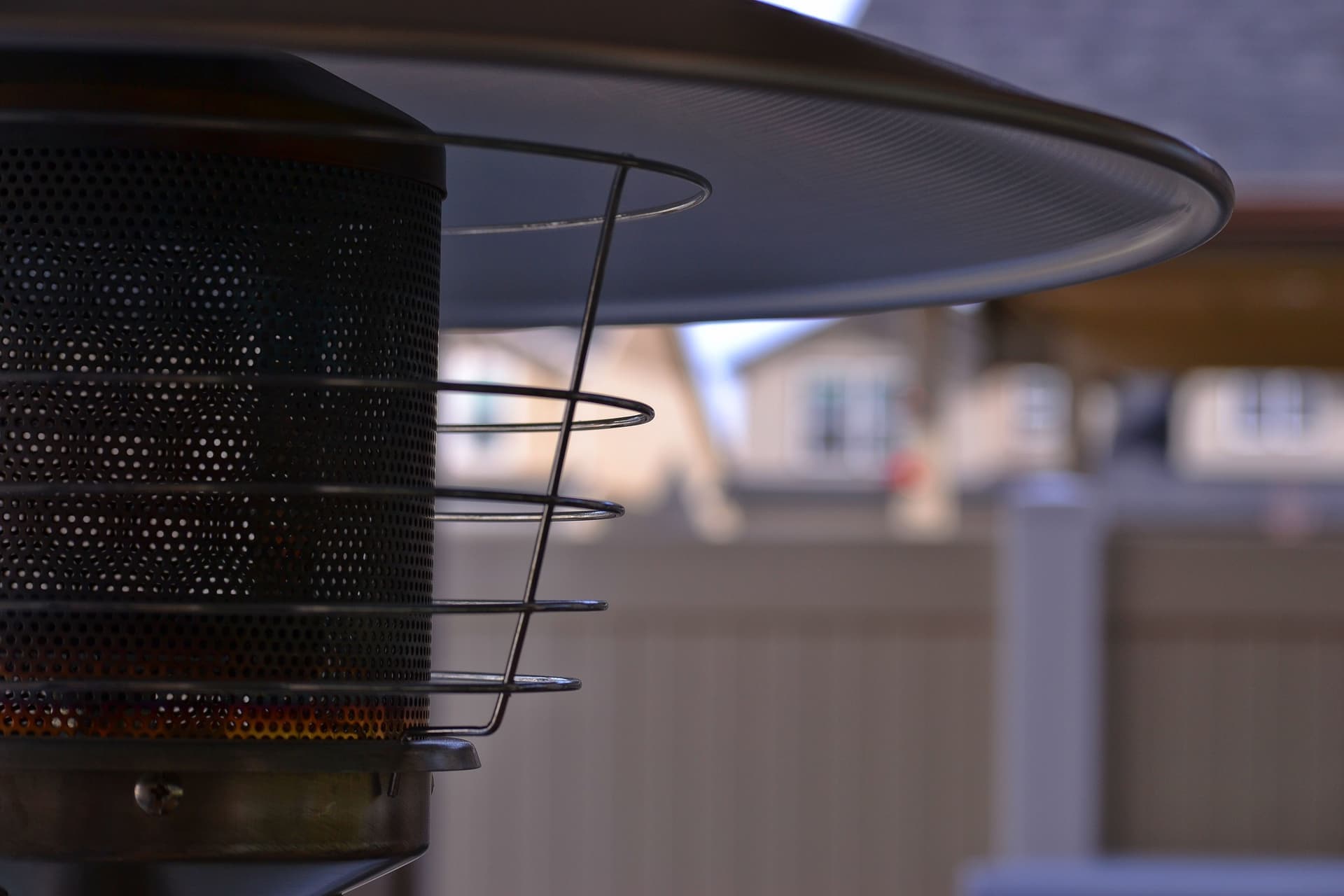
Both convert 1,500 W into about 5,118 BTU/h — the heat output is identical. Quartz elements run hotter and glow brighter, reaching temperature almost instantly. Carbon elements run cooler and dimmer with a softer spread. Choose on glare and warm-up, not on warmth.
The part that is not a difference
Start here, because most of the category's marketing depends on you not knowing it. A 1,500 W heater consumes 1,500 W and emits 1,500 W of energy, whatever the element is made of. There is no element technology that produces more heat from the same wattage, because that would be a violation of conservation of energy rather than an engineering advantage.
1,500 W is about 5,118 BTU/h in both cases. Any claim that one element type is "more powerful" at the same wattage is describing the sensation, not the physics.
What genuinely differs is the wavelength and the surface temperature of the emitter, and those change how the heat feels, where it lands, and how the thing looks while it is working.
What actually differs
| Quartz | Carbon | |
|---|---|---|
| Output at 1,500 W | About 5,118 BTU/h | About 5,118 BTU/h |
| Element temperature | Higher | Lower |
| Visible glow | Bright orange | Dimmer, deeper red |
| Warm-up | Near instant | A few seconds |
| Wavelength | Shorter, more intense | Longer, softer |
| Feel | Sharper, more directional | Gentler, broader |
| Typical use | Wide, including workshops | Patios and seating areas |
Element behavior described from published designs and from how each type is constructed. We have not measured either — see [how we work](/methodology).
The practical translation: a quartz element feels like standing near a bar fire — you notice the moment it points at you, and you notice the moment it stops. A carbon element feels more like being in a warm patch. Neither is better; they suit different seating.
The glare question, which decides it for most people
This is the difference nobody weighs at purchase and everybody notices afterward. A quartz element is bright. Mounted at head height on a small patio at nine in the evening, that brightness is in your field of view for the whole time it is on.
On a dark terrace where the point of the evening is the atmosphere, that matters more than a few seconds of warm-up time. On a workshop wall or an exposed deck where you want unambiguous heat and do not care what it looks like, it does not matter at all.
So the honest decision rule is: if you will be looking at it, prefer carbon. If you will be working under it, quartz is fine and warms up faster.
Both picks below are carbon, and that is the finding
We went looking for a currently-stocked quartz-element outdoor heater to sit beside the carbon one and could not verify a single one. The units we can check — including the Heat Storm Tradesman, whose maker publishes a carbon fiber element — are carbon. Treat the comparison above as the physics, and the picks below as what the shelf actually holds.
Quick picks
Ranked for fit, not for hype. Output is the maker’s published figure; reach is computed from it or from the maker’s own radius claim, and the table says which. Tap a row for the full write-up, or go straight to the listing.
| # | Product | Best for | Output | Reach | Price |
|---|---|---|---|---|---|
| 1 |  Dr Infrared 1500 WRadiant heat that a breeze cannot blow out, on a plug. 1,500 W is only 5,118 BTU/h, which sounds like nothing next to a propane tower and lands far more of itself on you. | Wind, and anywhere with a roof | 1,500 W | 256 sq ft | $148.98 · Check on Amazon |
| 2 |  Heat Storm TradesmanThe one electric unit here with a published IP rating, which is the difference between a heater that survives a wet winter mounted outdoors and one that is a warranty claim waiting to happen. | Leaving outside all year | 1,500 W | 256 sq ft | $99.99 · Check on Amazon-8% |
Reach marked “claimed” is the maker’s own published figure. Reach without that label is ours, computed from published output at 20 BTU per square foot for an open patio. Neither is a measurement we took.
Top pick · Wind, and anywhere with a roof
Dr Infrared Heater DR-238 Carbon Infrared Patio Heater with Kasa Outdoor Smart Plug
Radiant heat that a breeze cannot blow out, on a plug. 1,500 W is only 5,118 BTU/h, which sounds like nothing next to a propane tower and lands far more of itself on you.
- Fuel
- Electric
- Output
- 1,500 W = 5,118 BTU/h
- Reach (computed)
- 256 sq ft · 9.0 ft radius
- Cost per hour
- $0.28
What works
- Infrared warms objects, not air, so it is the only heat that survives a breeze — this is the single reason wind changes the whole buying decision
- No combustion means no flue gas, which is what makes it legal and sensible on a screened porch where propane is not
- Three settings matter more than they sound: 900 W costs a third less to run and is enough most evenings
What does not
- 1,500 W is 1,500 W. Nothing at this wattage heats faster than anything else at this wattage; the differences between electric heaters are beam shape and build, not power
- It heats what it points at. Step out of the beam and you are cold immediately — this is a fundamentally different experience from a tower
- A 120 V plug-in unit is capped by your circuit, not by the maker. See why 1,500 W is the ceiling
| Published specification | |
|---|---|
| Rated power | 1,500 W at 120 V |
| Settings | 900 W / 1,200 W / 1,500 W |
| Element | Carbon infrared lamp |
| Reflector | Mirror aluminum, 90% reflectivity per the maker |
| Housing | Anodized aluminum, rated for outdoor use |
| Mounting | Wall and ceiling brackets plus remote in the box |
| Bundle | Currently sold with a Kasa EP40 outdoor smart plug |
| Maker’s coverage claim | None published — the reach figure above is ours |
| Safety listing | ETL listed, per the maker's published product data |
Who it is for
A covered patio, pergola or screened porch where you can mount it overhead and point it at where people sit, and anywhere wind ruins a flame.
What it is not for
A big open patio with nowhere to mount it. Radiant heat needs a line of sight and a place to hang from.
2 · Leaving outside all year
Heat Storm Tradesman HS-1500-OTR-R 1500 W Weatherproof Infrared Heater
The one electric unit here with a published IP rating, which is the difference between a heater that survives a wet winter mounted outdoors and one that is a warranty claim waiting to happen.
- Fuel
- Electric
- Output
- 1,500 W = 5,118 BTU/h
- Reach (computed)
- 256 sq ft · 9.0 ft radius
- Cost per hour
- $0.28
What works
- A published IPX4 rating. Almost nobody in this category publishes an ingress rating at all, and mounting an unrated electric heater outdoors is a gamble you cannot price
- The maker publishes its own BTU figure (5,200), which is within a rounding error of the 5,118 our watts-to-BTU conversion gives — a company doing its own arithmetic honestly
- Wall or ceiling mount puts the heat above head height where a radiant beam belongs
What does not
- IPX4 rates water only — the solids digit is X, meaning none is published. It is splashing-water protection, not immersion, and it tells you nothing about dust ingress
- Fixed mounting means fixed aim. Get the position wrong and there is no adjusting it from the chair
- Same 1,500 W ceiling as every other plug-in electric heater
| Published specification | |
|---|---|
| Rated power | 1,500 W at 120 V |
| Published output | 5,200 BTU/h per the maker |
| Element | Carbon fiber infrared, per the maker |
| Weather rating | IPX4 |
| Dimensions | 27 x 8 x 6 in |
| Control | Remote included |
| Mounting | Wall or ceiling; tripod and tri-mount combos are separate SKUs |
| Maker’s coverage claim | None published — the reach figure above is ours |
| Safety listing | IPX4 weatherproof rating published by the maker |
Who it is for
A permanently mounted heater on a pergola, porch ceiling or exterior wall that you never want to take down and store.
What it is not for
Portability, and any open patio with no structure to mount to.
What neither element fixes
- The 1,500 watt ceiling. Both are limited by the same standard household circuit, and no element choice gets you past it. Why that ceiling exists.
- Aim. A radiant heater warms what it points at. Mounted wrong, both types heat a fence. Height and aim matter more than the element.
- Area. Radiant heat is a cone, not a circle. If you need to warm a whole open patio rather than a seating group, the comparison you actually want is against propane.
- Weather exposure. The published IP rating decides whether a unit survives on an exposed wall, and it has nothing to do with the element.
Both element types share infrared's one genuine advantage over flame heaters, which is that wind does not affect radiant output. That is worth far more on a real patio than the difference between them.
Where the confusion comes from
The category uses several overlapping terms for the same handful of things, and the overlap is doing marketing work rather than describing engineering. Untangling it makes the listings much easier to read.
| Term you will see | What it usually means |
|---|---|
| Infrared | Every radiant heater here. Not a distinguishing feature |
| Quartz | A tungsten filament in a quartz tube. Hot, bright, instant |
| Carbon | A carbon fiber element. Cooler, dimmer, softer spread |
| Halogen | A quartz lamp with halogen fill. Brightest of the lot |
| Golden tube / low glare | A coated quartz lamp, sold on reduced glare |
| Far infrared | Longer wavelength, which in practice means a cooler element |
| Ceramic | Usually a convection panel, not a radiant lamp at all |
Terms as they are commonly used on outdoor heater listings. Where a maker states an element type we quote it; these are descriptions of the language, not a technical standard.
The one on that list to watch for is ceramic, because it is frequently a different appliance rather than a different element. A ceramic panel warms air by convection, which outdoors is the mechanism wind defeats. A ceramic heater on an open patio is solving the wrong problem regardless of its wattage.
What to check on the listing
- Is the element type stated at all? Plenty of listings say only "infrared". That is not a specification, and a maker that will not name the element is usually not the one to buy.
- Is the element replaceable? This decides whether an eventual failure costs a part or a heater, and it is rarely prominent on the listing.
- Is there a published IP rating? More important than element type for anything mounted outdoors.
- What are the power steps? A 900 / 1,200 / 1,500 W unit can be run down when you do not need full output, which is most evenings and most of the running cost.
Durability, honestly
Both are lamps and both eventually fail. Manufacturers publish element life figures inconsistently and we are not going to compare numbers that are not stated on a like-for-like basis. What can be said without inventing anything: an element is a replaceable consumable on some units and a sealed part on others, and that is worth checking on the listing before you buy, because it decides whether a failure means a part or a new heater.
For a worked example of the carbon side of this, the DR-238 review goes through one carbon unit in full - including why buyers searching for a low glare heater are really searching for this element type.
So which one
For a patio where people sit and talk in the evening, carbon — the softer glow is the whole reason to spend the money on a nicer unit rather than a work lamp. For a covered work area, a garage doorway, or anywhere the light is irrelevant and instant heat is useful, quartz, which typically costs less for the same output.
And before either: check that 5,118 BTU/h is enough for your space at all. Run the numbers — on an open patio it very often is not, and that is a bigger decision than the element.
Common questions
Is carbon or quartz better for a patio heater?
Carbon for a seating area, because the glow is softer and less intrusive at night. Quartz for a work area or anywhere you want instant heat and do not care about glare. Heat output at the same wattage is identical.
Does a carbon heater produce more heat than a quartz one?
No. At the same wattage both produce the same energy — about 5,118 BTU/h at 1,500 W. Any claim otherwise is describing how the heat feels, not how much there is.
Which infrared element warms up faster?
Quartz, essentially instantly, because it runs at a higher element temperature. Carbon takes a few seconds. On a heater you leave on for an evening this rarely matters.
Do carbon or quartz heaters work better in wind?
Both are equally unaffected. Radiant energy crosses moving air almost unchanged, which is infrared's real advantage over flame heaters regardless of element type.
Is a ceramic patio heater the same as an infrared one?
Usually not. Ceramic outdoor heaters are frequently convection panels that warm air rather than radiant lamps that warm objects — and outdoors, warmed air is exactly what wind removes. Check whether a listing describes a radiant element or a convection panel, because they behave completely differently outside.
What does far infrared mean on a heater listing?
Longer-wavelength infrared, which in practice means a cooler, dimmer element. It is a real physical distinction but it is used loosely in marketing, and it does not mean more heat — output is set by wattage regardless of wavelength.
Which element lasts longer?
Makers publish life figures inconsistently, so we will not compare numbers that are not stated on the same basis. The more useful check is whether the element is a replaceable part or sealed into the unit, which decides what a failure costs you.
Sources
Read next
Infrared patio heaters, and why wind does not touch them
Four infrared heaters and heat lamps, with what radiant heat does that a flame cannot.
Electric patio heaters, and the ceiling nobody mentions
Four electric patio heaters compared on wattage, published IP rating and cost per hour.
Watts, BTU, and the 1,500 watt ceiling
The watts-to-BTU conversion, and why a household circuit caps every plug-in heater at 1,500 W.
Wall mounted patio heaters, and the rating that decides
Wall and ceiling mounted electric heaters, ranked on published weather rating and mounting.
Wind-resistant patio heaters
The heaters that keep working in a breeze, and the physics that makes the list mostly electric.
Dr Infrared DR-238 review
What 1,500 W of carbon infrared really buys, the IP rating its maker does not publish, and when to step up to 240 V.