Deep review
HEATAK pellet patio heater review
A gravity-fed pellet burner with a chimney and a window onto the fire. Its headline number does not survive its own published burn time, and it is still an interesting heater.

A gravity-fed wood pellet heater with a chimney, a viewing window and a published 24 ft coverage diameter — no cylinder, no outlet. The headline 70,000 BTU is a peak figure: the maker's own 20 lb hopper and 4-hour burn time imply about 40,000 BTU/h sustained. Buy it for fuel independence and live fire, not for the number on the box.
We have not burned pellets in this. What follows reads the published specification, does the arithmetic those numbers imply, and separates what HEATAK claims from what we calculate.
What it is
A steel column with a hopper on top, a burn chamber with a glass window, a stainless reflector and a chimney. Pellets feed down by gravity into the fire as it consumes them, so it runs unattended for hours rather than needing a log every twenty minutes. It has wheels, and it needs neither a propane cylinder nor an electrical outlet — which is a genuinely unusual combination in outdoor heating.
Published figures: 70,000 BTU/h rated, a hopper holding up to 20 lb of pellets, up to 4 hours on high and 6 hours on low, a 24 ft diameter of coverage stated as over 400 sq ft, gravity feed, steel frame and chimney, stainless reflector, dual wheels.
Quick picks
Ranked for fit, not for hype. Output is the maker’s published figure; reach is computed from it or from the maker’s own radius claim, and the table says which. Tap a row for the full write-up, or go straight to the listing.
| # | Product | Best for | Output | Reach | Price |
|---|---|---|---|---|---|
| 1 | 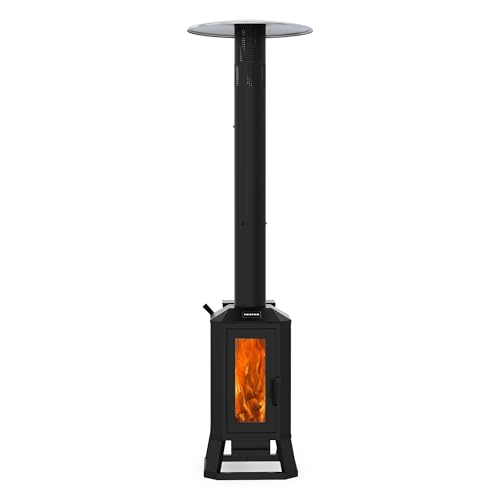 HEATAK pellet heaterA gravity-fed pellet burner with a chimney and a viewing window, and the rare pellet heater that publishes its hopper, its burn time and its coverage. Buy it for the fire and the fuel independence, not for the headline BTU number. | Live fire with no cylinder and no outlet | 70,000 BTU | 400 sq ft claimed | $349.99 · Check on Amazon |
Reach marked “claimed” is the maker’s own published figure. Reach without that label is ours, computed from published output at 20 BTU per square foot for an open patio. Neither is a measurement we took.
Top pick · Live fire with no cylinder and no outlet
HEATAK 70,000 BTU Wood Pellet Outdoor Patio Heater with Glass Viewing Window
A gravity-fed pellet burner with a chimney and a viewing window, and the rare pellet heater that publishes its hopper, its burn time and its coverage. Buy it for the fire and the fuel independence, not for the headline BTU number.
- Fuel
- Wood
- Output
- 70,000 BTU/h
- Reach (claimed)
- 400 sq ft · 12.0 ft radius
- Cost per hour
- n/a
What works
- It publishes what the category usually hides — hopper capacity, burn time at two settings, and a coverage figure that is internally consistent (a 24 ft diameter is about 452 sq ft of circle against their stated 400-plus)
- No cylinder to run out mid-evening and no outlet to reach — the only unit here independent of both, which is why it also works away from the house
- Pellets are a commodity sold by the 40 lb bag at any hardware store, and a bag stores in a way a swapped cylinder does not
- It is an actual fire behind glass, with the light and draw of one. A propane tower is a heater; this is closer to a fire pit with a chimney
What does not
- The published output and the published burn time do not agree. 70,000 BTU/h at a standard 8,000 BTU/lb would consume about 8.75 lb of pellets an hour, but the maker's own 20 lb hopper and 4-hour high setting imply about 5 lb an hour — roughly 40,000 BTU/h. Both figures are theirs. We show the arithmetic on the comparison page
- No published safety listing. Every propane unit on this site cites a CSA or equivalent certification and this one cites none, which is a real gap rather than a formality
- It has to be lit, tended and then emptied of ash — closer to running a fire pit than flicking a propane igniter
- Four hours on high is one evening, and refilling means opening a hopper on a unit that is already burning
- A steel chimney at this size is a large object to store, and the wheels are the only concession to moving it
| Published specification | |
|---|---|
| Rated input | 70,000 BTU/h (maker's published figure) |
| Published coverage | 24 ft diameter, stated as over 400 sq ft |
| Hopper | Up to 20 lb of pellets |
| Burn time | Up to 4 hours on high, 6 hours on low (maker's figures) |
| Feed | Gravity-fed automatic pellet system |
| Construction | Steel frame and chimney, stainless reflector, high-temperature black coating |
| Mobility | Built-in dual wheels |
| Maker’s coverage claim | 400 sq ft |
| Safety listing | No safety listing published by the maker or its retailers |
Who it is for
Someone who wants live fire on an open patio without running cylinders, is comfortable tending it, and values fuel that stores in a bag in the garage.
What it is not for
Anywhere under a roof, on a covered porch or near anything overhead — it is a solid-fuel appliance with a live flame, a chimney and an ash pan. Also wrong if you want heat in ten seconds.
Sources for this entry
- Amazon listing — HEATAK 70,000 BTU wood pellet outdoor patio heater with glass viewing window
- HEATAK / retailer published specification (70,000 BTU, 20 lb hopper, 4 h high and 6 h low, 24 ft diameter coverage, gravity-fed)
- American Wood Fibers — premium hardwood pellet specification (8,000 BTU/lb, 40 lb bag)
The 70,000 BTU figure, checked against its own numbers
This is the review. Everything else is detail.
Wood pellets carry about 8,000 BTU per pound — a standard published figure for premium hardwood pellets, not an estimate of ours. A hopper holding 20 lb therefore contains roughly 160,000 BTU of fuel in total.
HEATAK says that hopper lasts up to 4 hours on high. Divide the fuel by the time and the sustained burn rate is about 40,000 BTU/h — not 70,000. On the 6-hour low setting it works out nearer 27,000 BTU/h.
| Setting | Maker's burn time | Fuel in hopper | Implied sustained output |
|---|---|---|---|
| High | Up to 4 hours | About 160,000 BTU | About 40,000 BTU/h |
| Low | Up to 6 hours | About 160,000 BTU | About 27,000 BTU/h |
| Headline claim | — | — | 70,000 BTU/h |
Our arithmetic from the maker's own published hopper capacity and burn times, at the standard 8,000 BTU per pound for premium hardwood pellets.
None of this makes the heater bad, and none of it requires assuming anyone lied. A peak rating and a sustained rating are different measurements, and a gravity-fed solid-fuel burner can very plausibly peak well above what it holds for four hours. But 70,000 BTU is not comparable to a propane tower's 48,000, because the propane figure is a continuous rate the appliance holds until the cylinder runs out. Compared like with like, this sits below a mid-size propane tower rather than well above one.
Credit where it is due
HEATAK publishes the hopper size, both burn times and a coverage figure. That is more than most of this category discloses — and it is the only reason the arithmetic above is possible at all. A maker that published nothing would have left the 70,000 unchallengeable. We would rather have the numbers and be able to check them.
The coverage claim holds up
A 24 ft diameter is a 12 ft radius, which is a circle of about 452 square feet — and the maker describes it as "over 400 sq ft". Those two statements agree with each other, which is a lower bar than it should be and one that a surprising number of listings fail.
Against the sustained ~40,000 BTU/h computed above, 452 sq ft is a defensible claim on the 20 BTU per square foot open-patio baseline this site uses. The coverage page explains why a stated radius always flatters itself outdoors, but this one is at least internally consistent.
What it is actually for
Three things it does that nothing else on this site does at once.
- No cylinder and no outlet. Propane needs a supply chain and electric needs a circuit. Pellets come in bags from a hardware store and the heater needs nothing else, which makes it the answer for a patio with no power and no appetite for cylinder swaps.
- Visible fire without a fire pit. The window and the chimney give you flame to look at in a heater with a reflector — a fire pit gives you the fire but heats a low ring of people; this points heat outward at standing height.
- Unattended running. Gravity feed is the difference between a fire you tend and a fire you light. That is the whole appeal of pellets over logs.
What it costs to feed
Pellet prices vary by region and by season, and this site does not publish a national average for them because we have not sourced one we would stand behind. What we can give you is the physics: a 40 lb bag at 8,000 BTU per pound holds about 320,000 BTU, which is roughly three quarters of what a 20 lb propane cylinder holds.
Whether that is cheaper than propane depends entirely on what a bag costs where you are. The pellet versus propane comparison sets out the cost-per-BTU method so you can run it against your own local price rather than ours.
The gaps
- No safety listing is published by the maker or its retailers. On a solid-fuel appliance with a chimney that is a real absence, and it is the single biggest reason to hesitate.
- It makes ash. Every solid fuel does. A propane tower is off in one second and clean; this needs emptying and the chimney needs attention.
- The headline BTU is peak, not sustained, as above. Anyone buying on the 70,000 figure alone will feel misled even though the maker published the numbers that disprove it.
- Refueling mid-evening. Four hours on high is one evening, not two, and topping a hot hopper is a different chore from turning a valve.
Who should buy it
A patio with no outdoor circuit and no wish to run propane, where the owner actively wants a fire to look at and does not mind ash. It is also the only heater here that keeps working when the propane supplier is shut and the power is out, which for some buyers is the entire argument.
Who should not
- Anyone buying on the BTU number. A 48,000 BTU propane tower holds its rate for nine hours; this holds about 40,000 for four.
- Anywhere with something overhead. It is a solid-fuel appliance with a chimney. Open sky only.
- Anyone who wants heat at the flick of a switch. Lighting, feeding and cleaning are the deal.
- Anyone who needs a named safety listing — none is published for this model.
The verdict
An unusual and genuinely useful appliance sold behind a number that its own specification does not support. The honest version of the headline is roughly 40,000 BTU/h sustained on high, which is still real heat and still a perfectly good patio heater.
Buy it for fuel independence and for the fire in the window. Do not buy it believing it outguns a propane tower, and do not buy it if the absence of a safety listing bothers you — which is a reasonable thing for it to do.
Common questions
Is the HEATAK pellet heater really 70,000 BTU?
That is the maker's peak figure. Its own published numbers - a 20 lb hopper and up to 4 hours on high - imply about 40,000 BTU per hour sustained, because premium hardwood pellets carry roughly 8,000 BTU per pound. Peak and sustained are different measurements, and the sustained figure is the one to compare against a propane tower.
How long does a hopper of pellets last?
The maker publishes up to 4 hours on high and up to 6 hours on low from a hopper holding up to 20 lb. That is one evening rather than several, and topping up a hot hopper mid-evening is a different job from turning a propane valve.
Does a pellet patio heater need electricity?
Not this one. The pellet feed is gravity-driven rather than motorized, so it needs no outlet and no propane cylinder - which makes it a genuine option for a patio with no power supply at all.
How much area does the HEATAK pellet heater cover?
The maker publishes a 24 ft diameter, described as over 400 sq ft. A 24 ft diameter is a circle of about 452 sq ft, so those two claims agree with each other - which is a lower bar than it sounds and one many listings fail.
Are pellet patio heaters cheaper to run than propane?
It depends entirely on local pellet prices, which vary by region and season, so we do not publish a national figure. The physics is fixed: a 40 lb bag at 8,000 BTU per pound holds about 320,000 BTU, roughly three quarters of a 20 lb propane cylinder. Run that against the bag price where you are.
Is the HEATAK pellet heater safety certified?
No safety listing is published by the maker or its retailers. On a solid-fuel appliance with a chimney that is a meaningful absence, and it is the clearest reason to choose something else if a named certification matters to you.
Sources
- HEATAK / retailer published specification (70,000 BTU, 20 lb hopper, up to 4 h high and 6 h low, 24 ft diameter coverage stated as over 400 sq ft, gravity-fed, steel frame and chimney, stainless reflector, dual wheels)
- American Wood Fibers — premium hardwood pellet specification (8,000 BTU per pound), the figure used for the sustained-output arithmetic on this page
- Amazon listing — HEATAK 70,000 BTU wood pellet outdoor patio heater with glass viewing window
Read next
Pellet patio heater vs propane
Pellets versus propane on cost per BTU, handling and safety — with the output claim checked against its own spec sheet.
Every outdoor heating option, in one page
Eight outdoor heating options compared on output, cost and where each genuinely belongs.
Patio heater coverage area
Radius to area, why the two get confused, and how to sanity-check any coverage claim.
Hiland HLDS01 review
What a premium propane tower buys over the clones, the parts catalog behind it, and the one condition it cannot beat.
Patio heater vs fire pit
Output, direction, cost, wind and permitted use compared, with exits to both catalogs.