By mounting
Patio umbrella heaters
The case nothing else covers: a table in the middle of a patio, with no wall to mount to and no room for a tower beside the chairs.
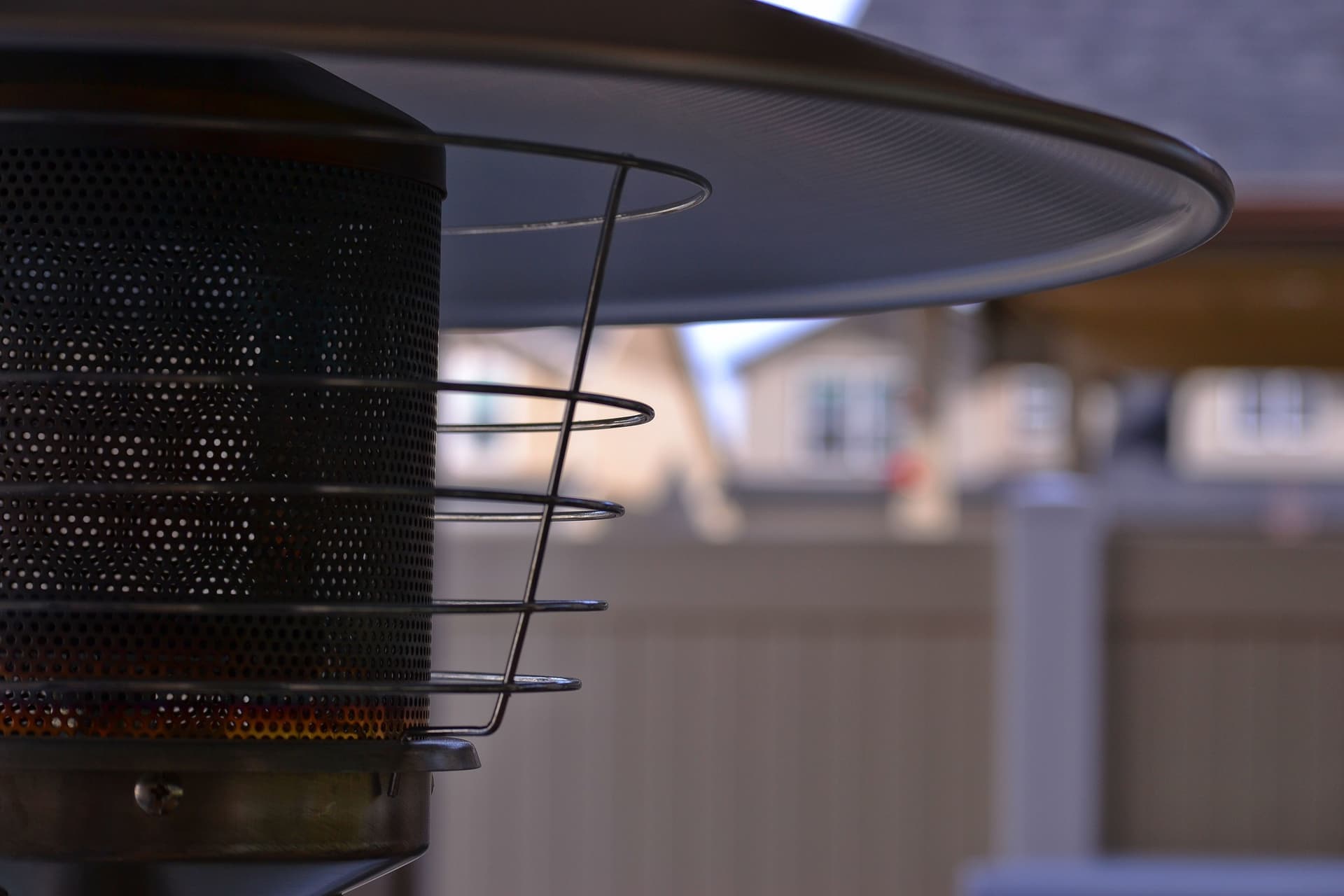
An umbrella heater clamps to the pole and radiates down onto the table underneath. It solves the case a wall-mounted unit cannot — a table in open space with nothing to fix to. Expect it to warm the table, not the patio, and make sure the umbrella is heavy enough to host it.
Worth knowing why a tabletop propane heater is not the answer here: the Hiland HLDS032 review covers the 24-inch ceiling clearance its manual requires, which a typical umbrella canopy does not give you.
The gap this fills
Most of the mounting advice on this site assumes structure. Wall and ceiling units want a wall or a ceiling; a tower wants floor space beside the seating. A dining table in the middle of a patio has neither, and it is a very common arrangement.
The umbrella is the structure that is already there. Clamping the heater to the pole puts it directly above the people, which is where radiant heat wants to be, and it uses space that is otherwise doing nothing.
It is also the arrangement with the best geometry in the whole category. A tower beside a table radiates sideways past the people at the far end; a pole-mounted unit radiates down onto all of them at once.
What the umbrella has to withstand
This is the part that decides whether the idea works, and it is about the umbrella rather than the heater.
- Mass on the pole, several feet up. A patio umbrella is engineered to hold fabric against wind, not to carry a bracketed appliance at head height. A heavy market umbrella with a substantial pole and a weighted base is the right host; a thin aluminum one is not.
- A base that will not lift. The whole assembly is only as stable as the base, and adding weight above the center of mass makes a marginal base worse. This is the same tip-over arithmetic as a tower, with a longer lever.
- Clearance to the canopy. Radiant heat pointed up at fabric is exactly the wrong direction, and every one of these has a stated minimum. Check it against your canopy height before buying, not after.
- Weather. Umbrella canopies leak at the seams and pool water in the panels. A unit under one is not sheltered in the way a porch ceiling shelters it, which makes a published ingress rating worth more here than people expect.
One true pole mount, and two ways to get the same geometry
Said plainly because it matters: only the first pick below actually clamps to an umbrella pole. It is a thin category — most makers do not build one, and we are not going to pad a list with heaters that cannot do the job the page is about.
The other two are what to buy when the umbrella cannot host one, and they reach the same place by a different route. Both mount to a ceiling as well as a wall, so if there is a pergola beam, a porch ceiling or a solid crossbar anywhere above the table, you get overhead radiant heat without asking the umbrella to carry anything.
Quick picks
Ranked for fit, not for hype. Output is the maker’s published figure; reach is computed from it or from the maker’s own radius claim, and the table says which. Tap a row for the full write-up, or go straight to the listing.
| # | Product | Best for | Output | Reach | Price |
|---|---|---|---|---|---|
| 1 |  Hiland parasol heaterThree independently switchable elements that clamp to an umbrella pole and angle where you want them. It is the brand's live electric unit, it is CSA certified, and it solves a problem no wall-mount heater can — heating a table that has no wall near it. | An umbrella you already have | 1,500 W | 256 sq ft | $203.59 · Check on Amazon |
| 2 | 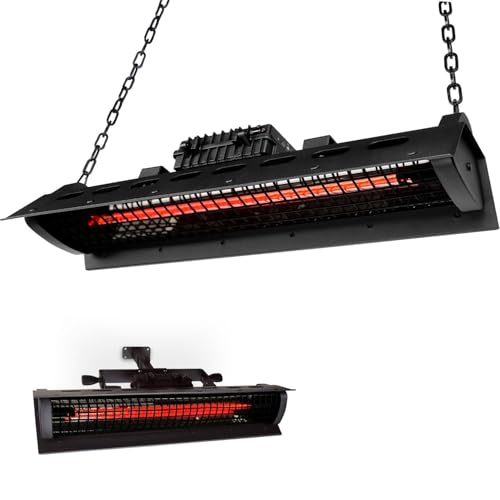 Star Patio STP2020-AOne of the very few electric units whose maker publishes a coverage area at all — 110 sq ft — and it mounts to a wall or hangs from a ceiling on chains. No ingress rating is published, so keep it somewhere sheltered. | A published coverage figure | 1,500 W | 110 sq ft claimed | $199.99 · Check on Amazon |
| 3 |  Dr Infrared 1500 WRadiant heat that a breeze cannot blow out, on a plug. 1,500 W is only 5,118 BTU/h, which sounds like nothing next to a propane tower and lands far more of itself on you. | Wind, and anywhere with a roof | 1,500 W | 256 sq ft | $148.98 · Check on Amazon |
Reach marked “claimed” is the maker’s own published figure. Reach without that label is ours, computed from published output at 20 BTU per square foot for an open patio. Neither is a measurement we took.
Top pick · An umbrella you already have
Hiland HIL-HR15B AZ Patio Heaters Infrared Parasol Heater with Remote
Three independently switchable elements that clamp to an umbrella pole and angle where you want them. It is the brand's live electric unit, it is CSA certified, and it solves a problem no wall-mount heater can — heating a table that has no wall near it.
- Fuel
- Electric
- Output
- 1,500 W = 5,118 BTU/h
- Reach (computed)
- 256 sq ft · 9.0 ft radius
- Cost per hour
- $0.28
What works
- Three independently switchable elements is genuinely unusual at this price — you can run one arm at a table for two or all three for a full table, which is the closest thing to a turn-down control electric heaters normally lack
- CSA certified, and the maker says so. That is the same standard the brand's propane towers cite, and it is more than most electric patio heaters in this band publish
- It solves the case a wall-mounted unit cannot: a table in the middle of a patio with no wall or ceiling within reach
- Comes from the one range in this category where replacement parts are genuinely stocked
What does not
- It needs an umbrella, and a sturdy one. Hanging 1,500 W of steel and aluminum off a pole is a real load, and a lightweight market umbrella is not the right host
- 1,500 W is the standard-circuit ceiling, split three ways here — so it is a table heater, not an answer for an open patio
- No weather rating and no coverage figure are published, so it belongs somewhere sheltered and any reach number for it is ours
- The brand's wall-mount line is currently unavailable. If a wall or ceiling is what you actually have, this is not a substitute for one and you should look at the wall-mounted roundup instead
| Published specification | |
|---|---|
| Rated power | 1,500 W at 120 V |
| Computed output | About 5,118 BTU/h — ours, from the wattage |
| Elements | Three, usable individually or in any combination |
| Aim | Each arm angles up to 45 degrees, vertical or horizontal |
| Mounting | Clamps to an umbrella pole |
| Construction | Steel and aluminum |
| Certification | CSA certified |
| Maker’s coverage claim | None published — the reach figure above is ours |
| Safety listing | CSA certified per the maker |
Who it is for
Someone with a patio table under an umbrella who wants heat at the table without a cylinder, a tower, or anything bolted to a wall.
What it is not for
A patio with no umbrella, an exposed position, or any space needing more than a table's worth of warmth.
2 · A published coverage figure
Star Patio STP2020-A-RMN2025 Wall and Ceiling Electric Infrared Patio Heater
One of the very few electric units whose maker publishes a coverage area at all — 110 sq ft — and it mounts to a wall or hangs from a ceiling on chains. No ingress rating is published, so keep it somewhere sheltered.
- Fuel
- Electric
- Output
- 1,500 W = 5,118 BTU/h
- Reach (claimed)
- 110 sq ft · 5.9 ft radius
- Cost per hour
- $0.28
What works
- It publishes a coverage figure. 110 sq ft is a real, checkable claim, and almost nobody in this category states one at all — which is the whole subject of our coverage page
- Wall bracket and ceiling chains both in the box, with 60 degrees of tilt, so the beam can actually be aimed at the chairs rather than at whatever the bracket decided
- 5,100 BTU/h published output is within a rounding error of the 5,118 our watts-to-BTU conversion gives, which is a maker doing its own arithmetic honestly
- Remote control on a unit mounted above head height is functional rather than a luxury
What does not
- No ingress rating is published for this model. Other units in this roundup publish one, and on a permanently mounted outdoor appliance that silence means you cannot price the weather risk. Treat it as a sheltered-position heater
- 110 sq ft is a small area — roughly a 10 by 11 ft patch, which is a seating group and not a patio
- 1,500 W, like everything else that plugs into a standard socket. The ceiling applies here as everywhere
- A 6 ft cord means the outlet has to be close, or an outdoor-rated extension has to be part of the plan
| Published specification | |
|---|---|
| Rated power | 1,500 W at 110 V, 60 Hz |
| Published output | 5,100 BTU/h per the maker |
| Published coverage | Up to 110 sq ft per the maker |
| Element | Golden tube |
| Mounting | Wall bracket or ceiling chains, up to 60 degrees of tilt |
| Size and weight | 27.5 x 7 x 5.7 in, 7.7 lb |
| Element life | 5,000 hours per the maker |
| Maker’s coverage claim | 110 sq ft |
| Safety listing | No ingress rating published for this model |
Who it is for
A sheltered wall or porch ceiling over a seating group, where you want a heater whose maker will tell you what area it actually covers.
What it is not for
An exposed wall where driving rain reaches it, since nothing is published about ingress protection, or any space much larger than a seating group.
3 · Wind, and anywhere with a roof
Dr Infrared Heater DR-238 Carbon Infrared Patio Heater with Kasa Outdoor Smart Plug
Radiant heat that a breeze cannot blow out, on a plug. 1,500 W is only 5,118 BTU/h, which sounds like nothing next to a propane tower and lands far more of itself on you.
- Fuel
- Electric
- Output
- 1,500 W = 5,118 BTU/h
- Reach (computed)
- 256 sq ft · 9.0 ft radius
- Cost per hour
- $0.28
What works
- Infrared warms objects, not air, so it is the only heat that survives a breeze — this is the single reason wind changes the whole buying decision
- No combustion means no flue gas, which is what makes it legal and sensible on a screened porch where propane is not
- Three settings matter more than they sound: 900 W costs a third less to run and is enough most evenings
What does not
- 1,500 W is 1,500 W. Nothing at this wattage heats faster than anything else at this wattage; the differences between electric heaters are beam shape and build, not power
- It heats what it points at. Step out of the beam and you are cold immediately — this is a fundamentally different experience from a tower
- A 120 V plug-in unit is capped by your circuit, not by the maker. See why 1,500 W is the ceiling
| Published specification | |
|---|---|
| Rated power | 1,500 W at 120 V |
| Settings | 900 W / 1,200 W / 1,500 W |
| Element | Carbon infrared lamp |
| Reflector | Mirror aluminum, 90% reflectivity per the maker |
| Housing | Anodized aluminum, rated for outdoor use |
| Mounting | Wall and ceiling brackets plus remote in the box |
| Bundle | Currently sold with a Kasa EP40 outdoor smart plug |
| Maker’s coverage claim | None published — the reach figure above is ours |
| Safety listing | ETL listed, per the maker's published product data |
Who it is for
A covered patio, pergola or screened porch where you can mount it overhead and point it at where people sit, and anywhere wind ruins a flame.
What it is not for
A big open patio with nowhere to mount it. Radiant heat needs a line of sight and a place to hang from.
What we would skip
A list with no losers is a list nobody edited. These are the choices we would actively steer you away from, and why.
Hanging a heater off a lightweight market umbrella
The failure that actually happens. A 1,500 W heater is a real mass of steel and aluminum on a pole that was engineered to hold fabric. If the umbrella flexes when you push it, it is not the host for this, and the fix is a heavier umbrella rather than a lighter heater.
Using one with the canopy closed
The heat has to go somewhere and the canopy is what keeps it near the table. With the umbrella shut you have an awkwardly mounted radiant heater pointing at nothing in particular, and you would have been better off with a unit on a stand.
Expecting it to heat the patio
It heats the table. That is the product, and it is a genuinely good one for that job. If the goal is a warm seating area across a whole patio, a tower does that and this does not.
Output, and what to expect from it
Everything in this category is bound by the same ceiling. A 1,500 W unit is about 5,118 BTU/h, and that is what a standard household circuit allows regardless of brand or mounting.
Pointed down at a table from four or five feet above it, that is a genuinely useful amount of heat — far more useful than the same figure spread across an open patio, because almost all of it lands on people. This is the arrangement where electric infrared performs best relative to its rating.
What it will not do is warm anyone who stands up and walks away from the table, or make a patio comfortable beyond the canopy's shadow. That is not a defect, it is the shape of radiant heat, and the coverage page explains why a published reach figure always flatters it.
What it costs to run
1,500 W at the current US average of 18.34 cents per kWh is about 28 cents an hour — roughly a fifth of a propane tower. Multi-element models let you run one arm for two people instead of all three, which is the closest thing to a turn-down control this category offers.
Getting the position right
More of the result comes from where this ends up on the pole than from which one you buy. Four things decide it.
- Height above the table. High enough that nobody at the table is near it, low enough that the heat is not spreading across the whole patio before it arrives. Above head height for a standing adult is the floor; the maker's stated canopy clearance is the ceiling. The usable band is narrower than people expect.
- Aim. Arms that angle are the feature worth paying for, because a fixed downward unit heats the tablecloth. Point each element at where a seated person's shoulders are, not at the table surface.
- Which arms you run. A unit with independently switchable elements is a heater with a low setting. Two people at a four-top need one arm, and running three is about triple the cost for no extra comfort.
- The cable. It runs down the pole and then across the floor to an outlet, and that is the worst cable position on a patio. Route it under the table where possible, use an outdoor-rated cord, and never run it where a chair leg drags across it.
One more, and it is the easiest to get wrong: check the clearance with the canopy fully open and the umbrella tilted, if yours tilts. A canopy that clears the heater upright can sit inches from it once angled, and that is the configuration people actually use on a low sun evening.
There is also a middle option worth knowing about. If there is a pergola beam, a gazebo frame or a porch ceiling anywhere above the table, a hanging heater gets you the same overhead geometry without asking the umbrella to carry anything at all.
When a tower is the better answer
Three cases, stated plainly because the umbrella arrangement is easy to over-apply.
- No umbrella, or a light one. The heater cannot be the reason you buy a heavier umbrella — at that point the tower is cheaper and simpler.
- Seating spread beyond the table. If people sit on a bench against a wall as well as at the table, the pole unit covers half of them. A tower covers a circle.
- No outlet within reach. An extension run across a patio to a table in the middle of it is the worst cable position available. If power is awkward, propane is the honest answer.
It is also worth being honest about what the mounting bracket is holding. A pole clamp is a friction fit on a tube, and tubes vary — check it after the first few uses and again at the start of each season, because a clamp that has crept an inch down the pole has moved the heater an inch closer to the thing it must not touch.
The short version
If your seating is a table under a solid umbrella and there is power nearby, this is the best-aimed heat you can buy for the money — directly overhead, onto everyone at once, at a fifth of propane's running cost. Check the canopy clearance and the umbrella's weight before you order, because those decide it rather than the heater does.
Common questions
Do patio umbrella heaters actually work?
Yes, and the geometry is the reason. Mounted on the pole above a table, a radiant heater points down onto everyone seated at once, so almost all of its output lands on people rather than spreading across a patio. It is the arrangement where a 1,500 W unit performs best relative to its rating.
Will a patio heater damage my umbrella?
Not if the stated clearance to the canopy is respected — every one of these publishes a minimum, and radiant heat pointed at fabric is exactly the wrong direction. The bigger risk is mechanical: a lightweight umbrella is not built to carry a bracketed appliance at head height.
What kind of umbrella do I need for a parasol heater?
A heavy one with a substantial pole and a weighted base. If the umbrella flexes when you push the pole, it is not the right host. Adding mass several feet up makes a marginal base meaningfully worse.
How much area does an umbrella heater cover?
The table, essentially. Makers publish coverage figures where they publish anything at all, but a radiant unit warms what it points at — so the honest answer is the seated people underneath it, and not the patio beyond the canopy.
What does an umbrella heater cost to run?
About 28 cents an hour at 1,500 W and current US average electricity prices, which is roughly a fifth of a propane tower. Models with multiple independently switchable elements can be run lower still when only two people are at the table.
Can you use an umbrella heater with the umbrella closed?
You can, but it defeats the point. The canopy is what keeps the heat near the table; with it shut you have an awkwardly positioned radiant heater aimed at nothing in particular, and a unit on a stand would serve better.
Read next
Wall mounted patio heaters, and the rating that decides
Wall and ceiling mounted electric heaters, ranked on published weather rating and mounting.
Electric patio heaters, and the ceiling nobody mentions
Four electric patio heaters compared on wattage, published IP rating and cost per hour.
Tabletop patio heaters heat a table
What a tabletop heater's 11,000 BTU actually covers, and the fuel arithmetic that decides how you feed it.
Patio heater coverage area
Radius to area, why the two get confused, and how to sanity-check any coverage claim.
AZ Patio Heaters and Hiland, explained
The two-name confusion settled, what the range covers, and why parts availability is the real reason to buy it.
Hanging patio heaters
Ceiling and chain-hung heaters judged on what they hang from, how they behave in wind, and the weather rating most listings omit.
Hiland tabletop patio heater review
The 24 in ceiling clearance that rules out umbrellas, the maker's own cold-weather limit, and the fuel choice that sets the cost per hour.