Parts
Patio heater replacement parts
Four parts account for nearly every dead patio heater, all of them cheap, all of them stocked. Repairing usually beats replacing, and here is how to know which one you need.
Four parts cover nearly every failure: the thermocouple (lights but dies on release), the tip-over switch (nothing since it fell), the control valve (pilot holds, burner will not light), and the glass tube on pyramid heaters. All are inexpensive and stocked.
Match the symptom to the part
| Symptom | Part | Notes |
|---|---|---|
| Lights, dies the moment you release the knob | Thermocouple | The commonest failure in the category. Clean it first, replace if it does not hold. Full diagnostic |
| Nothing at all since it fell over | Tip-over switch | Try resetting it before buying anything — many just need the unit upright. |
| Pilot holds, main burner will not light | Control valve, or a blocked orifice | Clean the orifice first; the valve is the more expensive answer. |
| No spark at the pilot | Piezo igniter | Verify with a match. If it lights by match, it is the igniter — and a long lighter is a legitimate permanent workaround. |
| Cracked or shattered flame tube | Quartz glass tube | Pyramid heaters only. Measure before ordering. |
| Rust through the burner or base | None — replace the heater | A compromised gas path is not a repair. |
Quick picks
Ranked for fit, not for hype. Output is the maker’s published figure; reach is computed from it or from the maker’s own radius claim, and the table says which. Tap a row for the full write-up, or go straight to the listing.
| # | Product | Best for | Output | Reach | Price |
|---|---|---|---|---|---|
| 1 | 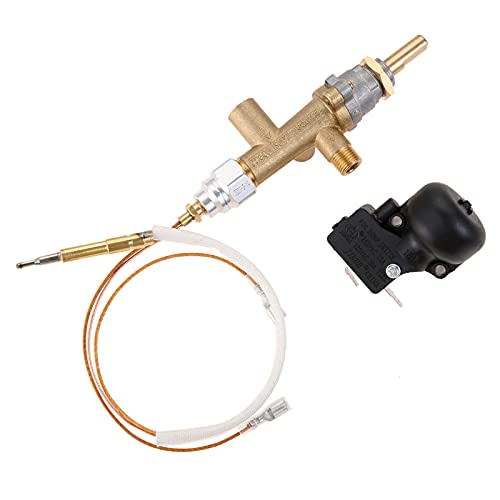 Thermocouple repair kitThe single most common patio-heater failure is a tired thermocouple, and the symptom is precise: it lights, you release the knob, it goes out. This kit is the fix, and it is cheap. | A heater that lights and dies | n/a | n/a | $19.98 · Check on Amazon |
| 2 |  Glass tube, 49.5 inA cracked flame tube makes a pyramid heater unusable and looks terminal. It is a twenty-minute repair with the right tube, and this is the standard four-sided size. | A cracked pyramid tube | n/a | n/a | $49.62 · Check on Amazon |
Reach marked “claimed” is the maker’s own published figure. Reach without that label is ours, computed from published output at 20 BTU per square foot for an open patio. Neither is a measurement we took.
Top pick · A heater that lights and dies
Propane Patio Heater Repair Kit — Thermocouple, Dump Switch and Control Valve
The single most common patio-heater failure is a tired thermocouple, and the symptom is precise: it lights, you release the knob, it goes out. This kit is the fix, and it is cheap.
- Fuel
- Accessory
- Output
- Not published
- Reach (computed)
- Not published
- Cost per hour
- n/a
What works
- It matches the exact symptom in our fault tree: flame holds while the knob is pressed, dies when released. That is a thermocouple, nearly every time
- Including the dump switch is sensible, because a heater that has fallen over often has both problems at once
- The parts cost a small fraction of a new heater, and this is the repair that keeps a five-year-old tower going
What does not
- Check the fit before ordering. The gas train is broadly standard across cheap towers but not universal — compare your existing part to the listing photographs
- Working on a gas appliance means a leak test with soapy water afterwards, every time, without exception
- If you are not comfortable disconnecting a gas line, this is the point to stop and call someone
| Published specification | |
|---|---|
| Contents | Thermocouple sensor, tilt dump switch, main control valve with pilot port |
| Fits | Common propane patio heaters using the standard gas train |
| Tools | Adjustable wrench; no gas fitting beyond the cylinder connection |
| Maker’s coverage claim | None published — the reach figure above is ours |
| Safety listing | Not applicable — replacement gas-train parts, not an appliance |
Who it is for
Anyone whose propane heater lights but will not stay lit, and who owns an adjustable wrench.
What it is not for
Electric heaters, which fail for [entirely different reasons](/troubleshooting/electric-not-working).
Sources for this entry
2 · A cracked pyramid tube
Unicoshape Replacement Quartz Glass Tube, 49.5 in x 4 in
A cracked flame tube makes a pyramid heater unusable and looks terminal. It is a twenty-minute repair with the right tube, and this is the standard four-sided size.
- Fuel
- Accessory
- Output
- Not published
- Reach (computed)
- Not published
- Cost per hour
- n/a
What works
- The connecting ring is included, which is the part people discover they need halfway through the job
- Measure before you order. Pyramid tubes come in several lengths and diameters, and this one is the 49.5 x 4 in size, not a universal fit
- Turns a written-off heater back into a working one for a fraction of a replacement
What does not
- Glass tubes are fragile in transit as well as in use; inspect on arrival before you start the job
- If the tube cracked because the heater fell over, fix the reason or you will buy another one
- Not every pyramid uses this size. Check yours with a tape measure, not with hope
| Published specification | |
|---|---|
| Length | 49.5 in |
| Diameter | 4 in |
| Fit | Four-sided pyramid flame heaters |
| Included | Neoprene rubber silicone connecting ring |
| Maker’s coverage claim | None published — the reach figure above is ours |
| Safety listing | Not applicable — replacement glass, not an appliance |
Who it is for
Anyone whose pyramid heater is intact except for the glass.
What it is not for
A mushroom-style tower, which has no flame tube at all.
Sources for this entry
What we would skip
A list with no losers is a list nobody edited. These are the choices we would actively steer you away from, and why.
Ordering a glass tube without measuring
Pyramid tubes come in several lengths and diameters and they are not interchangeable. The common four-sided size is 49.5 in x 4 in, and yours may not be that. Measure the tube, or the space it came out of, before ordering. A glass tube that arrives two inches short is a total loss.
Any part that requires modifying the gas line
Thermocouples, tip-over switches, control valves and igniters all disconnect with a wrench. If a repair requires cutting, brazing or re-piping, it is a gas technician's job and not an owner's. That line is not negotiable.
Repairing a heater whose burner or base has rusted through
The gas train being cheap does not make a corroded burner assembly worth saving. A compromised gas path is not something to patch, and this is where replacing beats repairing.
Measuring a pyramid glass tube
The single most common ordering mistake in this category, and it is entirely avoidable.
- Length, end to end, of the glass itself — not including the rubber connecting rings at each end.
- Outside diameter of the tube. The common four-sided size is 4 inches; others exist.
- Count the sides. Four-sided pyramid tubes and round tubes are different products and do not substitute.
- Check whether connecting rings are included with the replacement. They perish, and discovering you need them mid-job is a wasted evening.
If the tube is shattered and there is nothing to measure, measure the gap it occupied — the distance between the seats at the top and bottom of the frame — and the diameter of those seats.
The repair-or-replace line
A reasonable rule that holds up well: if the fault is in the gas train, repair it. If the structure has gone, replace it.
The gas train is thermocouple, valve, tip-over switch, igniter, orifice. Those parts are cheap, stocked, and replaceable with hand tools, and the rest of the heater is steel that has not worn out. Repairing is straightforwardly the better decision.
The structure is the burner assembly, the reflector and the base. If those have rusted through, the heater is at the end of its life. Patching a corroded gas path is not a repair anyone should make, and this is where buying a new one is the honest answer.
Leak-test after every gas repair
Soapy water on every joint you disturbed, cylinder valve open, look for bubbles. Ninety seconds, every time, no exceptions. If you see bubbles, close the valve and start again — and if you cannot stop them, that is where an owner's job ends.
How we picked
- Matched to symptoms, not to brands. The gas train on cheap towers is broadly standard, so the useful sorting is by what has failed rather than by badge.
- Fit warnings on every card, because pyramid glass tubes come in several sizes and a part that does not fit is worse than no part.
- Kits preferred where a failure mode implicates several parts — a heater that fell over often needs a thermocouple and a tip-over switch together.
- Nothing recommended that requires cutting into a gas line. Everything here is a wrench-and-hand-tighten job.
What we did not do
Everyone in this category says they tested twenty heaters. We have not tested any, and we say so. What we do instead: compile the published specs, compute the electrical and gas load from them, cite the maker’s own manual, and show the arithmetic so you can check it. The full method, including how to challenge a figure.
Stopping the next failure
Most of these parts fail from corrosion, and corrosion comes from a heater standing outdoors uncovered for most of the year. A cover and an off-season routine extend the life of every part on this page. The storage guide.
The other big cause is falls, which stress the whole gas train at once — a fallen heater frequently needs both a thermocouple and a tip-over switch. Ballast the base and it does not happen.
Common questions
What parts fail on a patio heater?
Four, and they cover nearly everything: the thermocouple, the tip-over switch, the control valve, and on pyramid heaters the quartz glass tube. All are inexpensive, widely stocked, and replaceable with hand tools.
How do I know what size glass tube my patio heater needs?
Measure the glass end to end excluding the rubber rings, measure the outside diameter, and count the sides — four-sided and round tubes are different products. The common four-sided size is 49.5 by 4 inches, and yours may not be. If the tube is gone, measure the gap between its seats.
Is it worth repairing a patio heater?
If the fault is in the gas train, yes — those parts cost a small fraction of a new heater and the rest of the unit has not worn out. If the burner assembly or base has rusted through, replace it: a compromised gas path is not something to patch.
Can I replace a patio heater thermocouple myself?
Yes. Close the cylinder valve, disconnect the cylinder, undo the nut at the valve end, free the tip from its bracket, fit the new one in the same position, and leak-test with soapy water before relighting. It is a wrench job, not a gas-fitting job.
Read next
Patio heater will not stay lit
The ordered diagnostic for a heater that lights and dies, ending in the part that fixes it.
AZ Patio Heaters and Hiland, explained
The two-name confusion settled, what the range covers, and why parts availability is the real reason to buy it.
Resetting a patio heater tip-over switch
How the tip-over switch works, how to clear it, and what to check when it will not reset.
Storing a patio heater for the off-season
The off-season routine, where the cylinder goes, and which cover shape fits which heater.
Pyramid vs mushroom patio heaters
Same BTU, opposite geometry: which shape actually puts heat on people.
Repair or replace your patio heater?
Which faults are a cheap part, which mean the heater is finished, and the three questions that decide it.