Running cost
Propane exchange vs refill
The cage outside the supermarket is the convenient option and the expensive one. The gap is bigger than the sticker price suggests, for a reason nobody prints on the cage.
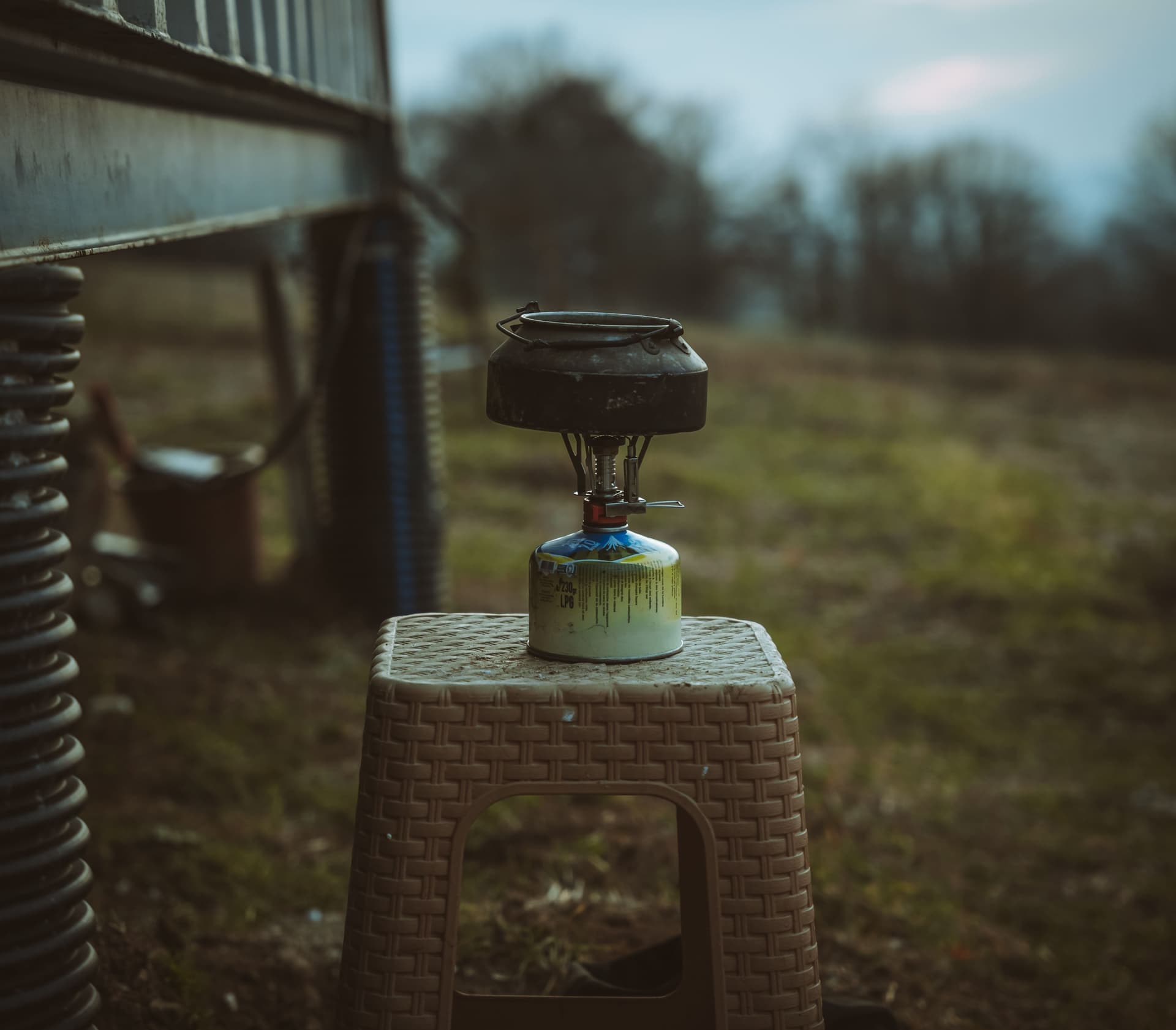
Exchange cylinders are commonly filled to about 15 lb, not the 20 lb the tank holds. So you are usually paying a higher price for roughly 25% less propane. Refilling is materially cheaper per gallon; exchanging buys convenience and a tank someone else has to recertify.
The fact that changes the arithmetic
A "20 lb" propane cylinder is named for what it holds, not for what is in it when you buy it. Exchange programs commonly fill to around 15 lb rather than the full 20, and that single fact does more to the cost comparison than the sticker prices do.
Worth being straight about the sourcing here: the clearest statements of the 15 lb figure come from companies that sell refills, U-Haul among them, and they are making a sales argument as well as a factual one. That does not make it wrong — it is checkable on your own receipt and on the cylinder collar — but you should know the direction the source leans. We have not measured a cylinder ourselves and do not claim to have.
The working
Propane weighs 4.24 lb per gallon at 60F, which is the industry fill basis and the number every calculation below uses.
How much propane you are actually buying
A full 20 lb cylinder is 20 ÷ 4.24 = 4.72 gallons. A typical 15 lb exchange fill is 15 ÷ 4.24 = 3.54 gallons. That is a 25% difference in fuel before either price is considered.
Now put prices against it. We are deliberately not pinning national exchange and refill prices — there is no credible national series for either, and both vary sharply by region and retailer. Use your own. The table shows the shape.
| What you pay | Exchange (15 lb = 3.54 gal) | Refill (20 lb = 4.72 gal) |
|---|---|---|
| $15 | $4.24 per gallon | $3.18 per gallon |
| $18 | $5.09 per gallon | $3.81 per gallon |
| $21 | $5.93 per gallon | $4.45 per gallon |
| $24 | $6.78 per gallon | $5.08 per gallon |
Cost per gallon at 4.24 lb per gallon. Exchange assumes a 15 lb fill, refill a full 20 lb. Substitute your own local prices — the arithmetic is the point, not our figures.
Read the table across a row and the effect is clear: at the same price paid, an exchange costs about a third more per gallon simply because there is less in the tank. In practice exchanges also tend to cost more at the counter than a refill, so the real gap is usually wider than one row implies.
For scale
The EIA's US average residential propane price is $2.674 a gallon. Every figure in the table above is well over it, which is what a small cylinder in a convenient location costs — the premium is for the packaging and the location, not the fuel.
The part people lose money on without noticing
Exchanging a cylinder that is not empty. The cage does not care how much is left in the tank you hand over, so any propane still in it is a gift to the next customer.
This matters on a patio heater more than on a grill, because a heater empties a cylinder in roughly ten hours at full output and people frequently swap a part-used tank before an evening rather than risk running out. Two-thirds of a tank handed in is around $8 to $10 of propane at exchange rates, thrown away for peace of mind.
The cheap fix is a second cylinder. Run one to genuinely empty, swap to the spare mid-evening, and refill the empty one on your own schedule. It is the single best value purchase in propane heating and it costs less than two exchanges.
Quick picks
Ranked for fit, not for hype. Output is the maker’s published figure; reach is computed from it or from the maker’s own radius claim, and the table says which. Tap a row for the full write-up, or go straight to the listing.
| # | Product | Best for | Output | Reach | Price |
|---|---|---|---|---|---|
| 1 |  Amazon Basics 46kOne of the very few towers whose maker publishes a coverage radius rather than a vague area, and the 9 ft figure survives the arithmetic. That alone puts it ahead of most of the field. | The published-radius honesty test | 46,000 BTU | 254 sq ft claimed | $156.16 · Check on Amazon |
| 2 |  Hiland HLDS01The mushroom tower the whole category is a copy of. 48,000 BTU is enough for a genuinely open patio, and the parts are the easiest in the category to replace when something eventually fails. | A full open patio | 48,000 BTU | 2,400 sq ft | $315.00 · Check on Amazon |
Reach marked “claimed” is the maker’s own published figure. Reach without that label is ours, computed from published output at 20 BTU per square foot for an open patio. Neither is a measurement we took.
Top pick · The published-radius honesty test
Amazon Basics 46,000 BTU Outdoor Propane Patio Heater
One of the very few towers whose maker publishes a coverage radius rather than a vague area, and the 9 ft figure survives the arithmetic. That alone puts it ahead of most of the field.
- Fuel
- Propane
- Output
- 46,000 BTU/h
- Reach (claimed)
- 254 sq ft · 9.0 ft radius
- Cost per hour
- $1.35
What works
- A published 9 ft radius is a 254 sq ft circle, and 46,000 BTU is far more than that area needs — a claim on the conservative side of its own specification, which is rare here
- The water-fill base box is a real anti-tip measure, not a sticker: filled, it is the difference between a windy evening and a repair bill
- One-touch ignition and a chain for the cylinder are both small things the cheap clones drop
What does not
- The listing does not name a safety certifying body, only the tilt valve, so we cannot tell you it is CSA listed
- 91 in tall with an open flame: the same wind exposure as every other tower of this shape
- The water box has to be emptied before a freeze or it splits
| Published specification | |
|---|---|
| Rated input | 46,000 BTU/h |
| Published reach | 9 ft radius |
| Dimensions | 32.1" L x 32.1" W x 91.3" H |
| Fuel | 20 lb propane cylinder, not included |
| Safety | Tilt auto-shutoff valve; chain to secure the cylinder |
| Base | Water-fill box for ballast, wheel kit included |
| Maker’s coverage claim | 9.0 ft radius, which is 254 sq ft |
| Safety listing | Tilt auto-shutoff valve; the listing does not name a certifying body |
Who it is for
An open patio where you want the largest honest circle of warmth per dollar and are happy to handle cylinders.
What it is not for
Anywhere enclosed, and anywhere the base cannot be filled with water — an empty ballast box makes this a tall, light, tippy object.
Sources for this entry
2 · A full open patio
Hiland / AZ Patio Heaters HLDS01-CG 87 in Propane Patio Heater
The mushroom tower the whole category is a copy of. 48,000 BTU is enough for a genuinely open patio, and the parts are the easiest in the category to replace when something eventually fails.
- Fuel
- Propane
- Output
- 48,000 BTU/h
- Reach (computed)
- 2,400 sq ft · 27.6 ft radius
- Cost per hour
- $1.40
What works
- 48,000 BTU is real output — on our sizing arithmetic that is a 2,400 sq ft open patio at the rule-of-thumb rate, so it is never the unit that is undersized
- Every wear part on this platform is a stocked commodity: thermocouples, control valves, dump switches and reflectors are all available separately
- The weight bladder in the base is the single most useful anti-tip feature in the category and most rivals leave it out
What does not
- An 87 in open-flame tower is the worst possible shape in wind — this is the unit our wind guide exists for
- The maker does not publish a coverage radius, so the reach figure we show is ours, computed rather than quoted
- Full output burns a 20 lb cylinder in well under a night. See the runtime arithmetic
| Published specification | |
|---|---|
| Rated input | 48,000 BTU/h |
| Height | 87 in |
| Fuel | 20 lb propane cylinder, not included |
| Reflector | 33 in aluminum heat shield |
| Safety | Anti-tilt cutoff and thermocouple flame-failure cutoff |
| Extras | Wheels, integrated table, weight bladder for the base |
| Maker’s coverage claim | None published — the reach figure above is ours |
| Safety listing | CSA certified per the maker's product literature |
Who it is for
An open patio with no roof, where you need volume of heat and can accept swapping cylinders. Also the right answer if you want a unit whose parts you can still buy in five years.
What it is not for
A screened porch, a garage, or anywhere without open sky above it. It is an open-flame combustion appliance and needs genuine outdoor ventilation.
When exchanging is genuinely the right call
- Your cylinder is out of date. Cylinders need periodic recertification, and an exchange makes that somebody else's problem — you hand over an expired tank and receive a certified one. This is a real and underrated benefit.
- The tank is damaged or rusted. Same logic. An exchange launders a tank you would otherwise have to dispose of.
- Nothing local refills. Refill points are less common than exchange cages, and a 30-mile round trip erases the saving comfortably.
- You need it now. Exchange is open when the propane dealer is not, and a cold terrace on a Saturday night is not the moment to optimize cost per gallon.
The second-cylinder arithmetic
This is the recommendation that follows from everything above, so it is worth doing the numbers rather than just asserting it.
What a spare cylinder saves
Suppose you swap at two-thirds full twice a season to avoid running out mid-evening. That is roughly 13 lb of propane given away, or about 3.1 gallons — around $19 at exchange rates. A spare cylinder costs more than that once and then never again, and it removes the reason you were swapping early in the first place.
It also changes the failure mode. Running out mid-evening stops being a ruined evening and becomes a two-minute swap, which means you can genuinely run a cylinder to empty — and running to empty is the only way the refill price you paid actually gets realized.
The same logic is why a spare is standard on any patio that gets used regularly, and why it appears in the first cold snap checklist rather than in a list of nice-to-haves.
How to check this yourself
- Weigh it. The cylinder's empty weight is stamped on the collar as the tare weight, usually marked TW. Full weight minus tare weight is the propane you actually received, in pounds. Divide by 4.24 for gallons.
- Divide what you paid by that. That is your real cost per gallon, and it is the only number that lets you compare a refill against an exchange honestly.
- Compare against $2.674, the current US average residential price, to see what the convenience is costing you.
None of this changes what the heater costs to run — that arithmetic depends on the burn rate, not on where the propane came from. What it changes is the price you paid for the fuel going in, which on a heater running several nights a week is a larger annual number than most people expect.
Common questions
Is it cheaper to refill or exchange a propane tank?
Refilling, usually by a wide margin. Exchange cylinders are commonly filled to about 15 lb rather than the tank's 20 lb capacity, so you get roughly 25% less propane — and exchanges typically cost more at the counter as well.
How many gallons are in a 20 lb propane tank?
About 4.72 gallons when genuinely full, at propane's fill-basis density of 4.24 lb per gallon. A typical 15 lb exchange fill is about 3.54 gallons.
Do you lose propane when you exchange a tank?
Yes, whatever is left in the cylinder you hand over. On a patio heater that is a common and expensive habit, since people often swap a part-used tank before an evening. A second cylinder solves it for less than the cost of two exchanges.
When is exchanging a propane tank worth it?
When your cylinder is out of certification or damaged — the exchange makes that someone else's problem — when nothing local refills, or when you need propane outside a dealer's opening hours.
Is a spare propane cylinder worth buying?
Yes, and it pays for itself quickly. Swapping a two-thirds-full tank twice a season to avoid running out mid-evening gives away roughly 3 gallons of propane, close to $19 at exchange rates. A spare costs that once, then removes the reason you were swapping early at all.
Does where I buy propane change what my heater costs to run?
No. Running cost depends on the burn rate, which is set by the appliance, not by where the fuel came from. What changes is the price you paid for the propane going in — which on a heater used several nights a week is a larger annual figure than most people expect.
How do I tell how much propane I actually got?
Weigh the cylinder and subtract the tare weight stamped on the collar (marked TW). The difference is the propane in pounds; divide by 4.24 for gallons. Then divide what you paid by that for your true cost per gallon.
Sources
Read next
How long a propane cylinder actually lasts
The cylinder arithmetic in full: energy content, burn rate, and every size from 15 to 40 lb.
What a patio heater costs to run
Cost per hour, evening and month for electric and propane, at named prices with the formulas shown.
Propane patio heaters, with the cylinder arithmetic
Four propane heaters compared on published BTU, computed reach and real cylinder runtime.
Patio heater will not stay lit
The ordered diagnostic for a heater that lights and dies, ending in the part that fixes it.
The cheapest patio heaters to run
Which heaters cost least per evening at published energy prices, and the change that beats all of them.