Head to head
Pyramid vs mushroom patio heaters
Identical ratings, opposite geometry. One is designed to push heat down at you; the other is a beautiful chimney. Here is the trade, stated honestly.
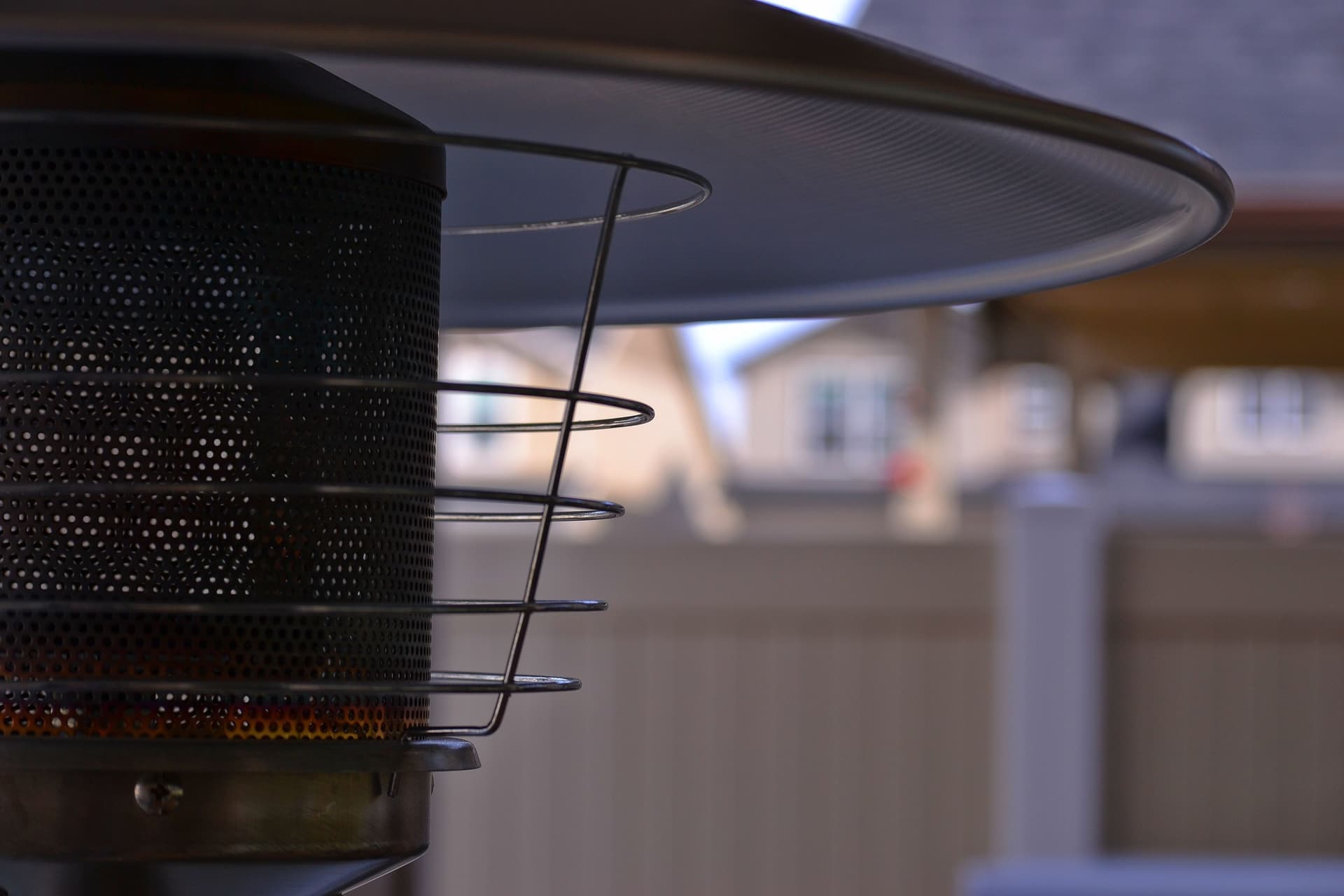
A mushroom heater puts more heat on people at the same rating, because its reflector is designed to push output downward and outward. A pyramid's glass flame column sends a larger share upward. Buy a pyramid for how it looks, knowing that, and a mushroom for warmth.
Same number, different destination
Both shapes are commonly sold at 48,000 BTU/h. That figure describes fuel consumed, and it is honest on both. What it does not describe is where the resulting heat goes, and on these two shapes it goes to very different places.
The mushroom is the older design and it is engineered around a single idea: a wide metal reflector above the burner, angled to bounce heat down and out across a circle. It is not subtle and it works. The reflector diameter is roughly what sets the coverage.
The pyramid puts the flame inside a tall quartz glass tube with a chimney above it. Hot gas rises up the tube, which is what produces the flame column people buy them for. Radiant heat comes off the glass sideways, and it is real, but a substantial share of the energy goes straight up the chimney by design. That is how the effect is produced.
The full comparison
| Mushroom tower | Pyramid / flame tower | |
|---|---|---|
| Heat direction | Reflected down and out across a circle | Radiated sideways from the tube, plus a large vertical share |
| Effective coverage | Wider for the same rating | Narrower; strongest close to the tube |
| Looks | Utilitarian; it looks like equipment | The reason people buy one |
| In wind | Tall and light, but the burner is well shielded | Flame is well protected inside the tube; the column is a large sail |
| Maintenance | Thermocouple, valve, igniter — all cheap and stocked | All of that plus a glass tube that can crack |
| Typical rating | 46,000 to 48,000 BTU/h | 40,000 to 48,000 BTU/h |
Behavior described from the published designs. We have not measured the radiant fraction of either shape and do not claim a percentage.
The maintenance difference is real
A pyramid has one significant failure mode a mushroom does not: the glass tube. A four-foot quartz tube is a fragile object standing in a windy place, and the size of the replacement tube market is its own quiet data point.
It is not a write-off when it happens — a replacement tube is an inexpensive part and about twenty minutes of work. But it is a maintenance item that the mushroom shape simply does not have, and it is worth pricing into the decision rather than discovering.
Quick picks
Ranked for fit, not for hype. Output is the maker’s published figure; reach is computed from it or from the maker’s own radius claim, and the table says which. Tap a row for the full write-up, or go straight to the listing.
| # | Product | Best for | Output | Reach | Price |
|---|---|---|---|---|---|
| 1 |  Hiland HLDS01The mushroom tower the whole category is a copy of. 48,000 BTU is enough for a genuinely open patio, and the parts are the easiest in the category to replace when something eventually fails. | A full open patio | 48,000 BTU | 2,400 sq ft | $315.00 · Check on Amazon |
| 2 |  Pamapic pyramidThe pyramid is the best-looking heater in the category and the least efficient way to spend 48,000 BTU, because the flame column throws most of its output straight up. Buy it knowing that trade. | Looking good while heating less | 48,000 BTU | 254 sq ft claimed | $255.99 · Check on Amazon |
Reach marked “claimed” is the maker’s own published figure. Reach without that label is ours, computed from published output at 20 BTU per square foot for an open patio. Neither is a measurement we took.
Top pick · A full open patio
Hiland / AZ Patio Heaters HLDS01-CG 87 in Propane Patio Heater
The mushroom tower the whole category is a copy of. 48,000 BTU is enough for a genuinely open patio, and the parts are the easiest in the category to replace when something eventually fails.
- Fuel
- Propane
- Output
- 48,000 BTU/h
- Reach (computed)
- 2,400 sq ft · 27.6 ft radius
- Cost per hour
- $1.40
What works
- 48,000 BTU is real output — on our sizing arithmetic that is a 2,400 sq ft open patio at the rule-of-thumb rate, so it is never the unit that is undersized
- Every wear part on this platform is a stocked commodity: thermocouples, control valves, dump switches and reflectors are all available separately
- The weight bladder in the base is the single most useful anti-tip feature in the category and most rivals leave it out
What does not
- An 87 in open-flame tower is the worst possible shape in wind — this is the unit our wind guide exists for
- The maker does not publish a coverage radius, so the reach figure we show is ours, computed rather than quoted
- Full output burns a 20 lb cylinder in well under a night. See the runtime arithmetic
| Published specification | |
|---|---|
| Rated input | 48,000 BTU/h |
| Height | 87 in |
| Fuel | 20 lb propane cylinder, not included |
| Reflector | 33 in aluminum heat shield |
| Safety | Anti-tilt cutoff and thermocouple flame-failure cutoff |
| Extras | Wheels, integrated table, weight bladder for the base |
| Maker’s coverage claim | None published — the reach figure above is ours |
| Safety listing | CSA certified per the maker's product literature |
Who it is for
An open patio with no roof, where you need volume of heat and can accept swapping cylinders. Also the right answer if you want a unit whose parts you can still buy in five years.
What it is not for
A screened porch, a garage, or anywhere without open sky above it. It is an open-flame combustion appliance and needs genuine outdoor ventilation.
2 · Looking good while heating less
Pamapic 48,000 BTU Pyramid Flame Patio Heater, Stainless Steel
The pyramid is the best-looking heater in the category and the least efficient way to spend 48,000 BTU, because the flame column throws most of its output straight up. Buy it knowing that trade.
- Fuel
- Propane
- Output
- 48,000 BTU/h
- Reach (claimed)
- 254 sq ft · 9.0 ft radius
- Cost per hour
- $1.40
What works
- It publishes a coverage figure, which most of this category does not. An 18 ft diameter is a checkable claim, and we convert it to an area and say whose number it is
- A 45-degree tilt cutoff is a more forgiving threshold than the twitchy switches that plague this shape, and flame-failure and overheat protection are published alongside it
- A cover is in the box, which on a unit that lives outside is the accessory that decides whether it still lights next year — see covers
- The quartz tube is a stocked commodity part, so a cracked one is a repair rather than a write-off
What does not
- A pyramid is a chimney. The visible flame column is beautiful and it sends heat vertically; a mushroom reflector at the same BTU puts more of it on people
- Tall glass tubes crack. Ours is not a durability test, but the existence of a whole replacement-tube market is its own data point
- No anchor stakes are published for it. On an exposed patio that makes ballasting it your problem rather than the maker's
- An 18 ft diameter describes where warmth is detectable, not where a patio is comfortable — the usable circle is much smaller
| Published specification | |
|---|---|
| Rated input | 48,000 BTU/h |
| Height | About 89 in |
| Flame tube | Quartz glass |
| Reflector | 32 in |
| Published coverage | 18 ft diameter per the maker |
| Ignition | Pulse ignition |
| Safety | Cutoff above 45 degrees of tilt, flame-failure and overheat protection |
| Fuel | 20 lb propane cylinder in the base, not included |
| Extras | Wheels and a cover included |
| Maker’s coverage claim | 9.0 ft radius, which is 254 sq ft |
| Safety listing | Anti-tip cutoff at 45 degrees, flame-failure and overheat protection per the maker |
Who it is for
Someone who wants the heater to be part of the evening rather than a utility object, on an open patio, and who has read the trade-off above and accepted it.
What it is not for
Getting the most warmth per dollar, or any covered space — a flame column under a roof is the exact scenario the [clearance rules](/spaces/safety) exist for.
For a worked example of the pyramid side, the Pamapic pyramid review checks its published 18 ft coverage claim against the arithmetic and puts a number on what the glass column costs you.
Which to buy
- Buy the mushroom if the point is to make a cold patio usable and you want the most warmth per dollar and per cylinder.
- Buy the pyramid if the heater is part of the evening rather than a utility object, and you have read the trade above and accepted it. That is a legitimate reason and we are not going to pretend otherwise.
- Buy neither if there is a roof over your patio, because a 7-foot flame column under a ceiling is the exact situation the clearance rules exist for.
Both shapes share the same real weakness
Height. Seven-plus feet of heater on a small base is a sail on a stick, and it is the reason both shapes end up on their side. Fill the ballast reservoir, use the anchor stakes if they came in the box, and read how to stop a heater blowing over before the first windy night rather than after it.
Common questions
Is a pyramid patio heater better than a mushroom?
Not for heat. At the same rating a mushroom reflector puts more output onto people, because a pyramid's glass column sends a large share upward by design. Pyramids win on appearance, which is a real reason to buy one as long as you know the trade.
Do pyramid patio heaters heat well?
They heat, and they heat a smaller effective area than a mushroom at the same BTU rating. The radiant heat from the glass tube is strongest close in, so a pyramid suits a tighter seating arrangement better than a wide terrace.
Do pyramid heater glass tubes break often?
Often enough that replacement tubes are a stocked commodity in several standard sizes. They are inexpensive and the swap takes about twenty minutes. If yours cracked because the heater fell over, fix the stability first or you will buy another.
Read next
Propane patio heaters, with the cylinder arithmetic
Four propane heaters compared on published BTU, computed reach and real cylinder runtime.
Patio heater replacement parts
The four parts that account for nearly every dead heater, with symptoms and measuring advice.
How to stop a patio heater blowing over
Ballast, anchors and placement — the three fixes, in the order they matter.
The best patio heaters, sorted by the patio
Six heaters covering every real patio case, with published output, computed reach and cost per hour.
Pamapic pyramid patio heater review
The 18 ft coverage claim checked, what the glass flame column costs in delivered warmth, and who should buy one regardless.