By space
The best patio heaters for a small patio
A 10 by 10 needs less heat than you think and has less room than you think. Those two facts point at completely different products from the ones a big patio wants.
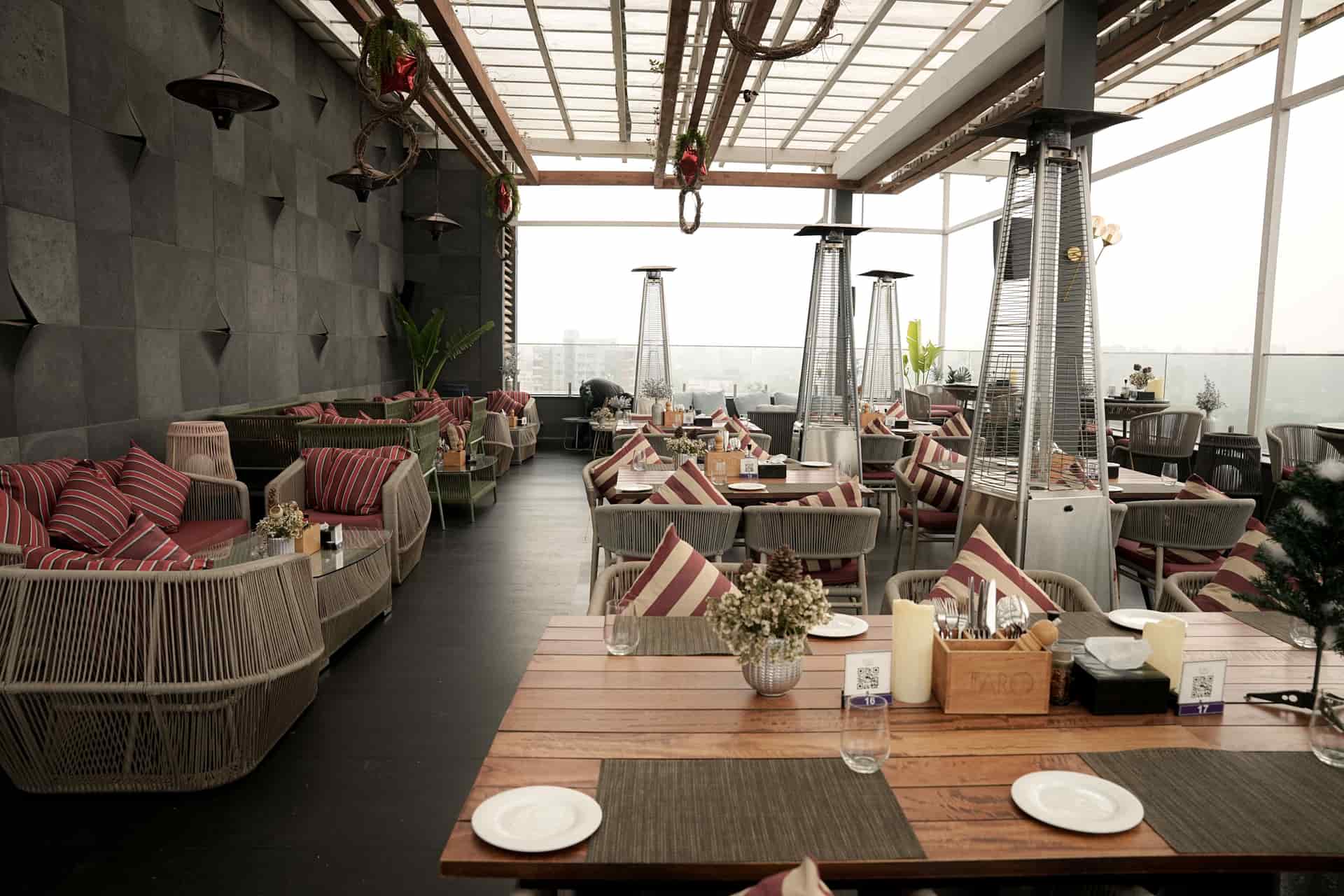
Mount it, or put it on the table. On a small patio the binding constraint is floor space and clearance rather than output — a 12 by 12 needs only about 2,900 BTU/h on a mild open evening, which a single 1,500 W electric unit exceeds. Get the heater off the floor and you get the patio back.
How little heat a small patio actually needs
Worth establishing first, because it reframes the whole purchase. A 12 by 12 ft patio is 144 square feet. At the 20 BTU per square foot baseline this site uses for an open patio in mild conditions, that is about 2,900 BTU/h.
A single 1,500 W electric infrared unit is about 5,118 BTU/h. A 46,000 BTU propane tower is nearly sixteen times the baseline figure.
Exposure and wind can multiply that baseline by two or three, so the real requirement is higher than 2,900 and still nowhere near a tower's rating. Run your own dimensions through the calculator rather than the rule of thumb — it applies the multipliers and prints the working.
| Patio area | Open sky, no roof | Roof overhead, open sides | Roof plus screens or partial walls |
|---|---|---|---|
| 100 sq ft | 2,000 BTU/h | 1,300 BTU/h | 1,000 BTU/h |
| 144 sq ft | 2,880 BTU/h | 1,872 BTU/h | 1,440 BTU/h |
| 196 sq ft | 3,920 BTU/h | 2,548 BTU/h | 1,960 BTU/h |
Area x 20 BTU per square foot for an open patio, then multiplied by 0.65 for a roof and 0.5 for a roof plus screens, and by 1 for average exposure. The reconciliation of where each factor comes from is on this page, not hidden.
Which means output is not the problem to solve here. Space is.
The constraint is the floor, and then the clearance
A standard propane tower has a base roughly 32 inches across. On a 100 square foot patio that base alone is about 7% of the floor, and the base is the smaller of the two costs.
The larger one is clearance. Every gas appliance publishes minimum distances to combustible material at the sides and overhead, and on a small patio those distances collide with the house wall, the furniture and whatever is above. The heater does not just occupy its base — it occupies an exclusion zone, and on a 10 by 10 that zone can be most of the patio. The safety page has the published figures.
Get the appliance onto a wall, a ceiling or a tabletop and both problems disappear at once. That is the entire strategy for this space, and it is why the picks below are ordered the way they are.
Quick picks
Ranked for fit, not for hype. Output is the maker’s published figure; reach is computed from it or from the maker’s own radius claim, and the table says which. Tap a row for the full write-up, or go straight to the listing.
| # | Product | Best for | Output | Reach | Price |
|---|---|---|---|---|---|
| 1 | 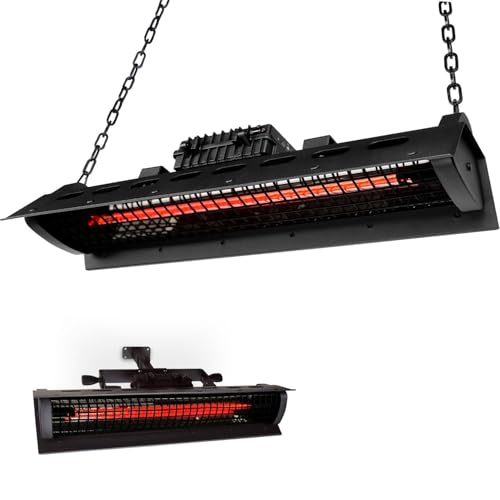 Star Patio STP2020-AOne of the very few electric units whose maker publishes a coverage area at all — 110 sq ft — and it mounts to a wall or hangs from a ceiling on chains. No ingress rating is published, so keep it somewhere sheltered. | A published coverage figure | 1,500 W | 110 sq ft claimed | $199.99 · Check on Amazon |
| 2 |  Dr Infrared 1500 WRadiant heat that a breeze cannot blow out, on a plug. 1,500 W is only 5,118 BTU/h, which sounds like nothing next to a propane tower and lands far more of itself on you. | Wind, and anywhere with a roof | 1,500 W | 256 sq ft | $148.98 · Check on Amazon |
| 3 | 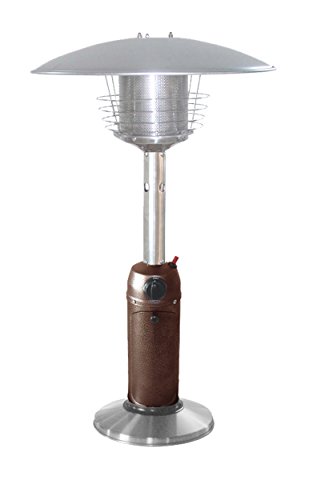 Hiland tabletop11,000 BTU heats a table, not a patio, and being clear about that is the whole point. For a bistro table on a balcony it is the right size and nothing bigger fits. | One table, four people | 11,000 BTU | 550 sq ft | $128.60 · Check on Amazon |
Reach marked “claimed” is the maker’s own published figure. Reach without that label is ours, computed from published output at 20 BTU per square foot for an open patio. Neither is a measurement we took.
Top pick · A published coverage figure
Star Patio STP2020-A-RMN2025 Wall and Ceiling Electric Infrared Patio Heater
One of the very few electric units whose maker publishes a coverage area at all — 110 sq ft — and it mounts to a wall or hangs from a ceiling on chains. No ingress rating is published, so keep it somewhere sheltered.
- Fuel
- Electric
- Output
- 1,500 W = 5,118 BTU/h
- Reach (claimed)
- 110 sq ft · 5.9 ft radius
- Cost per hour
- $0.28
What works
- It publishes a coverage figure. 110 sq ft is a real, checkable claim, and almost nobody in this category states one at all — which is the whole subject of our coverage page
- Wall bracket and ceiling chains both in the box, with 60 degrees of tilt, so the beam can actually be aimed at the chairs rather than at whatever the bracket decided
- 5,100 BTU/h published output is within a rounding error of the 5,118 our watts-to-BTU conversion gives, which is a maker doing its own arithmetic honestly
- Remote control on a unit mounted above head height is functional rather than a luxury
What does not
- No ingress rating is published for this model. Other units in this roundup publish one, and on a permanently mounted outdoor appliance that silence means you cannot price the weather risk. Treat it as a sheltered-position heater
- 110 sq ft is a small area — roughly a 10 by 11 ft patch, which is a seating group and not a patio
- 1,500 W, like everything else that plugs into a standard socket. The ceiling applies here as everywhere
- A 6 ft cord means the outlet has to be close, or an outdoor-rated extension has to be part of the plan
| Published specification | |
|---|---|
| Rated power | 1,500 W at 110 V, 60 Hz |
| Published output | 5,100 BTU/h per the maker |
| Published coverage | Up to 110 sq ft per the maker |
| Element | Golden tube |
| Mounting | Wall bracket or ceiling chains, up to 60 degrees of tilt |
| Size and weight | 27.5 x 7 x 5.7 in, 7.7 lb |
| Element life | 5,000 hours per the maker |
| Maker’s coverage claim | 110 sq ft |
| Safety listing | No ingress rating published for this model |
Who it is for
A sheltered wall or porch ceiling over a seating group, where you want a heater whose maker will tell you what area it actually covers.
What it is not for
An exposed wall where driving rain reaches it, since nothing is published about ingress protection, or any space much larger than a seating group.
2 · Wind, and anywhere with a roof
Dr Infrared Heater DR-238 Carbon Infrared Patio Heater with Kasa Outdoor Smart Plug
Radiant heat that a breeze cannot blow out, on a plug. 1,500 W is only 5,118 BTU/h, which sounds like nothing next to a propane tower and lands far more of itself on you.
- Fuel
- Electric
- Output
- 1,500 W = 5,118 BTU/h
- Reach (computed)
- 256 sq ft · 9.0 ft radius
- Cost per hour
- $0.28
What works
- Infrared warms objects, not air, so it is the only heat that survives a breeze — this is the single reason wind changes the whole buying decision
- No combustion means no flue gas, which is what makes it legal and sensible on a screened porch where propane is not
- Three settings matter more than they sound: 900 W costs a third less to run and is enough most evenings
What does not
- 1,500 W is 1,500 W. Nothing at this wattage heats faster than anything else at this wattage; the differences between electric heaters are beam shape and build, not power
- It heats what it points at. Step out of the beam and you are cold immediately — this is a fundamentally different experience from a tower
- A 120 V plug-in unit is capped by your circuit, not by the maker. See why 1,500 W is the ceiling
| Published specification | |
|---|---|
| Rated power | 1,500 W at 120 V |
| Settings | 900 W / 1,200 W / 1,500 W |
| Element | Carbon infrared lamp |
| Reflector | Mirror aluminum, 90% reflectivity per the maker |
| Housing | Anodized aluminum, rated for outdoor use |
| Mounting | Wall and ceiling brackets plus remote in the box |
| Bundle | Currently sold with a Kasa EP40 outdoor smart plug |
| Maker’s coverage claim | None published — the reach figure above is ours |
| Safety listing | ETL listed, per the maker's published product data |
Who it is for
A covered patio, pergola or screened porch where you can mount it overhead and point it at where people sit, and anywhere wind ruins a flame.
What it is not for
A big open patio with nowhere to mount it. Radiant heat needs a line of sight and a place to hang from.
3 · One table, four people
Hiland HLDS032-BB Portable Table Top Patio Heater, Hammered Bronze
11,000 BTU heats a table, not a patio, and being clear about that is the whole point. For a bistro table on a balcony it is the right size and nothing bigger fits.
- Fuel
- Propane
- Output
- 11,000 BTU/h
- Reach (computed)
- 550 sq ft · 13.2 ft radius
- Cost per hour
- $0.32
What works
- Runs off a 1 lb canister, which makes it the only heater here you can carry out to a table and back with one hand
- 11,000 BTU is honest for the job: our reach arithmetic puts that at roughly a table's worth of warmth, and the unit does not pretend otherwise
- A burner screen guard on a table-height heater is a genuine safety feature, not a spec-sheet line
What does not
- 1 lb canisters are the most expensive propane per BTU you can buy — get the 20 lb adapter hose if you use it regularly
- At 38 in on a table, this puts an open flame at seated head height. Placement matters more than with any other unit here
- It will not touch an open patio. Anyone expecting a room-scale effect will be disappointed
| Published specification | |
|---|---|
| Rated input | 11,000 BTU/h, adjustable |
| Height | 38 in |
| Fuel | 1 lb canister or 20 lb cylinder, per the listing |
| Finish | Hammered bronze |
| Safety | Thermocouple, anti-tilt device, burner screen guard |
| Stability | Weight plate in the base |
| Maker’s coverage claim | None published — the reach figure above is ours |
| Safety listing | Thermocouple flame-failure cutoff and anti-tilt device per the listing |
Who it is for
A balcony, a bistro table, or a second heater that warms hands at the table while a tower does the space.
What it is not for
Heating an area. And never indoors, on a covered porch with a low ceiling, or anywhere a tablecloth can reach it.
Sources for this entry
What we would skip
A list with no losers is a list nobody edited. These are the choices we would actively steer you away from, and why.
A full-size propane tower
The default patio heater is 32 inches across the base and needs clearance on every side. On a 10 by 10 it eats a meaningful share of the usable floor, and the clearance requirement takes more space than the base does. It is the right product on a big open patio and the wrong one here.
A wood fire pit
An open fire needs distance from furniture, walls and anything overhead, and a small patio usually cannot provide all three at once. The fire pit question is a real one, but the answer at this size is normally no.
An indoor space heater carried outside
Convection heaters warm air, and outdoors the air leaves. They are also not built for damp, which is a safety issue rather than a performance one. The fact that it is a small space does not make it behave like an indoor room.
Where to put it on a small patio
Small spaces are less forgiving about position, and there is usually only one right answer rather than several acceptable ones.
- On the house wall, aimed outward across the seating. The wall is already there, it is the most sheltered surface you have, and heat aimed away from it crosses the whole patio.
- High enough to clear heads, low enough to still be aimed at people. A mounted unit angled down at seated shoulder height does far more than the same unit pointed straight ahead at standing height.
- Not over the door. The one position that looks obvious and is not — every time the door opens you are heating the doorway, and the traffic path is the one part of a small patio nobody lingers in.
- Check what is overhead before you drill. On a small patio the mounting height that clears heads often puts the unit close to an awning, a balcony above or a soffit, and the published clearance to that is the number that decides the position.
The advantage a small patio has
Worth stating, because these pages tend to read as a list of limitations and this one genuinely has an upside.
Small patios are usually more enclosed — tucked between a house wall and a fence, or in the corner of a building. Enclosure is the single biggest variable in outdoor heating, and it works in your favor here: the same heater that disappoints on an exposed 400 sq ft terrace performs noticeably better in a sheltered 100 sq ft corner, because far less of the warmed air is being carried off.
It also means the cheapest improvement available is usually cheap to complete. If three sides are already sheltered, closing most of the fourth with a screen or a curtain is a small job with a large effect — and on a space this size it can be the difference between needing a heater at all and not.
Enclosure has a limit, and it is a safety one
This cuts both ways. A small space with walls on three sides and something overhead is approaching the point where a combustion appliance does not belong in it at all. Propane produces combustion products that need somewhere to go, and the more successfully you shelter a small patio, the more firmly the answer becomes electric.
What it costs to run
The other reason small patios favor electric: at this size you are not giving anything up to get the cheaper fuel.
A 1,500 W unit is about 28 cents an hour at the national average electricity price this site cites — roughly $50 across a 20-week season at three evenings a week. The propane tower it replaces would be nearer $253 over the same season, to deliver output the space cannot use.
On a big exposed patio that premium buys something real. On a 10 by 10 it buys heat that leaves over the fence, which is the clearest case in outdoor heating of paying more for less.
Mounted or tabletop?
Both get the heater off the floor, which is the main thing, but they suit different small patios and it is worth being deliberate about which one you have.
Mounted wins where the seating stays put. A fixed unit aimed across a permanent arrangement gives the best geometry available on a small patio — overhead, angled down, nothing in the way — and it is permanently out of the walking space. The cost is that it commits you to a layout, which on a small patio is a bigger commitment than it sounds because there are fewer alternatives.
A tabletop unit wins where the patio changes use. If the same 100 square feet is dinner for four on Saturday and two chairs and a book on Sunday, a heater that moves with the table is worth more than a better-aimed one that does not. It takes table space rather than floor space, which is the trade to be aware of — the tabletop roundup covers what that costs you.
If you can only have one and the layout is settled, mount it. The aim advantage is real and it compounds every evening, and a unit that is never in the way is a unit that never gets moved into a worse position.
The short version
Work out the requirement and it will be smaller than you expected. Then get the heater off the floor — wall, ceiling or table — because on a small patio the floor is the resource you are short of. Electric infrared, mounted on the house wall and aimed across the seating, is the answer here far more often than it is anywhere else on this site.
Common questions
What size patio heater do I need for a small patio?
Less than you think. A 12 by 12 patio is 144 sq ft, which on a mild open evening works out at about 2,900 BTU/h - a single 1,500 W electric unit produces more than that. Wind and exposure raise the requirement, but not to anywhere near a 46,000 BTU tower's rating.
Is a propane heater too big for a small patio?
Usually, yes - and the problem is space rather than heat. A standard tower has a base about 32 inches across plus a published clearance zone on every side, and on a 10 by 10 that exclusion zone can take up most of the patio.
What is the best heater for a 10x10 patio?
A wall-mounted or ceiling-mounted electric infrared unit, aimed across the seating from the house wall. It uses no floor space, the sheltered position suits it, and at this size the 1,500 W output is genuinely enough.
Where should I mount a heater on a small patio?
On the house wall, high enough to clear heads and angled down toward seated shoulder height, aimed outward across the seating. Avoid the space above the door - that is the one part of a small patio nobody stays in. Check the clearance to anything overhead before drilling.
Can you use a patio heater in a small enclosed space?
An electric one, yes. A propane one, be careful - it is a combustion appliance producing products that need somewhere to go, and the more enclosed a small space is, the more firmly the answer becomes electric. Published clearances to walls and overhead structure are the constraint to check.
Does a small patio need less heating?
Yes, on both counts. The area is smaller, and small patios tend to be more enclosed - tucked between a wall and a fence - which is the single biggest variable in outdoor heating. The same heater that disappoints on an exposed terrace performs noticeably better in a sheltered corner.
Read next
Heating an apartment balcony
Why balconies rule out open flame, and the small electric units that actually suit the space.
Patio heaters for a covered patio
The clearance arithmetic for a roofed patio, and the mounted heaters that actually fit.
Wall mounted patio heaters, and the rating that decides
Wall and ceiling mounted electric heaters, ranked on published weather rating and mounting.
Patio heater BTU calculator
Your patio's BTU requirement with every multiplication shown, plus why the published rules disagree.
Tabletop patio heaters heat a table
What a tabletop heater's 11,000 BTU actually covers, and the fuel arithmetic that decides how you feed it.