Radiant propane
Propane infrared heaters
The category quietly assumes infrared means electric and propane means warm air. Both assumptions are wrong, and the units that break them are cheaper and more wind-proof than either.
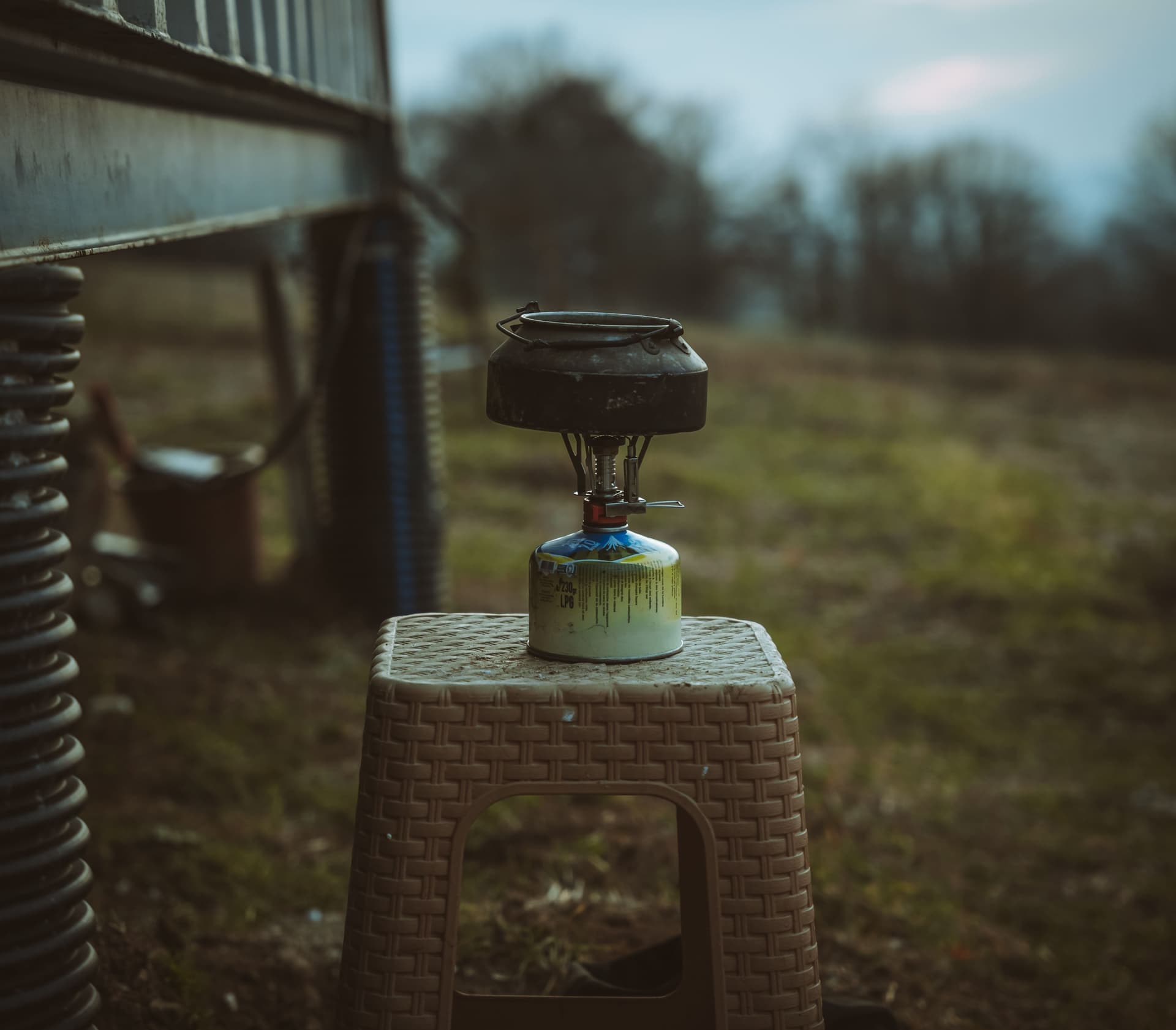
Most propane patio heaters are convective — they warm air. True propane infrared heaters are radiant: they warm objects and people directly, so wind barely affects them and they need no outlet. The mainstream examples are tank-top heaters, which are cheap, effective, outdoor-only, and unapologetically industrial-looking.
The distinction the category blurs
This site has spent a lot of pages on one idea: some heaters warm the air around you and some warm you directly, and outdoors that difference decides almost everything. What we have implied along the way — and what most of the category states outright — is that radiant means electric and propane means convective.
That is a useful simplification and it is not true. The mechanism is set by how the burner is built, not by what the fuel is.
| Appliance | Mechanism | Typical output | Cost per hour | Needs power |
|---|---|---|---|---|
| Propane tower | Convective, some radiant | 46,000 to 48,000 BTU/h | About $1.40 | No |
| Propane tank top | Radiant | 10,000 to 30,000 BTU/h | $0.29 to $0.88 | No |
| Electric infrared | Radiant | 1,500 W = 5,118 BTU/h | About $0.28 | Yes |
Heat mechanism by appliance type. Cost per hour computed at $2.674 per gallon of propane and 18.34 cents per kWh, the current US averages.
Read the middle row against the other two and the appeal is obvious. Radiant propane is the only thing on this site that combines infrared's indifference to wind with propane's independence from an outlet. Every other option gives you one or the other.
Why that combination matters outdoors
The reason wind ruins patio heaters is that a breeze does not reduce output — it removes the warmed air that output produced, before you feel it. That is a devastating problem for a convective tower and essentially a non-problem for a radiant emitter, because radiant energy crosses moving air largely unaffected and deposits itself in the first solid thing it meets.
Until now the site's answer to that has been electric infrared, with the caveat that it needs somewhere to plug in and something to mount to. On an open deck, a driveway, a dock or a site with no power, that answer runs out. Radiant propane is what is left, and it is genuinely good at the job.
Quick picks
Ranked for fit, not for hype. Output is the maker’s published figure; reach is computed from it or from the maker’s own radius claim, and the table says which. Tap a row for the full write-up, or go straight to the listing.
| # | Product | Best for | Output | Reach | Price |
|---|---|---|---|---|---|
| 1 |  Mr. Heater MH30TSDouble the burners and a swivel head, which is the version that actually solves the single unit's worst flaw — you can aim it. Still job-site equipment, but job-site equipment that reaches a seating area. | Radiant propane with real output | 30,000 BTU | 1,500 sq ft | $97.55 · Check on Amazon |
| 2 |  Mr. Heater MH15TThe cheapest way to buy propane heat that behaves like infrared rather than like warm air. It screws onto a cylinder, needs no outlet, and looks exactly like the job-site equipment it is. | Radiant propane heat, cheaply | 15,000 BTU | 750 sq ft | $49.99 · Check on Amazon-8% |
| 3 |  Hiland HLDS01The mushroom tower the whole category is a copy of. 48,000 BTU is enough for a genuinely open patio, and the parts are the easiest in the category to replace when something eventually fails. | A full open patio | 48,000 BTU | 2,400 sq ft | $315.00 · Check on Amazon |
Reach marked “claimed” is the maker’s own published figure. Reach without that label is ours, computed from published output at 20 BTU per square foot for an open patio. Neither is a measurement we took.
Top pick · Radiant propane with real output
Mr. Heater MH30TS Double Tank Top Propane Radiant Heater, Spark Ignition
Double the burners and a swivel head, which is the version that actually solves the single unit's worst flaw — you can aim it. Still job-site equipment, but job-site equipment that reaches a seating area.
- Fuel
- Propane
- Output
- 30,000 BTU/h
- Reach (computed)
- 1,500 sq ft · 21.9 ft radius
- Cost per hour
- $0.88
What works
- The swivel head is the whole upgrade. A radiant heater warms what it points at, and being able to aim it upward at seated people rather than at their shins changes what the thing is useful for
- A hi-med-low regulator plus the option to run one burner or both, so it can genuinely be turned down — which matters, because at full output it empties a cylinder roughly twice as fast as the single-burner unit
- 30,000 BTU/h of radiant output is genuinely substantial; most of it reaches what it is aimed at rather than rising into the sky
- Same wind tolerance as any radiant heater, and still no outlet or wiring anywhere
What does not
- Still unmistakably work equipment. Chrome mesh guards on top of a gas bottle. It does not read as patio furniture and no amount of placement fixes that
- Outdoor only, like every tank-top heater. Enclosing it is a carbon monoxide problem rather than a comfort decision
- At 30,000 BTU/h it burns about twice as fast as the single unit, so the impressive runtime figures belong to the lower settings
- The maker publishes no coverage area, so the reach figure on this site is ours
- Directly on the cylinder means the whole assembly is only as stable as the bottle it stands on, which on soft ground is worth thinking about
| Published specification | |
|---|---|
| Rated input | 10,000 to 30,000 BTU/h |
| Settings | Hi-med-low regulator; one or two burners, per the maker |
| Ignition | Electronic spark |
| Heat type | Radiant, per the maker |
| Aim | Adjustable swivel head |
| Construction | Chrome and stainless steel components |
| Mounting | Direct connection to a 20 lb bulk cylinder |
| Assembly | Assembled in Cleveland, Ohio; all components replaceable per the maker |
| Maker’s coverage claim | None published — the reach figure above is ours |
| Safety listing | Two tip-over safety shut-offs per the maker; no third-party listing published |
Who it is for
Someone who wants radiant propane heat with enough output for a group, and who values being able to aim it more than they mind how it looks.
What it is not for
Anywhere enclosed, anywhere appearance matters, or anyone who wants to set it and forget it at full output all evening.
Sources for this entry
2 · Radiant propane heat, cheaply
Mr. Heater MH15T Single Tank Top Propane Radiant Heater
The cheapest way to buy propane heat that behaves like infrared rather than like warm air. It screws onto a cylinder, needs no outlet, and looks exactly like the job-site equipment it is.
- Fuel
- Propane
- Output
- 15,000 BTU/h
- Reach (computed)
- 750 sq ft · 15.5 ft radius
- Cost per hour
- $0.44
What works
- Radiant heat with no outlet required — the one combination electric infrared cannot offer and a convective propane tower does not deliver
- Wind barely touches it, for the same reason it barely touches electric infrared: radiant energy crosses moving air largely unaffected
- Our computed runtime from the published BTU range reproduces the 28 to 43 hour figure retailers quote for a 20 lb cylinder, which is a rare case of a published claim surviving arithmetic
- 3.3 lb and no base — it goes in a truck, and there is nothing to blow over in the sense a seven-foot tower can
What does not
- It is work equipment, not patio furniture. The maker's own listed uses are construction sites, loading docks, sporting events, hunting, fishing and camping. Patios are not on that list and the thing looks it
- Outdoor use only, stated plainly by the maker. No garage with the door part-open, no screened porch, no enclosure of any kind
- Match lit on this model, which in a breeze is genuinely annoying — the spark-ignition variants exist for a reason
- It sits at cylinder height, so it radiates at knees and shins rather than at a seated upper body. Aim is fixed by wherever the cylinder stands
- No published coverage figure, so any reach number for it is computed rather than quoted
| Published specification | |
|---|---|
| Rated input | 10,000 to 15,000 BTU/h, adjustable |
| Heat type | Radiant, per the maker |
| Use | Outdoor use only, per the maker |
| Ignition | Match lit |
| Mounting | Screws directly to a cylinder; 5 lb minimum, 20 lb typical |
| Size and weight | 9 x 8 in, 3.3 lb |
| Warranty | 1 year limited |
| Maker’s coverage claim | None published — the reach figure above is ours |
| Safety listing | Tip-over safety shut-off switch per the maker; no third-party listing published |
Who it is for
Anyone who wants radiant propane heat cheaply on an open deck, a driveway, a tailgate or a work area, and does not care what it looks like.
What it is not for
A furnished patio where appearance matters, anything enclosed or partly enclosed, or a seated group wanting heat at chest height.
3 · A full open patio
Hiland / AZ Patio Heaters HLDS01-CG 87 in Propane Patio Heater
The mushroom tower the whole category is a copy of. 48,000 BTU is enough for a genuinely open patio, and the parts are the easiest in the category to replace when something eventually fails.
- Fuel
- Propane
- Output
- 48,000 BTU/h
- Reach (computed)
- 2,400 sq ft · 27.6 ft radius
- Cost per hour
- $1.40
What works
- 48,000 BTU is real output — on our sizing arithmetic that is a 2,400 sq ft open patio at the rule-of-thumb rate, so it is never the unit that is undersized
- Every wear part on this platform is a stocked commodity: thermocouples, control valves, dump switches and reflectors are all available separately
- The weight bladder in the base is the single most useful anti-tip feature in the category and most rivals leave it out
What does not
- An 87 in open-flame tower is the worst possible shape in wind — this is the unit our wind guide exists for
- The maker does not publish a coverage radius, so the reach figure we show is ours, computed rather than quoted
- Full output burns a 20 lb cylinder in well under a night. See the runtime arithmetic
| Published specification | |
|---|---|
| Rated input | 48,000 BTU/h |
| Height | 87 in |
| Fuel | 20 lb propane cylinder, not included |
| Reflector | 33 in aluminum heat shield |
| Safety | Anti-tilt cutoff and thermocouple flame-failure cutoff |
| Extras | Wheels, integrated table, weight bladder for the base |
| Maker’s coverage claim | None published — the reach figure above is ours |
| Safety listing | CSA certified per the maker's product literature |
Who it is for
An open patio with no roof, where you need volume of heat and can accept swapping cylinders. Also the right answer if you want a unit whose parts you can still buy in five years.
What it is not for
A screened porch, a garage, or anywhere without open sky above it. It is an open-flame combustion appliance and needs genuine outdoor ventilation.
What we would skip
A list with no losers is a list nobody edited. These are the choices we would actively steer you away from, and why.
Any tank-top heater used indoors, in a garage, or on a screened porch
The maker states outdoor use only, and this is the one item on the page that is a safety line rather than a comfort trade. An open-flame appliance without an oxygen-depletion sensor, in a space with restricted air exchange, is a carbon monoxide risk. A part-open garage door does not make a garage outdoors.
Buying one expecting it to look like a patio heater
It will not. These are chrome mesh guards bolted to the top of a gas bottle, and the maker's own listed applications are construction sites, loading docks, hunting and camping. If the heater has to look like furniture, buy a tower and accept the convective trade-off.
Assuming the marketing word 'infrared' means radiant
Plenty of convective propane towers carry infrared language because they have a reflector. A reflector directs some radiant share downward; it does not make an air-heating appliance a radiant one. Check whether the maker describes the heat as radiant in the specification, not in the headline.
The running cost, and a claim that survives checking
Propane costs the same per unit of heat whatever burns it — about 2.9 cents per 1,000 BTU at the current US average. What changes with a radiant unit is that far more of that heat reaches a person instead of rising, so the cost per hour is lower simply because you need less output.
The working
15,000 BTU/h ÷ 91,420 BTU per gallon = 0.164 gallons an hour, which at $2.674 is about 44 cents an hour. 30,000 BTU/h is 0.328 gal/h, about 88 cents. Turned down to 10,000 BTU/h it is roughly 29 cents — inside touching distance of a 1,500 W electric heater, with no outlet involved.
The runtime arithmetic is worth doing too, because it is one of the rare occasions in this category where a published claim survives being checked.
A published figure that holds up
A 20 lb cylinder holds about 4.72 gallons. At 15,000 BTU/h that is 4.72 ÷ 0.164 = 28.8 hours; turned down to 10,000 BTU/h it is 4.72 ÷ 0.109 = 43.1 hours. Retailers quote 28 to 43 hours for this heater. Our arithmetic reproduces both ends of their range from published inputs, which is more than most coverage claims in this category manage.
Compare that against a 48,000 BTU tower emptying the same cylinder in about ten hours and the practical difference is stark. A tank-top heater on low is a genuinely long evening; a tower at full output is two of them.
The catch, stated plainly
These are not patio products. The manufacturer's own listed applications for the single-burner unit are construction sites, loading docks, sporting events, hunting, fishing and camping. Patios are not mentioned, and the design reflects that — a chrome mesh guard screwed onto the top of a propane bottle.
There are three practical consequences beyond appearance:
- Height and aim. The heater sits at cylinder height, so a fixed unit radiates at shins rather than at a seated upper body. The swivel-head model exists precisely to fix this and it is the main reason to pay more for it.
- Stability. The whole assembly is only as stable as the bottle it stands on. That is fine on a flat deck and worth thinking about on grass or gravel.
- Outdoor only, without exception. No garage, no screened porch, no gazebo with the sides down. This is not the same caution we apply to towers under a roof — it is a harder line, because these units have no oxygen-depletion sensor.
Where a tower still wins
It would be easy to read the cost table and conclude the tower is simply worse. It is not, and the honest comparison has three points on it.
- Total output. 48,000 BTU/h against 30,000 is a real difference, and on a genuinely large open patio the tower is what covers it. Work out what your space needs before assuming the smaller unit is enough.
- Coverage shape. A tower's reflector spreads heat in a rough circle around it, which suits seating arranged around the unit. A radiant emitter throws a cone in whatever direction it faces, which suits seating on one side.
- It looks like a patio heater, which for a furnished terrace is not a trivial consideration and is the reason the category is shaped the way it is.
That is why the tower is the third pick above rather than an afterthought. For many readers arriving at this page, the correct answer will turn out to be the conventional one — and the useful thing this page can do is let you reach that conclusion deliberately rather than by default.
Safety, which is not the usual boilerplate here
Every gas appliance on this site comes with the instruction that your own manual is the authority, and that holds here. But tank-top heaters carry one caution that is genuinely stricter than the rest of the category.
A propane tower under a roof is a clearance question — answerable with a number from the manual. A tank-top heater in a partly enclosed space is not a clearance question at all: the maker says outdoor use only, these units do not carry an oxygen-depletion sensor, and combustion in restricted air produces carbon monoxide. Treat that as a hard boundary rather than a conservative recommendation, and read the safety page for where the lines fall generally.
The ordinary precautions still apply on top: keep the published clearances, keep it away from anything that can catch, and check the hose and regulator connection every season the way you would on any propane appliance.
For one of these read closely — the runtime arithmetic, the shin-height geometry and what match-lit ignition is like in wind — see our Mr. Heater MH15T review.
So who should buy one
Buy radiant propane if you need heat somewhere there is no power, in wind, and you do not care how it looks — an open deck, a driveway, a dock, a tailgate, a workshop doorway, a site. It is the cheapest wind-proof heat available and nothing else on this site does that job.
Buy the swivel-head version if anyone will be sitting down. Aim is the difference between warming a seating group and warming their ankles, and it is worth more than the extra output.
Buy a conventional tower if the space is furnished, large, and has people arranged around it — or if the heater has to look like it belongs. And if there is a roof and an outlet, ignore all of this and buy electric infrared, which is a fifth of the running cost and needs no cylinders at all.
Common questions
Are propane infrared heaters a real thing, or just marketing?
Both exist. True radiant propane heaters — tank-top units in the mainstream — are described as radiant in the maker's own specification. But plenty of convective propane towers use infrared language because they have a reflector, and a reflector does not make an air-heating appliance radiant. Check the specification, not the headline.
Do propane infrared heaters work in wind?
Much better than a propane tower. Radiant energy crosses moving air largely unaffected, so wind does not strip the heat away the way it removes a tower's warmed air. The flame itself still needs some shelter, but the heat delivery is far more wind-tolerant.
What does a propane tank top heater cost to run?
About 44 cents an hour at 15,000 BTU/h and 88 cents at 30,000, at the current US average propane price. Turned down to 10,000 BTU/h it is roughly 29 cents — close to a 1,500 W electric heater, with no outlet needed.
How long does a 20 lb tank last on a tank top heater?
About 28 hours at 15,000 BTU/h and roughly 43 hours turned down to 10,000. That is our arithmetic from the published BTU range and propane's energy content, and it reproduces the 28 to 43 hour figure retailers quote.
Can you use a tank top propane heater in a garage?
No. The maker states outdoor use only, and these units carry no oxygen-depletion sensor. Combustion in a space with restricted air exchange is a carbon monoxide risk, and a part-open garage door does not make a garage outdoors.
Is a tank top heater better than a propane patio heater?
For wind, cost per hour and portability, yes. For total output, coverage shape and appearance, no. A 48,000 BTU tower covers a large space in a circle and looks like patio equipment; a tank-top unit throws a cone, costs less to run and looks like a job site.
Sources
- Mr. Heater — MH15T published specification (radiant, 10,000-15,000 BTU/h, outdoor use only)
- Mr. Heater — MH30TS published specification (radiant, 10,000-30,000 BTU/h, electronic spark ignition, adjustable swivel head)
- EIA — Weekly residential propane price, US average
- U.S. DOE Alternative Fuels Data Center — propane energy content
Read next
Infrared patio heaters, and why wind does not touch them
Four infrared heaters and heat lamps, with what radiant heat does that a flame cannot.
Infrared vs propane patio heaters
Radiant versus convective heat outdoors, and why the ten-to-one output gap is not the whole story.
Propane patio heaters, with the cylinder arithmetic
Four propane heaters compared on published BTU, computed reach and real cylinder runtime.
Wind-resistant patio heaters
The heaters that keep working in a breeze, and the physics that makes the list mostly electric.
How long a propane cylinder actually lasts
The cylinder arithmetic in full: energy content, burn rate, and every size from 15 to 40 lb.
Mr. Heater MH15T review
Radiant propane with no outlet for under fifty dollars, the runtime arithmetic, and why it radiates at your shins.