Head to head
Windscreen mesh vs vinyl curtains
The two ways to fix the thing that is actually ruining your patio. They work differently, they fail differently, and only one of them is safe around an open flame.

Mesh slows wind and breathes; vinyl stops wind and encloses. Mesh is the safer default, especially with any flame appliance. Vinyl turns a porch into a room and is far more effective — but an enclosed space plus a combustion heater is a ventilation problem, not a comfort upgrade.
Why this is the highest-value fix on the site
Because wind is the reason most patio heaters disappoint. A breeze does not reduce a heater's output — it removes the warmed air that output produced before you feel it, which is the thing this whole section exists to explain.
Blocking wind on the exposed side of a patio can cut the heat you need by more than half. That is a bigger effect than any heater upgrade and it costs a fraction as much, which is why we keep telling people to fix the wind before buying more heater.
How each one actually works
Mesh is a knitted permeable fabric. It does not stop air, it slows it and breaks up the turbulence, and the sheltered zone extends some distance downwind. Because air still passes through, it does not act as a sail in the way a solid panel does, and it does not trap anything.
Clear vinyl is a solid impermeable sheet. It stops air completely, which is why it is dramatically more effective and why it converts an open side into a wall. It also keeps rain out and holds warmth in, which is the whole appeal.
| Windscreen mesh | Clear vinyl curtains | |
|---|---|---|
| Blocks wind | Slows and diffuses | Stops |
| Air exchange | Yes, through the fabric | None where closed |
| View | Filtered, translucent | Clear |
| Rain | Passes through | Kept out |
| Load in a gale | Lower, air passes through | High, acts as a sail |
| With a gas heater | Generally fine, still ventilated | Ventilation becomes critical |
| Fixing | Grommets, ties, cable ties | Grommets, ropes, ties |
| Seasonal | Can stay up | Usually rolled up in summer |
Behavior described from how each material is constructed and from the makers' stated intended uses. We have not tested either.
Quick picks
Ranked for fit, not for hype. Output is the maker’s published figure; reach is computed from it or from the maker’s own radius claim, and the table says which. Tap a row for the full write-up, or go straight to the listing.
| # | Product | Best for | Output | Reach | Price |
|---|---|---|---|---|---|
| 1 | 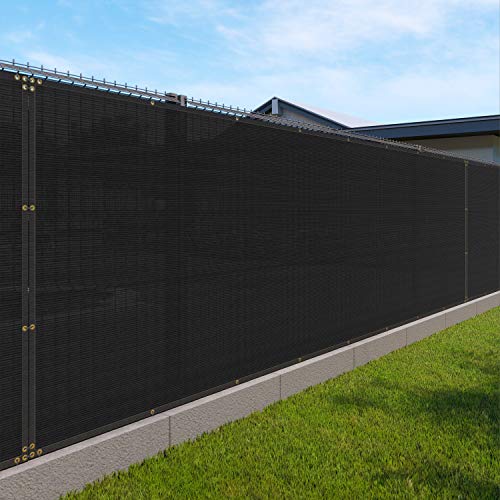 Windscreen4less 6x50Mesh is the counter-intuitive right answer in strong wind: a permeable screen sheds load instead of catching it, which is why solid panels tear off railings and mesh ones do not. | Wind you want slowed, not stopped | n/a | n/a | $42.98 · Check on Amazon |
| 2 |  Clear vinyl curtainsThe highest-leverage purchase on this whole site. Blocking the wind on two sides changes the heat a patio needs by more than any heater upgrade does, and costs a fraction as much. | Turning open sides into walls | n/a | n/a | $63.17 · Check on Amazon-10% |
Reach marked “claimed” is the maker’s own published figure. Reach without that label is ours, computed from published output at 20 BTU per square foot for an open patio. Neither is a measurement we took.
Top pick · Wind you want slowed, not stopped
Windscreen4less 6 ft x 50 ft Privacy Fence Screen, Black
Mesh is the counter-intuitive right answer in strong wind: a permeable screen sheds load instead of catching it, which is why solid panels tear off railings and mesh ones do not.
- Fuel
- Accessory
- Output
- Not published
- Reach (computed)
- Not published
- Cost per hour
- n/a
What works
- A permeable screen reduces wind speed without becoming a sail — the failure mode of solid panels on a railing is the panel leaving with the railing attached
- Cheap enough to fit a whole railing line, which is what actually changes a patio's exposure rating
- Doubles as privacy screening, which is usually the reason it survives the household vote
What does not
- A 50 ft roll is far more than most patios need. It is priced as fencing stock, so you are buying a run and cutting it down rather than buying a panel that fits
- It cuts wind speed rather than blocking it — for full shelter you want solid or vinyl panels
- Mesh windscreen is a commodity category sold at wildly different fabric weights. 150 GSM is a reasonable mid-weight; much lighter stock exists at similar prices and does not last
- Sun-bleaches over a few seasons
| Published specification | |
|---|---|
| Size | 6 ft x 50 ft roll, black |
| Fabric weight | 150 GSM polyethylene mesh per the listing |
| Blockage | About 90% visibility blocking per the listing |
| Fixing | Reinforced brass grommets on stitched edges; cable ties or rope |
| Typical use | Deck railings, fence panels, balcony edges |
| Maker’s coverage claim | None published — the reach figure above is ours |
| Safety listing | Not applicable — this is a fabric panel, not an appliance |
Who it is for
An exposed deck or balcony with a railing to attach to, in a spot where the wind is persistent rather than occasional.
What it is not for
Creating a genuinely still pocket. If the goal is a still corner, use solid panels or vinyl.
Sources for this entry
2 · Turning open sides into walls
Clear Vinyl Patio Enclosure Curtains, 23 oz, with Grommets
The highest-leverage purchase on this whole site. Blocking the wind on two sides changes the heat a patio needs by more than any heater upgrade does, and costs a fraction as much.
- Fuel
- Accessory
- Output
- Not published
- Reach (computed)
- Not published
- Cost per hour
- n/a
What works
- On our own sizing model, moving a patio from exposed to sheltered cuts the required output by about a third — that is a bigger change than any heater swap
- Clear vinyl keeps the view, which is why people actually leave it up rather than taking it down after a week
- Grommets every 12 inches make it a rope-and-tie job, not a construction project
What does not
- Enclosing a patio changes the heater rules. Once you have walls and a roof, an open-flame propane unit is no longer appropriate — read the safety page before you buy both
- Vinyl goes cloudy and stiff with age and UV, faster in hot climates
- It flogs and cracks in real wind unless it is tied at every grommet, not just the corners
| Published specification | |
|---|---|
| Material | 23 oz clear PVC vinyl tarpaulin |
| Fixing | Metal grommets, ropes and ties included |
| Claimed properties | Waterproof, anti-UV, tear resistant per the listing |
| Intended use | Porch, pergola, gazebo, balcony |
| Maker’s coverage claim | None published — the reach figure above is ours |
| Safety listing | Not applicable — this is a fabric panel, not an appliance |
Who it is for
Any patio where wind is the actual problem and the heater is being blamed for it.
What it is not for
Sealing a space fully. A partly open, well-ventilated enclosure is the goal; an airtight one with a combustion heater inside is dangerous.
Sources for this entry
The ventilation rule, which is the important part
Enclosing a space changes what you can burn in it
Vinyl curtains on all sides turn a porch into an enclosed room. A propane or natural gas heater in an enclosed space is a carbon monoxide risk, not a comfort decision — combustion appliances need genuine air exchange. If you are closing sides in, the heater should be electric, or you must keep sides genuinely open.
This is the single most important sentence on the page and it is the one the product listings do not say. Vinyl enclosure and gas heating are a bad combination, and the fix is not a rule of thumb about leaving a gap — it is using an electric heater in a space you have deliberately sealed, or keeping the space genuinely ventilated.
Mesh does not have this problem in the same way, because air passes through the fabric continuously. That is a real safety argument for mesh beyond any question of effectiveness, and it is why we default to it. More on where the lines are: safety and clearances and heating a screened porch.
Wind load, the failure people do not plan for
A solid vinyl panel in a gale is a sail attached to your railings. The failure is rarely the vinyl tearing in the middle — it is the grommets pulling through, or the structure it was tied to giving way, and both are more expensive than the curtain.
Practical consequences: fix vinyl to something structural rather than to a fence panel, use every grommet rather than every third one, and roll it up when serious weather is forecast. Mesh is far more tolerant here because it lets air through, which is why it can stay up all season with less thought.
How much of the perimeter to cover
A question people get wrong in both directions. Enclosing everything is rarely necessary and often counterproductive; covering one panel of a four-sided space usually does nothing.
The useful approach is to establish the prevailing direction first and treat it as the only side that matters initially. Tie a ribbon to the railing and watch it for a week — the wind on most sites comes predominantly from one quarter, and blocking that quarter captures most of the available benefit for a quarter of the cost.
- One windward side is the highest-value single intervention and where to start.
- Two adjacent sides creates a genuine sheltered corner, and is usually where a seating group ends up.
- Three sides starts to feel like a room and is where ventilation becomes a real consideration with any flame appliance.
- Four sides is an enclosure, not a windbreak, and changes what you can safely burn entirely.
Fixing methods that actually hold
Both materials come with grommets and the assumption that you have something to tie them to. That assumption is where most installations fail.
- Fix to structure, not to fence panels. A fence panel is itself the weakest part of most gardens, and a loaded screen will take it out before the screen fails.
- Use every grommet. Load per fixing is what pulls grommets through, and using every other one doubles the load on each.
- Prefer bungee or elastic ties over rigid rope on solid vinyl. A little give absorbs gusts that would otherwise be taken by the fabric.
- Leave the bottom hem able to move slightly. A panel pinned rigidly at every edge has nowhere to shed a gust.
- Take vinyl down for storms. Mesh can stay; a solid panel in a named storm is a liability rather than a windbreak.
Choosing
- Open patio, gas heater, keep the view — mesh. It is the safe default and it addresses the actual problem.
- Porch or pergola you want to use in real cold, electric heat — vinyl. It is far more effective and it is the only one of the two that makes a space feel like a room.
- Exposed, windy site — mesh on the windward side, because a solid panel there is a structural question rather than a soft-furnishing one.
- You want both — that is normal. Mesh on the permanently exposed side and vinyl on the side you close down in midwinter is a common and sensible split.
Either way, do this before buying a bigger heater. The sizing arithmetic rewards shelter more than it rewards output, and shelter is much the cheaper purchase — as the seasonal cost figures make plain.
Common questions
Is mesh or vinyl better for blocking patio wind?
Vinyl blocks more, because it stops air completely rather than slowing it. Mesh is the safer default — it breathes, it takes far less wind load, and it does not create the ventilation problem that enclosing a space with a gas heater does.
Can I use a propane heater behind vinyl curtains?
Not in a space you have genuinely enclosed. Combustion appliances need real air exchange and an enclosed porch is a carbon monoxide risk. Either keep sides genuinely open, or use an electric heater in the enclosed space.
Does a windbreak really reduce how much heat I need?
Substantially. Blocking wind on the exposed side of a patio can cut the required heat by more than half, which is a larger effect than upgrading the heater and costs far less.
Will vinyl curtains survive a storm?
Only if fixed to something structural and using every grommet. A solid panel acts as a sail, and the usual failure is grommets pulling through or the fence they were tied to giving way. Roll them up when serious weather is forecast.
How much of my patio should I screen?
Start with the prevailing windward side only — on most sites the wind comes predominantly from one quarter, and blocking that captures most of the benefit for a fraction of the cost. Two adjacent sides creates a genuinely sheltered corner. Four sides is an enclosure, which changes what you can safely burn.
What should I fix a windbreak to?
Something structural, never a fence panel — a loaded screen will take the fence out before the screen fails. Use every grommet rather than every other one, prefer elastic ties on solid vinyl so gusts are absorbed, and take vinyl down for named storms.
Can I leave windscreen mesh up all year?
Generally yes — it passes air, so it carries much lower wind load than a solid panel, which is a large part of its appeal. Vinyl is normally rolled up outside the cold months.
Read next
Patio windbreaks, and why they beat a bigger heater
Vinyl, mesh and curtains compared, with what enclosing a patio changes about your heater choice.
How to build a patio windbreak
Solid or permeable, how to fix it so it survives, and how much shelter is enough.
Wind-resistant patio heaters
The heaters that keep working in a breeze, and the physics that makes the list mostly electric.
Heating a screened porch
Why a screened porch is electric-only, and the mounted units that suit it.
Patio heater safety, with the published numbers
Published clearance figures, the ventilation rule, and where each heater type must never go.