Deep review
Shintenchi 43 in fire table review
A fire table is furniture with a flame in it, and judged as furniture this one is well specified. Judged as heating it loses to a tower, and that is the trade to go in knowing.
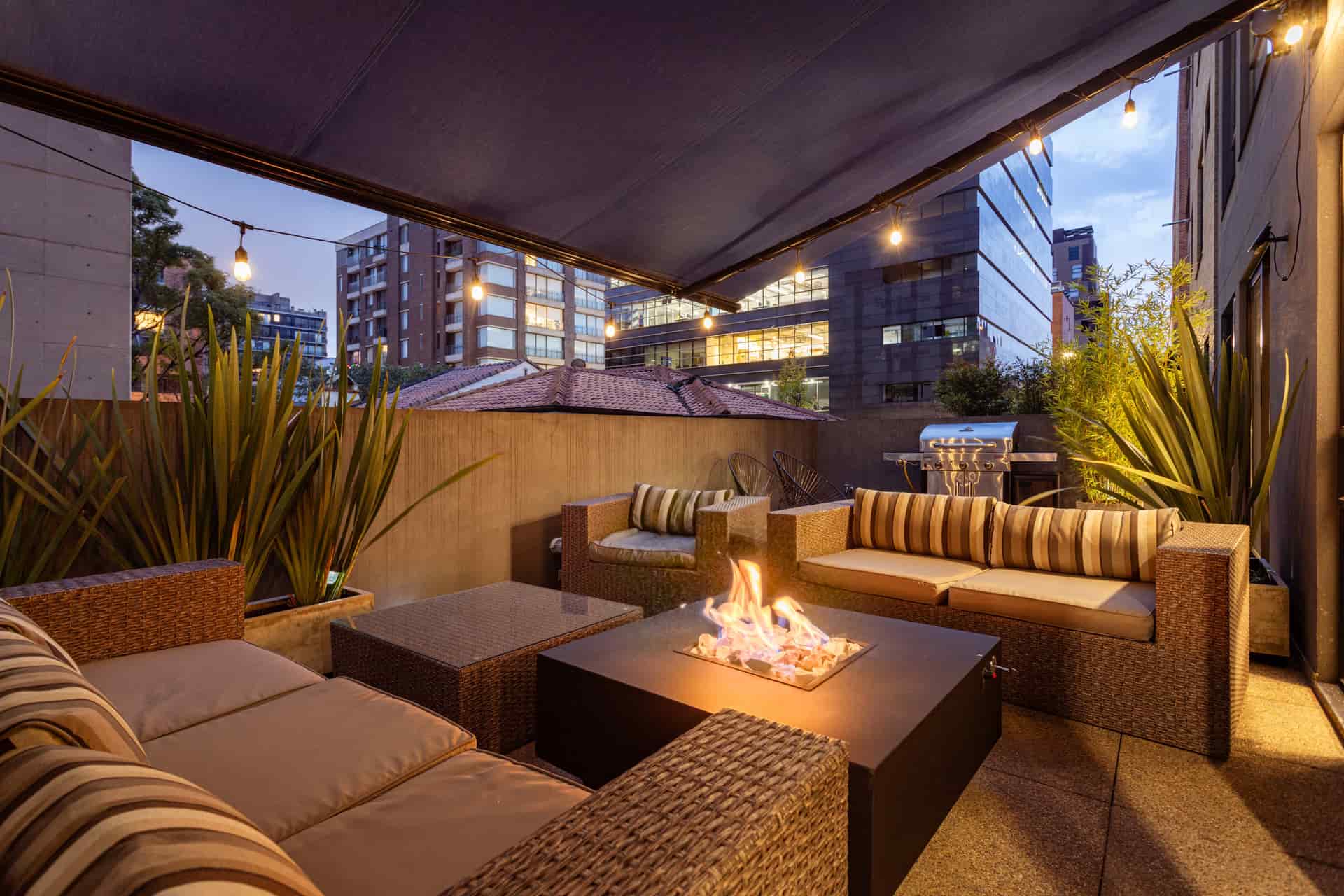
A 43-inch rectangular propane fire table rated 50,000 BTU, CSA certified per the listing, with the cylinder concealed in the base and a lid and lava rock included. Expect about eight and a half hours from a 20 lb cylinder at roughly $1.45 an hour. It is the worst heat per dollar in this category and the best reason to stay outside until eleven.
We have not lit this table. What follows reads the published specification, runs the arithmetic, and is clear that the specification here comes from the retail listing rather than a manufacturer datasheet.
What it is
A steel rectangle about 43 inches across, table height, with a burner running down the middle under a bed of lava rock. A 20 lb propane cylinder lives inside the base, hidden behind a door, connected internally. A lid covers the burner so the whole thing works as an ordinary patio table when it is not lit.
The listing publishes 50,000 BTU/h, steel construction, CSA certification, and includes both the lid and the lava rock.
Quick picks
Ranked for fit, not for hype. Output is the maker’s published figure; reach is computed from it or from the maker’s own radius claim, and the table says which. Tap a row for the full write-up, or go straight to the listing.
| # | Product | Best for | Output | Reach | Price |
|---|---|---|---|---|---|
| 1 |  Shintenchi fire table50,000 BTU of table-height flame plus somewhere to put a drink, and a lid that turns it back into a table when it is out. As heat it loses to a tower; as a reason to stay outside until eleven it beats one. | A table that is also the fire | 50,000 BTU | 2,500 sq ft | $199.99 · Check on Amazon |
Reach marked “claimed” is the maker’s own published figure. Reach without that label is ours, computed from published output at 20 BTU per square foot for an open patio. Neither is a measurement we took.
Top pick · A table that is also the fire
Shintenchi 43 in Rectangular Propane Fire Pit Table, 50,000 BTU
50,000 BTU of table-height flame plus somewhere to put a drink, and a lid that turns it back into a table when it is out. As heat it loses to a tower; as a reason to stay outside until eleven it beats one.
- Fuel
- Propane
- Output
- 50,000 BTU/h
- Reach (computed)
- 2,500 sq ft · 28.2 ft radius
- Cost per hour
- $1.46
What works
- Concealing the cylinder inside the base is the whole design argument — no hose across the patio, no cylinder to look at
- A lid is included, which is what makes a fire table usable as a table for the other six days of the week and keeps rain out of the burner
- CSA certification is published, which on a gas appliance is the kind of claim you can actually look up — plenty of fire tables in this price band state nothing
- 50,000 BTU at table height puts heat where hands and torsos are, which is more usefully placed than a tower's overhead radiance
What does not
- Fire tables are the worst heat-per-dollar in this category and it is not close. You are buying furniture with a flame in it
- At 50,000 BTU/h a 20 lb cylinder empties faster than on a mid-size tower — run the runtime arithmetic before assuming an evening
- The flame sits in an open bowl and a stiff breeze is a real problem for it
- No coverage figure is published, so any reach number for it is ours rather than the maker's
| Published specification | |
|---|---|
| Rated input | 50,000 BTU/h |
| Size | 43 in rectangle |
| Construction | Steel |
| Fuel | 20 lb cylinder, concealed in the base |
| Included | Lid and lava rock |
| Certification | CSA certified per the listing |
| Maker’s coverage claim | None published — the reach figure above is ours |
| Safety listing | CSA certified per the listing |
Who it is for
A seating arrangement that already has a coffee table in the middle of it, where the fire is the point rather than the heating strategy.
What it is not for
Heating an area. If the goal is to make a cold patio usable, [a heater does that better for less](/fire-pits/heater-vs-fire-pit).
The concealed cylinder is the design
Everything that makes a fire table worth its premium over a fire bowl comes down to where the propane sits.
A portable fire bowl runs a ten-foot hose across the ground to a cylinder standing somewhere nearby. That is a trip line at shin height in the dark, a cylinder in your eyeline, and a hose that gets stepped over every time someone reaches a chair. It is the compromise that format accepts in exchange for portability and a much lower price.
A fire table puts the cylinder inside the furniture. No hose, nothing to trip on, nothing to look at. On a patio you are trying to make pleasant rather than functional, that is the whole argument, and it is a good one.
The lid matters almost as much and is easier to overlook. It is what makes the table a table for the other six days of the week, and it keeps rain out of the burner and the rock bed — which is the failure mode that quietly ruins uncovered gas fire features.
What it costs to run
| Burn rate | 15 lb cylinder | 20 lb cylinder | 30 lb cylinder | 40 lb cylinder |
|---|---|---|---|---|
| 50,000 BTU/h | 6.5 h | 8.6 h | 12.9 h | 17.2 h |
Cylinder energy = pounds ÷ 4.24 lb per gallon x 91,420 BTU per gallon, divided by the burn rate. A 20 lb cylinder therefore holds 4.7 gallons and 431,226 BTU. Full output only — turn it down and every figure here stretches proportionally.
A 20 lb cylinder holds roughly 431,000 BTU. At 50,000 BTU/h that is about eight and a half hours at full output, and at the national average propane price this site cites — a fill around $12.60 — that is close to $1.45 an hour.
In practice a fire table spends most of an evening turned down, because the flame is the point rather than the output, and a low flame looks much the same as a high one across a table. That makes the real-world figure considerably better than the number above.
The prices every cost figure on this site uses
- Electricity: 18.34 cents per kWh. U.S. average residential retail price, June 2026. EIA, Electric Power Monthly, Table 5.6.A (residential, U.S. total).
- Propane: $2.674 per gallon. U.S. average residential price, week ending March 30, 2026. EIA, Weekly Heating Oil and Propane Prices (residential, U.S. average). That series only runs through the heating season, which is why the latest reading is a March one.
- Propane energy content: 91,420 BTU per gallon (higher heating value, the same basis appliance BTU ratings use). U.S. DOE Alternative Fuels Data Center, Fuel Properties Comparison.
- Conversion: 1 kWh = 3,412 BTU. Which is why a 1,500 W electric heater is a 5,118 BTU/h appliance, and why comparing it to a 48,000 BTU propane tower is not the comparison it looks like.
The heat-per-dollar problem, stated plainly
This is where an honest review has to be unhelpful to the sale.
50,000 BTU sounds like more than a 48,000 BTU patio tower, and in delivered warmth it is dramatically less. A tower has a wide reflector at seven feet whose entire purpose is to push heat down and outward across a seating area. A fire table has an open flame at table height with nothing above it, so the hot gas rises and leaves.
What reaches you is radiant heat at the table — good on hands, arms and torso if you are sitting at it, close to nothing if you are four feet away in a lounge chair. It heats the people at the table and nobody else. If the goal is a warm patio, a patio heater does that and this does not; the heater versus fire pit comparison works the whole question through.
Table height is not a disadvantage everywhere
For a group seated around it, waist-height radiant heat lands on exactly the parts of a person that feel cold first, which a tower's overhead radiance reaches less directly. The geometry is genuinely good for dining and genuinely poor for a spread-out patio — the format is not worse, it is narrower.
The certification, and where it comes from
CSA certification is published for this table, which on a gas appliance is a claim you can look up and a real point in its favor — plenty of fire tables in this price band state nothing at all.
One caveat we would rather state than hide: that certification, and the rest of this specification, is published on the retail listing. We found no manufacturer datasheet for this model. It is a checkable claim on the seller's page rather than a figure traced back to a maker's own literature, and we would treat it accordingly.
Who should buy it
A patio that needs a table anyway. That is the clean case, and it is the one where the money makes sense — you are buying furniture you were going to buy, with a flame included, rather than buying a heater badly.
It suits dining, small groups, and anyone who wants the evening to look like something. It also suits people who want fire without smoke, ash or a fire ban problem — propane versus wood covers that trade.
Who should not
- Anyone trying to heat a patio. It heats the table. A tower heats a circle.
- Anyone short of space. A 43-inch table is a large object that does not fold, move easily or go away in winter.
- Anywhere with something overhead. Open flame needs clear sky — no pergola, awning or umbrella. The clearances apply.
- Anyone who wants a real fire. A flame over lava rock is convincing at a glance and it is not a wood fire; there is no crackle, no smell and no coals.
The verdict
Well specified for the format: the cylinder is hidden, the lid and rock are in the box rather than on the accessories page, and a CSA certification is published. Those are the three things that separate a fire table worth owning from a steel box with a burner in it.
Buy it as furniture that happens to burn, on a patio that needed a table. Do not buy it as heating — on that measure it loses to a propane tower costing less, and no amount of BTU on the box changes where an open flame sends its heat.
Common questions
Is a fire table worth it?
As furniture, often yes - especially on a patio that needed a table anyway, where you get a hidden cylinder, no hose across the ground and a lid that turns it back into a table. As heating it is the worst value in the category, because an open flame at table height sends most of its output upward.
How long does a propane tank last in a 50,000 BTU fire table?
About eight and a half hours at full output. A 20 lb cylinder holds roughly 431,000 BTU and the table is rated at 50,000 BTU per hour. In practice most people run a fire table turned well down, which extends it considerably.
How much does a fire table cost to run?
Around $1.45 an hour at full output, using the national average propane price this site cites. Because a low flame looks much the same as a high one across a table, the real-world figure is usually well below that.
Does a fire table actually heat a patio?
It heats the people sitting at it. Radiant heat at table height lands well on hands, arms and torso for anyone seated around it, and reaches almost nobody four feet away. For a spread-out patio a heater with an overhead reflector is the right product.
Can you put a fire table under a pergola or awning?
No. It is an open-flame gas appliance and needs clear sky above it. Published clearances to anything overhead apply regardless of how the table looks, and a covered patio needs a different kind of appliance entirely.
Is the Shintenchi fire table CSA certified?
CSA certification is published for it, which is a checkable claim and more than many fire tables in this price band offer. Worth noting that this specification appears on the retail listing rather than a manufacturer datasheet - we found no maker's own literature for the model.
Sources
Read next
Fire table vs fire pit
What a fire table costs, what it heats, and the patio where it is genuinely the right buy.
Outland Firebowl 893 review
What 58,000 BTU really delivers from an open bowl, the cost per hour, using it on a deck, and the fire-ban claim in context.
Patio heater vs fire pit
Output, direction, cost, wind and permitted use compared, with exits to both catalogs.
Are fire pits worth it?
What a fire pit actually delivers, what it costs to feed, and the three cases where the answer is no.
The best fire pits for heat
Fire pits ranked on delivered warmth rather than rated output, with runtime and cost computed.