Flagship roundup
The best patio heaters, sorted by the patio
Six heaters covering every real patio case, with published output, computed reach and cost per hour.
The catalog
Six form factors, two fuels, and one decision that matters more than either: whether your patio has a roof over it. Start there and the rest narrows fast.
New to this? Start with every type explained — it is the page that makes the rest of this section make sense in about four minutes.
For an open patio, a 46,000 to 48,000 BTU propane tower gives the most heat per dollar. For anything with a roof over it, a 1,500 W electric infrared unit mounted overhead beats it, because radiant heat is not blown away and there is no combustion under your ceiling.
Every buying guide in this category opens by listing heater types. That is the wrong first move, because the type is downstream of a question you can answer in one second: is there anything above your patio?
If there is open sky above you, warmed air rises and leaves, and you need volume of heat to keep replacing it. That is what a propane tower is for — 46,000 to 48,000 BTU/h, cylinder underneath, reflector on top. Nothing electric that plugs into a wall comes close to that output, and the reason is not brand quality but physics and wiring: a standard U.S. outlet tops out at about 1,440 W of continuous load, which is roughly 4,900 BTU/h. Ten times less.
If there is a roof, a pergola, a porch ceiling or a gazebo above you, the arithmetic inverts. Warmed air is trapped rather than lost, so you need far less of it — and infrared radiant heat, which warms objects and people directly rather than heating air, works properly for the first time because nothing carries it away. An overhead-mounted 1,500 W infrared unit under a roof will make a seating area comfortable when a 48,000 BTU tower on an open patio next door is losing most of its output to the sky.
There is also a safety reason the roof question comes first. Propane heaters are open-combustion appliances that consume oxygen and produce flue gas. They are outdoor products, and every manual says so. A roof with open sides is usually fine; a roof with three walls is not. The safety and clearances page has the manufacturer figures rather than our opinion.
| Form factor | Typical output | Where it belongs | The honest catch |
|---|---|---|---|
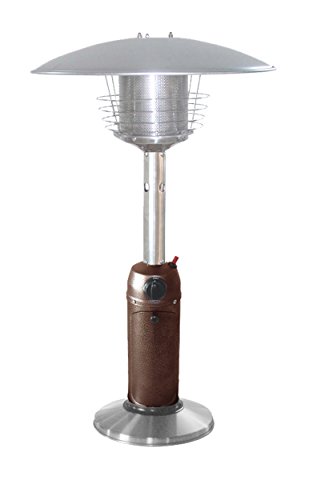
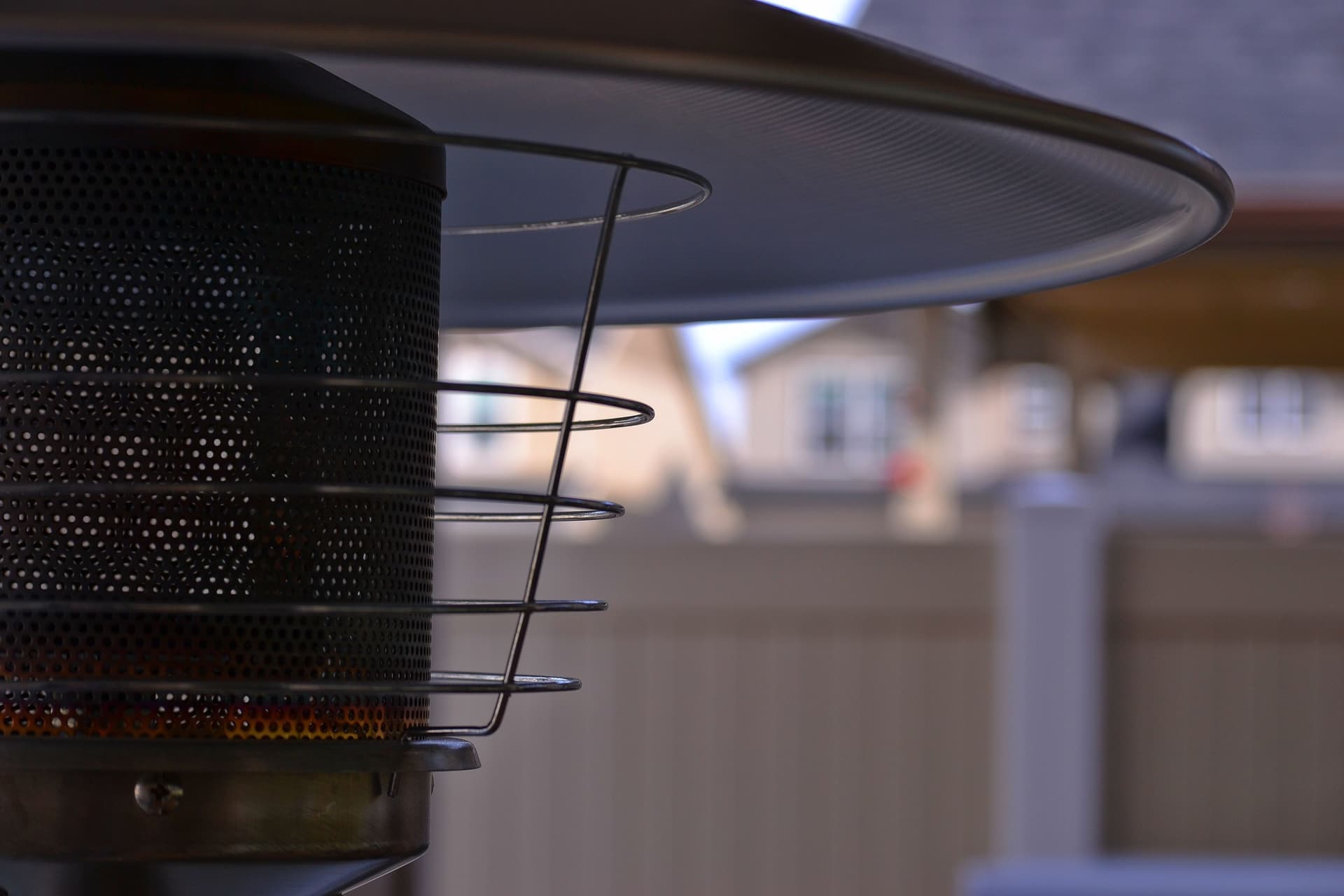
| Mushroom tower | 46,000 to 48,000 BTU | Open patios, restaurant terraces | Tall, light and open-flamed: the worst possible shape in wind |
| Pyramid / flame tower | 40,000 to 48,000 BTU | Open patios where the look matters | The flame column throws heat vertically; less lands on people |
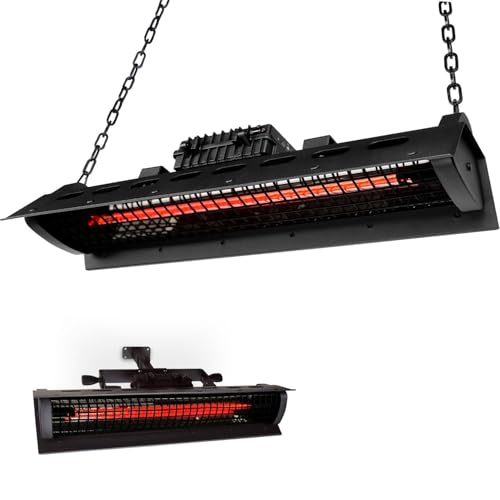
| Electric infrared, mounted | 1,500 W = about 5,100 BTU | Covered patios, pergolas, porches | Heats only what it points at; needs somewhere to hang from |
| Wall or ceiling infrared | 1,500 W = about 5,100 BTU | Permanent installations | Fixed aim, and you need an outdoor-rated circuit |
| Tabletop propane | 10,000 to 11,000 BTU | One table, a balcony | Heats a table, never a space, whatever the listing implies |
| Natural gas | 40,000 BTU and up | Permanent patios with a gas line | A plumbing job, not a purchase |
Output figures are what the makers publish. The BTU equivalents for electric units are computed at 3,412 BTU per kWh, not quoted from a marketing page.
Every propane heater in this category is sold on its rated input — 48,000 BTU/h, in enormous type. That figure is real, and it is the amount of fuel energy the burner consumes per hour. It is not the amount of warmth that reaches you.
How much reaches you depends on the shape of the thing. A mushroom reflector is designed to push heat down and out; a pyramid's glass column sends a large share straight up; an open fire bowl is essentially a chimney with a nice view. Two 48,000 BTU appliances can deliver very different amounts of comfort to the same four chairs, and no manufacturer publishes the fraction.
Which is why the useful number is not the rated input but the area it has to cover, and that is arithmetic anyone can do. Our BTU calculator shows the working: area, times a published rule, times an enclosure factor, times an exposure factor. It will not tell you which brand is better. It will tell you within about a minute whether the heater you are looking at is the right size, which is the mistake that actually costs people money.
Propane is cheaper per unit of heat than electricity in most of the United States, and electric heaters are cheaper to run per evening, and both of those statements are true at the same time. The reason is that they are not the same size. A 48,000 BTU propane tower costs roughly ten times as much per hour as a 1,500 W electric unit because it is putting out roughly ten times as much heat.
The comparison only becomes meaningful once you have decided how much heat you need, which is why the sizing section sits next to the cost pages rather than somewhere else. Get the size right and the fuel question mostly answers itself.
The mistake that costs the most
It is not buying the wrong brand. It is buying a heater sized for a still, sheltered patio and putting it somewhere exposed. On our own model, moving from sheltered to exposed raises the output you need by about 55 percent — more than the gap between most models. If wind is your problem, read the wind section first and buy second.
33 pages. Roundups and tools first, then the comparisons, then the guides.
Flagship roundup
Six heaters covering every real patio case, with published output, computed reach and cost per hour.
Propane
Four propane heaters compared on published BTU, computed reach and real cylinder runtime.

Electric
Four electric patio heaters compared on wattage, published IP rating and cost per hour.
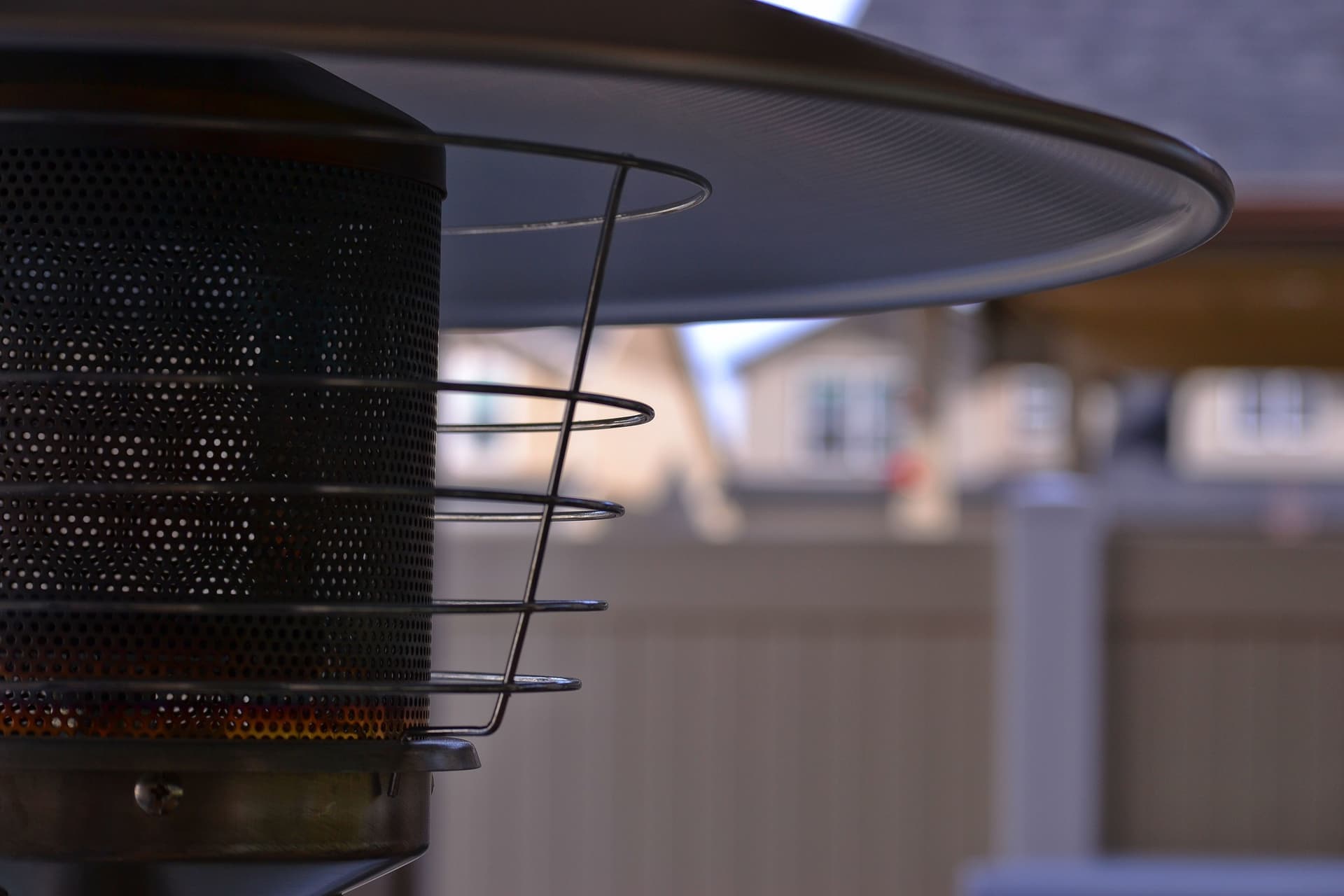
Infrared
Four infrared heaters and heat lamps, with what radiant heat does that a flame cannot.

Tabletop
What a tabletop heater's 11,000 BTU actually covers, and the fuel arithmetic that decides how you feed it.
Wall mounted
Wall and ceiling mounted electric heaters, ranked on published weather rating and mounting.
Brand guide
The two-name confusion settled, what the range covers, and why parts availability is the real reason to buy it.
Radiant propane
True radiant propane heaters: wind-proof like infrared, cordless like propane, and honest about looking industrial.
Under $200
What $200 actually buys in outdoor heat, and why the answer differs by a factor of nine between fuels.
First heater
What to buy first, the three predictable beginner mistakes, and the ownership costs nobody mentions.
By mounting
Heaters that clamp to an umbrella pole, what the umbrella has to take, and when a tower is the better answer.
Hanging
Ceiling and chain-hung heaters judged on what they hang from, how they behave in wind, and the weather rating most listings omit.
Deep review
The 9 ft radius checked against the arithmetic, the real cost per evening, and the one thing the listing will not tell you.
Deep review
What 1,500 W of carbon infrared really buys, the IP rating its maker does not publish, and when to step up to 240 V.
Deep review
What a premium propane tower buys over the clones, the parts catalog behind it, and the one condition it cannot beat.
Deep review
The 18 ft coverage claim checked, what the glass flame column costs in delivered warmth, and who should buy one regardless.
Deep review
What IPX4 covers and what the X leaves out, why its published BTU number is a good sign, and where this belongs.

Deep review
Why its own hopper and burn-time figures imply far less than 70,000 BTU sustained, and who should buy it anyway.

Deep review
What leaving the 1,500 W ceiling actually buys, what IP55 and ETL cover, and when the 120 V model is the smarter purchase.
Deep review
The 24 in ceiling clearance that rules out umbrellas, the maker's own cold-weather limit, and the fuel choice that sets the cost per hour.
Deep review
Radiant propane with no outlet for under fifty dollars, the runtime arithmetic, and why it radiates at your shins.
Head to head
Output, cost, coverage, wind and installation compared, with the arithmetic and picks for both answers.
Head to head
Radiant versus convective heat outdoors, and why the ten-to-one output gap is not the whole story.
Head to head
Same BTU, opposite geometry: which shape actually puts heat on people.
Head to head
Pellets versus propane on cost per BTU, handling and safety — with the output claim checked against its own spec sheet.
Head to head
The two infrared element types compared on warm-up, glare and durability — and why output is identical.
Natural gas
Why natural gas is the cheapest patio heat to run and the most expensive to install.
Pillar guide
Eight outdoor heating options compared on output, cost and where each genuinely belongs.

Buying guide
Six questions in order — roof, enclosure, area, exposure, power, budget.
Ownership
The breakeven point between hiring a heater and owning one, and the three cases where renting still wins.
Before you buy
What an extra evening outside actually costs, and the three patios where a heater is the wrong purchase.
Upgrade tier
Why the premium bracket does not buy more heat, what it does buy, and the three cases where paying more pays off.
Index
Every unit on the site with the same computed columns, and what our reviews are based on.
Start from area. The published rule of thumb is 20 BTU per square foot for an open patio, so a 12 x 14 ft patio (168 sq ft) works out at about 3,400 BTU/h in still air — well within any tower. Then correct for a roof (multiply by about 0.65) and for exposure (multiply by up to 1.4 if it is genuinely windy). The calculator shows every step.
A 1,500 W electric infrared heater costs about 28 cents an hour at the U.S. average residential rate. A 48,000 BTU propane tower costs about $1.40 an hour at the U.S. average residential propane price. Those are not competing figures — the propane unit is producing roughly ten times the heat. The full cost tables are here.
Usually yes, with conditions, and the conditions are the whole answer. Fire Sense publishes at least 36 inches of overhead clearance for propane and 12 to 24 inches for electric, and no manufacturer permits use in an enclosed space. The covered patio page has the figures and the reasoning.