Decks
Deck-safe fire pits
There is no fire pit that is safe on a deck by itself. There is a combination that is, and it costs less than most people expect.
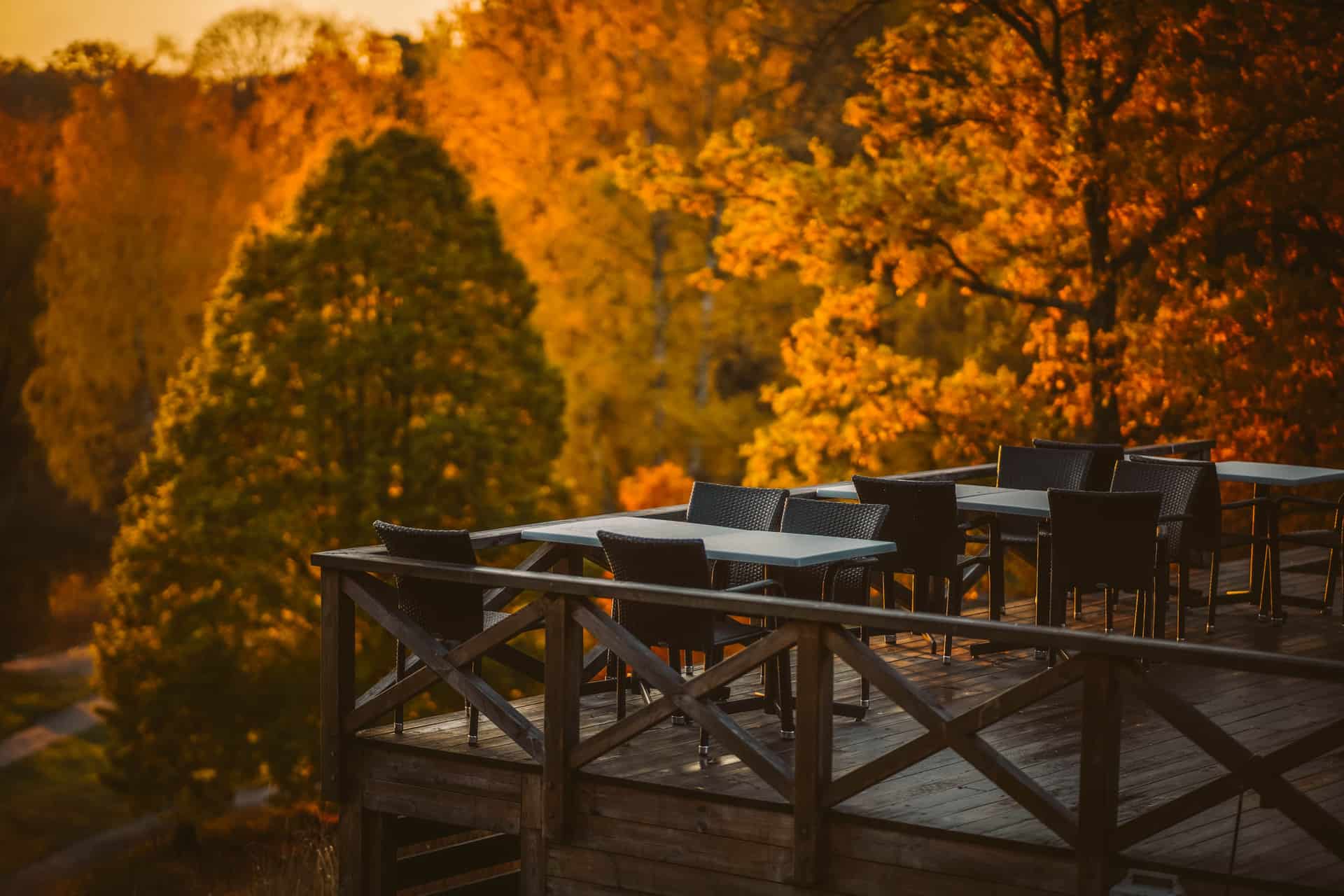
Use a raised fire pit on a stand, on a rated multi-layer heat barrier larger than the pit's footprint, with open sky above. The stand reduces transferred heat and the barrier catches what remains; neither alone is sufficient, and on composite decking the risk starts well below ignition.
The failure that actually happens
Ask about fire pits on decks and everyone thinks about fire. That is the dramatic outcome and the rare one. What happens far more often is that a pit sits in one spot for four hours and the boards underneath are permanently marked.
On timber that shows as drying, darkening and eventually scorching. On composite decking it is worse and it happens sooner, because composite boards contain plastic binders that soften at temperatures nowhere near what wood needs to ignite. A composite deck can be permanently deformed by an evening that never came close to being dangerous.
So the precaution is a thermal one. It is not primarily about preventing a fire; it is about the boards still being flat in the spring.
The three-part system
- A raised pit. A stand puts air between the fire and the deck, and air is a decent insulator. This reduces transferred heat substantially and it is why the stand is worth buying with the pit rather than later.
- A rated heat barrier, sized with margin. Multi-layer and thick, extending well past the footprint of the pit. Radiant heat spreads, and falling embers do not respect the outline of the bowl.
- Open sky above. Not part of the deck at all, and the condition that is most often overlooked. Embers rise, and nothing on the ground addresses a spark landing on an awning.
Quick picks
Ranked for fit, not for hype. Output is the maker’s published figure; reach is computed from it or from the maker’s own radius claim, and the table says which. Tap a row for the full write-up, or go straight to the listing.
| # | Product | Best for | Output | Reach | Price |
|---|---|---|---|---|---|
| 1 |  Solo Stove Bonfire 2.0The secondary-burn design does genuinely reduce smoke, and a wood fire puts out more heat than any patio heater here. It heats a circle of people, not a patio, and those are different products. | Heat you gather around | Not published | Not published | $349.99 · Check on Amazon |
| 2 | DocSafeNo photo DocSafe 40 in mat40 x 40 in and four layers, which is the size and build that matters under anything with a real fire in it. The published dimensions are the part you can actually check. | Larger pits and generous margins | n/a | n/a | Check price on Amazon |
| 3 |  Newtex FirePad 24 inThe thing standing between a fire pit and a scorched deck board. It is not optional on timber or composite, and it is the cheapest part of the whole setup. | A fire pit on a wood deck | n/a | n/a | $39.95 · Check on Amazon |
| 4 |  Outland Firebowl 89358,000 BTU is more rated input than any patio heater in this registry, in a 19 in bowl you can carry. The catch is that an open bowl throws most of that straight up. | The highest published output here | 58,000 BTU | 2,900 sq ft | $159.99 · Check on Amazon |
Reach marked “claimed” is the maker’s own published figure. Reach without that label is ours, computed from published output at 20 BTU per square foot for an open patio. Neither is a measurement we took.
Top pick · Heat you gather around
Solo Stove Bonfire 2.0 Smokeless Fire Pit with Stand, 19.5 in
The secondary-burn design does genuinely reduce smoke, and a wood fire puts out more heat than any patio heater here. It heats a circle of people, not a patio, and those are different products.
- Fuel
- Wood
- Output
- Not published
- Reach (computed)
- Not published
- Cost per hour
- n/a
What works
- A wood fire's output is not comparable to a patio heater's — this is the reason the heater versus fire pit question resolves the way it does
- The stand is not an accessory, it is the thing that makes it usable on a surface. Buy the version that includes it
- Removable ash pan turns cleanup from a chore into a step, which is the difference between using it weekly and using it twice
What does not
- Smokeless is a comparison, not an absolute. It smokes noticeably less than an open pit; it does not produce no smoke, especially while it comes up to temperature
- The heat is radiant and low — it warms a ring of people standing close, and does nothing for anyone six feet back
- Even with the stand, this needs a heat barrier on a wood deck. The stand reduces transferred heat, it does not eliminate it
| Published specification | |
|---|---|
| Diameter | 19.5 in |
| Height | 16.75 in |
| Weight | 21.75 lb |
| Material | 304 stainless steel, Gunmetal finish |
| Maker's capacity | Suits 4 to 6 people |
| Ash handling | Removable ash pan under the base plate |
| Maker’s coverage claim | None published — the reach figure above is ours |
| Safety listing | No safety listing applies; this is a wood-burning appliance, not a gas one |
Who it is for
A group that gathers around the fire rather than sitting in a spread-out seating arrangement, on a patio where wood smoke is not a neighbor problem.
What it is not for
Anywhere with a roof — this is an open wood fire and belongs under open sky. Also not for anyone who wants heat at the flick of a switch.
2 · Larger pits and generous margins
DocSafe 40 x 40 in Square Fire Pit Mat, 4-Layer
40 x 40 in and four layers, which is the size and build that matters under anything with a real fire in it. The published dimensions are the part you can actually check.
- Fuel
- Accessory
- Output
- Not published
- Reach (computed)
- Not published
- Cost per hour
- n/a
What works
- A square 40 in mat gives a genuine margin around a 19 in bowl like the Solo Stove, which is where falling embers land
- Four layers rather than a single sheet — a thin one-layer pad conducts heat straight into the board it is meant to protect
- Also works under a grill, which is the other thing that quietly ruins deck boards
What does not
- No thickness figure is published, and thickness is what separates a mat that protects from one that only looks like it does. Four layers is the only build claim you get
- Bulky to store compared with a thin round pad
- Square under a round pit looks exactly as you would expect, and some people mind
- Same limit as every mat: it handles heat, not bad placement
| Published specification | |
|---|---|
| Size | 40 x 40 in square |
| Build | Four layers per the listing |
| Thickness | Not published |
| Also rated for | Under a grill, fireplace and smoker per the listing |
| Maker’s coverage claim | None published — the reach figure above is ours |
| Safety listing | Not applicable — a heat barrier, not an appliance |
Who it is for
Anyone with a larger fire pit, or with a deck they care about more than they care about the mat looking tidy.
What it is not for
Small tabletop pits, where a smaller pad is proportionate and this is overkill.
Sources for this entry
3 · A fire pit on a wood deck
Newtex FirePad Deck Protector, 24 in
The thing standing between a fire pit and a scorched deck board. It is not optional on timber or composite, and it is the cheapest part of the whole setup.
- Fuel
- Accessory
- Output
- Not published
- Reach (computed)
- Not published
- Cost per hour
- n/a
What works
- Composite decking softens and deforms at temperatures well below ignition, so a barrier matters even where nothing is going to catch fire
- 24 in covers the footprint of most portable pits with a margin — the margin is where ember damage happens
- Rolls up, which is what makes it a thing you actually use rather than store
What does not
- A mat is a barrier, not a license. It does not make it safe to put a fire pit under a roof, near a wall, or on a surface the pit overhangs
- 24 in is too small for the larger bowls — match the mat to the pit, with room to spare
- Embers that clear the mat entirely are still an ember on a deck; a mat handles radiant heat, not sparks
| Published specification | |
|---|---|
| Diameter | 24 in |
| Intended use | Under fire pits, grills, smokers, chimineas |
| Stated surfaces | Porch, patio, deck, wood, grass, stone, composite |
| Maker’s coverage claim | None published — the reach figure above is ours |
| Safety listing | Not applicable — a heat barrier, not an appliance |
Who it is for
Anyone putting any fire pit on a wood or composite deck. See [deck-safe fire pits](/fire-pits/deck-safe) for the full set of conditions.
What it is not for
Making an unsafe placement safe. If the pit is too close to a wall or under an overhang, no mat fixes that.
Sources for this entry
4 · The highest published output here
Outland Firebowl 893 Deluxe Portable Propane Fire Pit, 19 in
58,000 BTU is more rated input than any patio heater in this registry, in a 19 in bowl you can carry. The catch is that an open bowl throws most of that straight up.
- Fuel
- Propane
- Output
- 58,000 BTU/h
- Reach (computed)
- 2,900 sq ft · 30.4 ft radius
- Cost per hour
- $1.70
What works
- 58,000 BTU with no wood, no smoke and no ash — it is on in ten seconds and off in one
- Propane means it is legal in most fire-ban conditions where wood is not, though check your own county before assuming
- Portable enough to take camping, which no other heat source here manages
What does not
- An open bowl is a chimney. The rated input is the highest here and the useful radiant fraction is among the lowest — do not read 58,000 BTU as 58,000 BTU of warmth on people
- At full output a 20 lb cylinder empties fast. The runtime table has the exact figure
- The hose runs across the ground to the cylinder, which is a trip hazard and a design compromise the fire tables avoid
| Published specification | |
|---|---|
| Rated input | 58,000 BTU/h |
| Diameter | 19 in |
| Fuel | 20 lb cylinder via the included hose and regulator |
| Included | Cover and carry kit on the Deluxe |
| Fill | Lava rock included |
| Maker’s coverage claim | None published — the reach figure above is ours |
| Safety listing | CSA certified per the maker's published product data |
Who it is for
Somewhere that needs instant, smokeless flame on demand, including places where a wood fire is not permitted.
What it is not for
Efficient heating, decks without a [heat barrier](/fire-pits/deck-safe), and anywhere with anything overhead.
Sources for this entry
What we would skip
A list with no losers is a list nobody edited. These are the choices we would actively steer you away from, and why.
A fire pit on a deck with no barrier
This is the whole page. Even a raised, stand-mounted pit transfers substantial radiant heat downward over an evening. On timber that is scorching; on composite it is permanent deformation, and it starts a long way below ignition. The mat is the cheapest part of the setup.
A thin decorative pad instead of an insulating mat
A single-layer mat looks like protection and provides very little. Thickness and layer count are what does the work. On a deck you actually care about, buy the multi-layer version.
A wood fire pit on a deck under any overhang
Embers rise. A mat handles heat traveling downward and does nothing about a spark landing on a soffit, an awning or a neighbor's fence. Open sky above, or do not light it.
The barrier itself has its own page now. Fire pit deck protectors compares mats on published thickness and construction, works through how to size one against your pit, and covers the air-gap requirement most listings leave in the fine print.
Wood or propane on a deck?
Propane, if the deck is the deciding factor, and the reason is embers rather than heat.
A heat barrier handles radiant heat traveling downward, which both fuels produce. It does nothing about a spark that leaves the bowl and lands three feet away on a deck board, which only wood produces. On a timber deck with gaps between the boards — and every deck has gaps — a spark that falls through is somewhere you cannot see it.
A propane bowl removes that risk completely. It also lights in seconds, produces no ash to clean off decking, and is frequently permitted during fire restrictions when a wood pit is not. If the goal is a fire on a deck rather than a wood fire specifically, gas is the more sensible product.
For one propane pit examined in full against this system, our Outland Firebowl 893 review goes through what its 10-foot hose means for a deck, why no embers is not the same as no downward heat, and what the maker's own specification does and does not say.
Placement on a deck
- Over a joist, not mid-span. Deck boards flex, and a loaded pit on a bouncing board is less stable than one over structure.
- Away from the railing. A railing is a combustible vertical surface at exactly the height radiant heat reaches.
- Nothing overhead. No awning, no soffit, no branch, no umbrella. The umbrella is the one people forget.
- Clear the boards first. Leaves and debris in the gaps between deck boards are the tinder that catches a spark, and they accumulate exactly where you cannot easily see them.
- Have water to hand. Not a dramatic precaution, just a sensible one, and it matters more on a deck than on a slab.
How we picked
- Assessed as a system, not as products. A pit, a stand and a barrier together are what makes a deck installation acceptable; no single item does it alone.
- Barrier size checked against pit footprint, with a margin, because radiant spill and falling embers do not stop at the outline of the bowl.
- Composite decking treated as the harder case, since plastic binders soften well below wood's ignition temperature.
- Propane included alongside wood, because a gas pit removes the ember risk entirely, which is the part a mat cannot address.
What we did not do
Everyone in this category says they tested twenty heaters. We have not tested any, and we say so. What we do instead: compile the published specs, compute the electrical and gas load from them, cite the maker’s own manual, and show the arithmetic so you can check it. The full method, including how to challenge a figure.
The general deck considerations for heaters as well as fire features are on the wood deck page, and if what you actually want is a warm seating area rather than a fire, a heater is the better product.
Common questions
Can you put a fire pit on a wood deck?
Yes, with a raised pit on a rated multi-layer heat barrier and nothing overhead. The stand reduces heat transfer and the mat catches what remains; neither on its own is sufficient for an evening's use.
What is the best fire pit for a composite deck?
A raised propane bowl on a thick insulating mat. Composite decking softens and marks at temperatures well below ignition, so the thermal barrier matters more than on timber, and propane removes the ember risk that a mat cannot address.
Does a fire pit mat really work?
A thick multi-layer one does. A thin single-layer pad provides very little insulation and mostly looks like protection. Size it with a genuine margin around the pit, because radiant heat and falling embers spread beyond the footprint.
Is a fire pit stand enough on a deck?
No. A stand reduces transferred heat and does not eliminate it, and it does nothing about embers. Use a stand and a barrier together — that combination is what makes a deck installation reasonable.
Read next
Patio heaters on a wood deck
Heat barriers, base stability, and the composite decking problem that starts before ignition.
The best fire pits for heat
Fire pits ranked on delivered warmth rather than rated output, with runtime and cost computed.
Patio heater vs fire pit
Output, direction, cost, wind and permitted use compared, with exits to both catalogs.
Patio heater safety, with the published numbers
Published clearance figures, the ventilation rule, and where each heater type must never go.
Solo Stove Bonfire 2.0 review
How the secondary burn works, what smokeless really means, what wood costs, and when a propane pit is the better buy.
Outland Firebowl 893 review
What 58,000 BTU really delivers from an open bowl, the cost per hour, using it on a deck, and the fire-ban claim in context.
Fire pit deck protectors
Mats judged on published thickness and stated limits, plus how to size one and why leg height matters more than the rating.