Head to head
Propane vs wood fire pit
One is a fire you tend and the other is a fire you switch on. Almost every difference that matters follows from that single distinction.
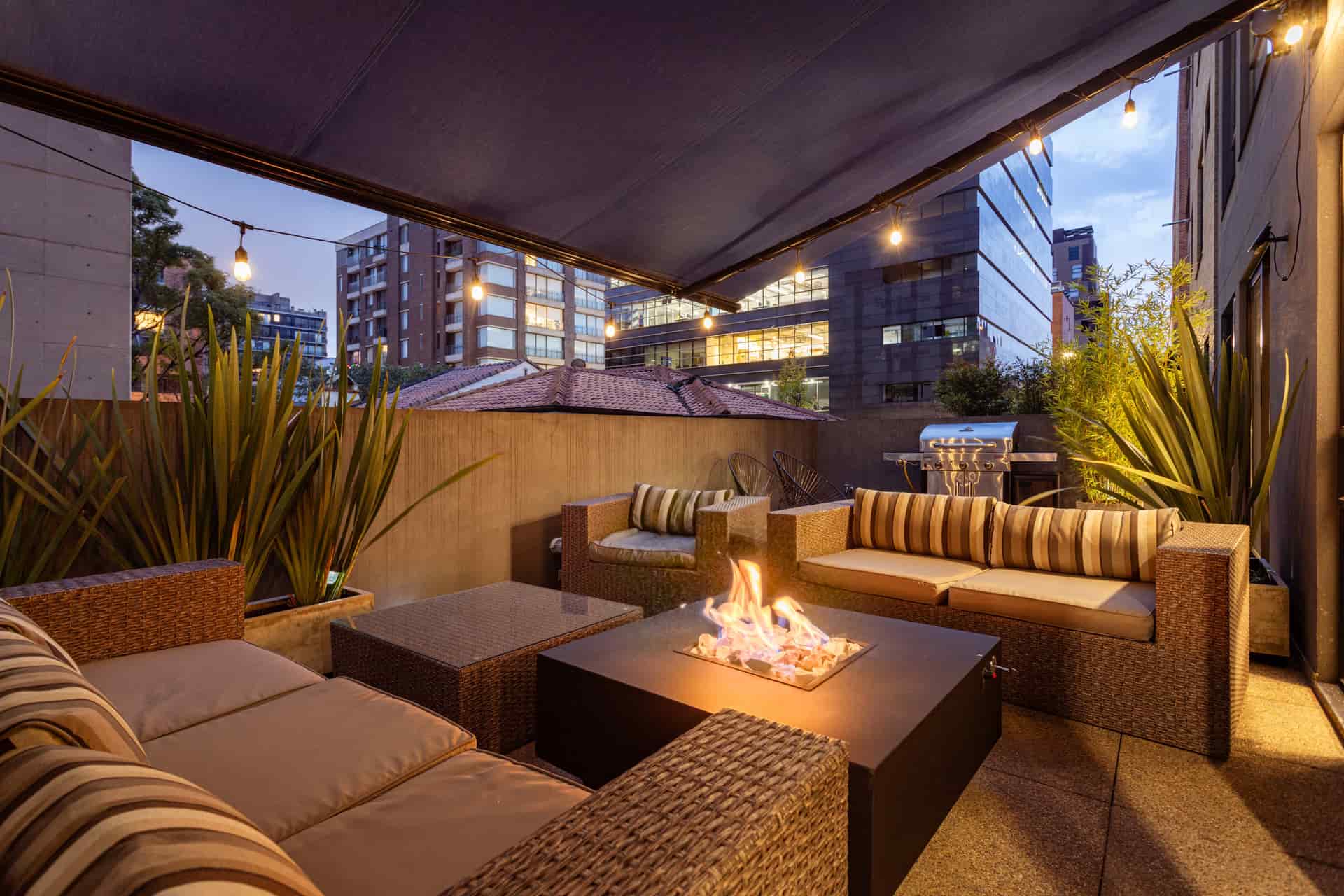
Wood gives more heat and more atmosphere for less money per evening; propane gives instant, controllable, smokeless fire with no ash. The deciding question is not cost or heat — it is whether tending a fire is the point of your evening or an obstacle to it.
The distinction everything follows from
A wood fire pit is an activity. You lay it, light it, feed it, and it changes over the course of an evening. That is either the appeal or the chore, and people are surprisingly consistent about which.
A propane fire pit is an appliance. You turn a knob and there is fire, at the level you chose, until you turn it off. Nothing to fetch, nothing to tend, nothing to clear up.
Almost every practical difference below is downstream of that. It is also why the two rarely feel like alternatives to the people who own them.
Heat
Wood wins, and by more than the specifications suggest. A well-built wood fire in a decent pit produces a large and rising amount of radiant heat, and unlike a gas burner it is not limited by a rated output — it is limited by how much wood you put in.
Propane fire pits publish their output, typically in the 35,000 to 58,000 BTU range, and that number is a ceiling rather than a target. It is real heat, but it is heat aimed at atmosphere: a gas flame in a bowl of lava rock is designed to look like a fire, and a significant share of its output goes straight up.
Neither is a substitute for a patio heater if what you want is an evenly warm seating area, because both heat one side of you at a time.
Running cost
Propane is the one we can compute exactly, because the burn rate is published and the fuel has a national price.
Propane, per evening
A 58,000 BTU/h fire pit burns 58,000 ÷ 91,420 = 0.63 gallons an hour. At the US average residential propane price of $2.674 that is about $1.70 an hour, or roughly $5 for a three-hour evening — and it empties a 20 lb cylinder in about seven and a half hours.
Wood we will not pretend to price nationally. Firewood pricing is intensely local — a bundle at a gas station and a cord delivered in fall differ by an order of magnitude per unit of heat — and there is no credible national series to quote. What is safe to say is that bought by the cord or scrounged, wood is normally cheaper per evening than propane, and bought as supermarket bundles it is normally not.
The honest version: if you buy wood in bulk, wood is cheaper. If you buy it in bundles at a convenience store, propane probably wins. Check your own local price per unit and compare it against the $5-an-evening figure above.
The comparison table
| Wood | Propane | |
|---|---|---|
| Heat | Higher, and unlimited by rating | 35,000 to 58,000 BTU/h, capped |
| Cost per evening | Local; cheap by the cord, dear by the bundle | About $5 for three hours |
| Lighting | Kindling, patience | A knob |
| Control | Add wood or wait | Immediate, variable |
| Smoke | Yes, unless smokeless design | None |
| Smell | Woodsmoke, which people either love or launder | None |
| Cleanup | Ash, every time | None |
| Fuel storage | A dry stack, meaningful space | A cylinder |
| Burn bans | Frequently affected | Frequently exempt |
| Deck safety | Embers are the risk | No embers |
Propane figures computed from published burn rates at $2.674 a gallon. Wood figures are qualitative because firewood has no national price series and heat output depends on how you build the fire.
Quick picks
Ranked for fit, not for hype. Output is the maker’s published figure; reach is computed from it or from the maker’s own radius claim, and the table says which. Tap a row for the full write-up, or go straight to the listing.
| # | Product | Best for | Output | Reach | Price |
|---|---|---|---|---|---|
| 1 |  Solo Stove Bonfire 2.0The secondary-burn design does genuinely reduce smoke, and a wood fire puts out more heat than any patio heater here. It heats a circle of people, not a patio, and those are different products. | Heat you gather around | Not published | Not published | $349.99 · Check on Amazon |
| 2 |  Outland Firebowl 89358,000 BTU is more rated input than any patio heater in this registry, in a 19 in bowl you can carry. The catch is that an open bowl throws most of that straight up. | The highest published output here | 58,000 BTU | 2,900 sq ft | $159.99 · Check on Amazon |
Reach marked “claimed” is the maker’s own published figure. Reach without that label is ours, computed from published output at 20 BTU per square foot for an open patio. Neither is a measurement we took.
Top pick · Heat you gather around
Solo Stove Bonfire 2.0 Smokeless Fire Pit with Stand, 19.5 in
The secondary-burn design does genuinely reduce smoke, and a wood fire puts out more heat than any patio heater here. It heats a circle of people, not a patio, and those are different products.
- Fuel
- Wood
- Output
- Not published
- Reach (computed)
- Not published
- Cost per hour
- n/a
What works
- A wood fire's output is not comparable to a patio heater's — this is the reason the heater versus fire pit question resolves the way it does
- The stand is not an accessory, it is the thing that makes it usable on a surface. Buy the version that includes it
- Removable ash pan turns cleanup from a chore into a step, which is the difference between using it weekly and using it twice
What does not
- Smokeless is a comparison, not an absolute. It smokes noticeably less than an open pit; it does not produce no smoke, especially while it comes up to temperature
- The heat is radiant and low — it warms a ring of people standing close, and does nothing for anyone six feet back
- Even with the stand, this needs a heat barrier on a wood deck. The stand reduces transferred heat, it does not eliminate it
| Published specification | |
|---|---|
| Diameter | 19.5 in |
| Height | 16.75 in |
| Weight | 21.75 lb |
| Material | 304 stainless steel, Gunmetal finish |
| Maker's capacity | Suits 4 to 6 people |
| Ash handling | Removable ash pan under the base plate |
| Maker’s coverage claim | None published — the reach figure above is ours |
| Safety listing | No safety listing applies; this is a wood-burning appliance, not a gas one |
Who it is for
A group that gathers around the fire rather than sitting in a spread-out seating arrangement, on a patio where wood smoke is not a neighbor problem.
What it is not for
Anywhere with a roof — this is an open wood fire and belongs under open sky. Also not for anyone who wants heat at the flick of a switch.
2 · The highest published output here
Outland Firebowl 893 Deluxe Portable Propane Fire Pit, 19 in
58,000 BTU is more rated input than any patio heater in this registry, in a 19 in bowl you can carry. The catch is that an open bowl throws most of that straight up.
- Fuel
- Propane
- Output
- 58,000 BTU/h
- Reach (computed)
- 2,900 sq ft · 30.4 ft radius
- Cost per hour
- $1.70
What works
- 58,000 BTU with no wood, no smoke and no ash — it is on in ten seconds and off in one
- Propane means it is legal in most fire-ban conditions where wood is not, though check your own county before assuming
- Portable enough to take camping, which no other heat source here manages
What does not
- An open bowl is a chimney. The rated input is the highest here and the useful radiant fraction is among the lowest — do not read 58,000 BTU as 58,000 BTU of warmth on people
- At full output a 20 lb cylinder empties fast. The runtime table has the exact figure
- The hose runs across the ground to the cylinder, which is a trip hazard and a design compromise the fire tables avoid
| Published specification | |
|---|---|
| Rated input | 58,000 BTU/h |
| Diameter | 19 in |
| Fuel | 20 lb cylinder via the included hose and regulator |
| Included | Cover and carry kit on the Deluxe |
| Fill | Lava rock included |
| Maker’s coverage claim | None published — the reach figure above is ours |
| Safety listing | CSA certified per the maker's published product data |
Who it is for
Somewhere that needs instant, smokeless flame on demand, including places where a wood fire is not permitted.
What it is not for
Efficient heating, decks without a [heat barrier](/fire-pits/deck-safe), and anywhere with anything overhead.
Sources for this entry
The three things that usually decide it
- Smoke. The single most common regret with wood, and the reason smokeless designs exist. If your seating is close, your yard is small, or your neighbors are close, smoke is not a minor consideration.
- Burn restrictions. Many areas restrict open wood burning seasonally or during dry spells, and propane is commonly exempt because there are no embers. If your area has burn bans, a wood pit is a fire you are sometimes not allowed to have.
- Where it sits. On a wooden deck, embers are the whole risk, and it is why deck-safe is a category at all. Propane removes the ember problem entirely, though not the radiant-heat-downward problem — a barrier is still the answer.
Smokeless designs change the wood argument
The strongest case against wood is smoke, and it is the one part of this comparison that has genuinely moved. Double-wall secondary-combustion designs pull air through the wall of the pit and reburn the smoke above the fire, which reduces smoke substantially compared with an open bowl.
Two honest caveats. Smokeless is a design goal, not a description of the result — these pits produce noticeably less smoke, not none, and they smoke like anything else while lighting and when fed damp wood. And they do not touch the other wood objections: there is still ash, still fuel to store, and still a burn ban that applies to them.
But if smoke was the only thing pushing you toward gas, it is worth reading how the smokeless designs actually work before deciding, because that argument is weaker than it was five years ago.
Storing the fuel
An underrated practical difference. A cylinder is one object that lives outside, upright, and takes up about a square foot. Firewood is a stack that needs to stay dry, needs air around it, and takes real space — and wet wood is the single most common reason a fire pit evening goes badly, because it will not light cleanly and it smokes heavily when it does.
If you do not have somewhere dry and ventilated to keep a stack, the wood option is worse in practice than it looks on paper, whatever the fuel arithmetic says.
If you want each side read closely rather than compared in outline, there is a full review of each: the Outland Firebowl 893 on the propane side, and the Solo Stove Bonfire 2.0 on the wood side.
Where each one is clearly right
Wood if the fire is the event — you have somewhere to store a stack, no burn restrictions to work around, space between you and the neighbors, and you enjoy building it. It is more heat, more atmosphere, and usually less money.
Propane if the fire is the backdrop — a small yard, a deck, a burn-ban area, or an evening where you want to sit down and have fire immediately without a fifteen-minute preamble and an ash pan in the morning.
And if what you actually want is a warm patio rather than a fire to look at, neither is the right purchase — that is a heater, and the two products answer genuinely different questions.
Common questions
Do wood or propane fire pits put out more heat?
Wood, and by a clear margin. A wood fire is limited by how much you put in rather than by a rated output, while propane pits are capped at their published figure — typically 35,000 to 58,000 BTU/h — much of which goes straight up.
Is a propane fire pit cheaper to run than wood?
It depends entirely on how you buy wood. A 58,000 BTU propane pit costs about $1.70 an hour, roughly $5 for an evening. Wood bought by the cord usually beats that; wood bought as convenience-store bundles usually does not.
How long does a propane tank last on a fire pit?
About seven and a half hours on a 58,000 BTU pit at full output — a 20 lb cylinder holds roughly 430,000 BTU. Turned down, proportionally longer.
Are propane fire pits allowed during burn bans?
Frequently yes, because there are no embers, while open wood burning is commonly restricted. Rules are local and vary, so check yours — but it is a real practical advantage of gas in dry-season areas.
Do smokeless fire pits really not smoke?
They smoke noticeably less, not none. Double-wall secondary combustion reburns much of the smoke above the fire, but they still smoke while lighting and they smoke heavily on damp wood. Treat smokeless as a real improvement rather than a description of the result.
Is storing firewood a problem?
It is the practical difference people underestimate. Wood needs a dry, ventilated stack with real space, and wet wood is the most common reason a fire pit evening goes badly — it will not light cleanly and it smokes heavily when it does. A propane cylinder is one object that lives outside.
Which is better on a wooden deck?
Propane, because it removes the ember risk that makes wood dangerous on timber. It does not remove downward radiant heat, so a heat barrier is still the right precaution either way.
Sources
Read next
The best fire pits for heat
Fire pits ranked on delivered warmth rather than rated output, with runtime and cost computed.
Smokeless fire pits, honestly described
How secondary burn works, what it does not do, and what really determines smoke.
Deck-safe fire pits
The stand-plus-barrier combination that protects decking, and the pits that suit it.
Patio heater vs fire pit
Output, direction, cost, wind and permitted use compared, with exits to both catalogs.
How long a propane cylinder actually lasts
The cylinder arithmetic in full: energy content, burn rate, and every size from 15 to 40 lb.
Outland Firebowl 893 review
What 58,000 BTU really delivers from an open bowl, the cost per hour, using it on a deck, and the fire-ban claim in context.