Infrared
Infrared patio heaters, and why wind does not touch them
Radiant heat passes through air and warms what it lands on. That single property is why infrared is the answer under a roof, in a breeze, and on a screened porch.
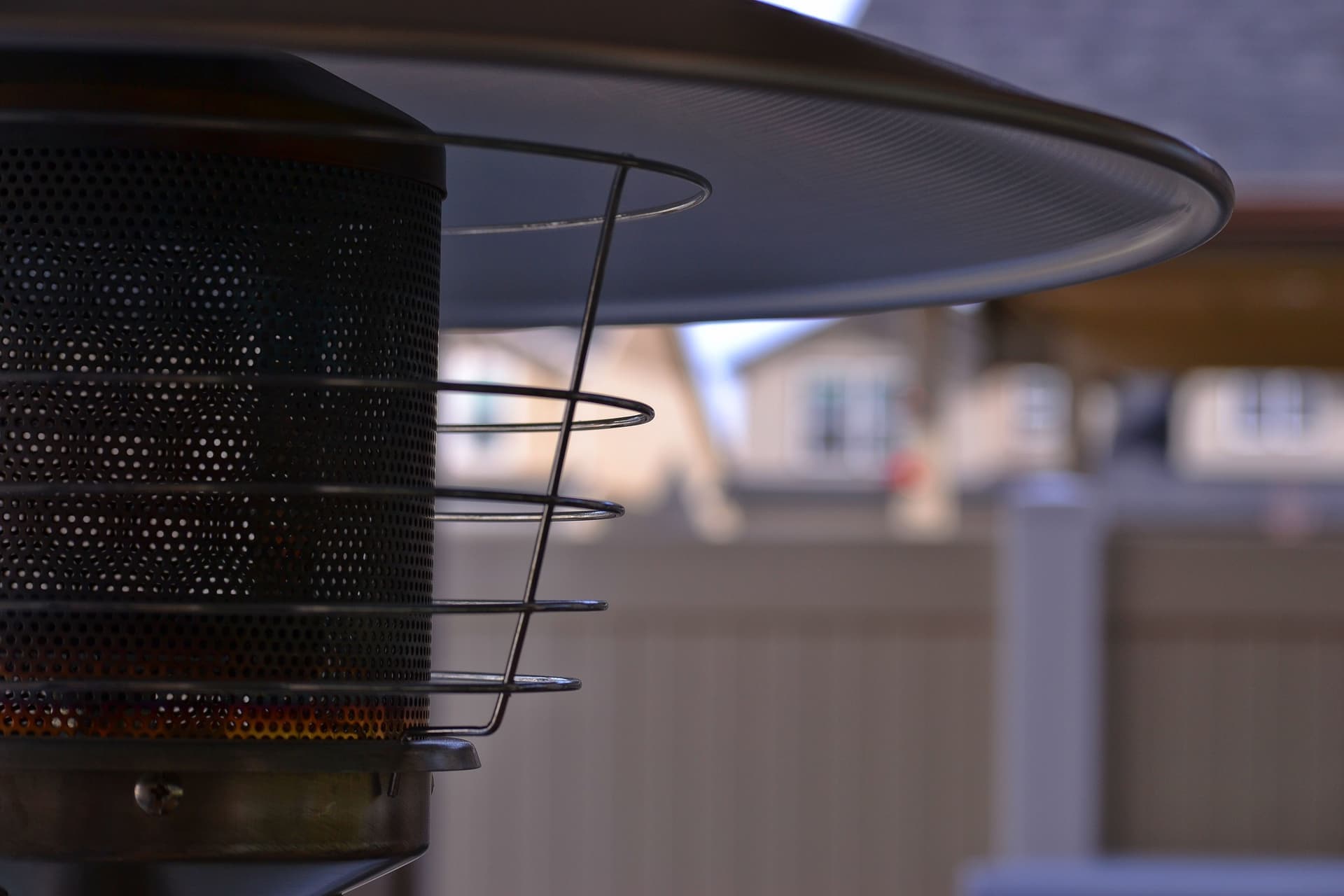
Infrared heaters emit radiation that passes through air and warms objects directly, so wind cannot carry the heat away and there is no flame to blow out. At 1,500 W they produce about 5,118 BTU/h — a tenth of a propane tower — and deliver far more of it onto the people in the beam.
The physical difference, in one paragraph
A propane heater warms the air near it, and that warm air rises and drifts. Some radiant heat comes off the reflector too, but a large share of the output goes into air that then leaves. An infrared heater does almost none of that: it emits in the infrared band, that radiation crosses the gap essentially unaffected by moving air, and it deposits its energy in the first solid thing it meets.
This is why the comparison of rated outputs is so misleading. A 1,500 W infrared unit puts out 5,118 BTU/h against a tower's 48,000 — but the tower is spending most of its output on air, and on a breezy evening that air is gone. Sitting in the beam of the small unit can be warmer than standing on a windy patio next to the big one.
What that means for where you put it
- Height and aim decide everything. Mounted at seven to nine feet, angled down at the seating, an infrared heater covers the chairs. On the floor pointing sideways, it warms one shin.
- Coverage is a cone, not a circle. Unlike a tower's roughly symmetrical field, an infrared unit covers what it points at, which is often better matched to a real seating arrangement.
- A roof helps twice. It gives you something to mount to, and it keeps the small amount of convected warmth from leaving. This is why pergolas are the single best case for infrared on this site.
- Screens make it mandatory rather than optional. Anywhere combustion is inappropriate, infrared is the only option, which is the whole of the screened porch page.
Quick picks
Ranked for fit, not for hype. Output is the maker’s published figure; reach is computed from it or from the maker’s own radius claim, and the table says which. Tap a row for the full write-up, or go straight to the listing.
| # | Product | Best for | Output | Reach | Price |
|---|---|---|---|---|---|
| 1 |  Dr Infrared 1500 WRadiant heat that a breeze cannot blow out, on a plug. 1,500 W is only 5,118 BTU/h, which sounds like nothing next to a propane tower and lands far more of itself on you. | Wind, and anywhere with a roof | 1,500 W | 256 sq ft | $148.98 · Check on Amazon |
| 2 | 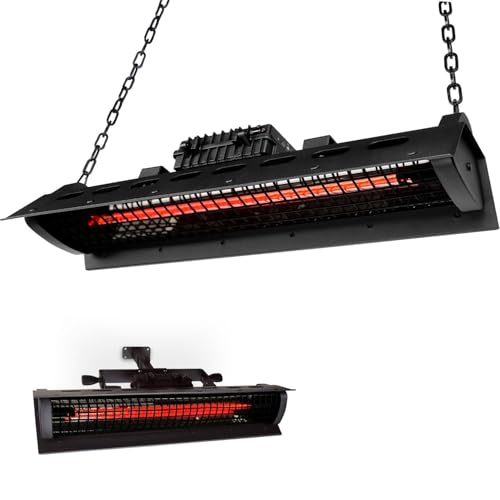 Star Patio STP2020-AOne of the very few electric units whose maker publishes a coverage area at all — 110 sq ft — and it mounts to a wall or hangs from a ceiling on chains. No ingress rating is published, so keep it somewhere sheltered. | A published coverage figure | 1,500 W | 110 sq ft claimed | $199.99 · Check on Amazon |
| 3 |  Heat Storm TradesmanThe one electric unit here with a published IP rating, which is the difference between a heater that survives a wet winter mounted outdoors and one that is a warranty claim waiting to happen. | Leaving outside all year | 1,500 W | 256 sq ft | $99.99 · Check on Amazon-8% |
| 4 | 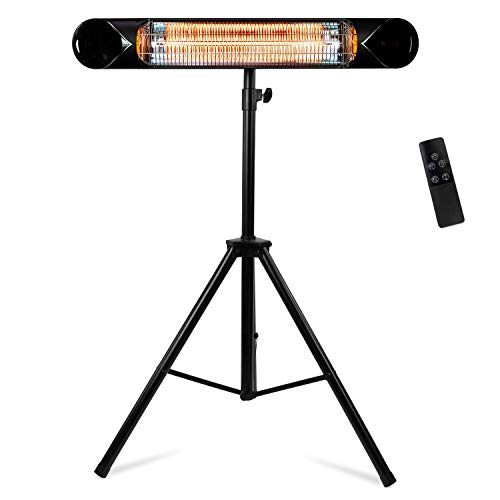 Briza 1500 WThe same 1,500 W infrared element as everything else, sold with a tripod as well as the brackets. That flexibility is the entire argument for it, and it is a decent one. | Not committing to a mounting point | 1,500 W | 256 sq ft | $199.90 · Check on Amazon |
Reach marked “claimed” is the maker’s own published figure. Reach without that label is ours, computed from published output at 20 BTU per square foot for an open patio. Neither is a measurement we took.
Top pick · Wind, and anywhere with a roof
Dr Infrared Heater DR-238 Carbon Infrared Patio Heater with Kasa Outdoor Smart Plug
Radiant heat that a breeze cannot blow out, on a plug. 1,500 W is only 5,118 BTU/h, which sounds like nothing next to a propane tower and lands far more of itself on you.
- Fuel
- Electric
- Output
- 1,500 W = 5,118 BTU/h
- Reach (computed)
- 256 sq ft · 9.0 ft radius
- Cost per hour
- $0.28
What works
- Infrared warms objects, not air, so it is the only heat that survives a breeze — this is the single reason wind changes the whole buying decision
- No combustion means no flue gas, which is what makes it legal and sensible on a screened porch where propane is not
- Three settings matter more than they sound: 900 W costs a third less to run and is enough most evenings
What does not
- 1,500 W is 1,500 W. Nothing at this wattage heats faster than anything else at this wattage; the differences between electric heaters are beam shape and build, not power
- It heats what it points at. Step out of the beam and you are cold immediately — this is a fundamentally different experience from a tower
- A 120 V plug-in unit is capped by your circuit, not by the maker. See why 1,500 W is the ceiling
| Published specification | |
|---|---|
| Rated power | 1,500 W at 120 V |
| Settings | 900 W / 1,200 W / 1,500 W |
| Element | Carbon infrared lamp |
| Reflector | Mirror aluminum, 90% reflectivity per the maker |
| Housing | Anodized aluminum, rated for outdoor use |
| Mounting | Wall and ceiling brackets plus remote in the box |
| Bundle | Currently sold with a Kasa EP40 outdoor smart plug |
| Maker’s coverage claim | None published — the reach figure above is ours |
| Safety listing | ETL listed, per the maker's published product data |
Who it is for
A covered patio, pergola or screened porch where you can mount it overhead and point it at where people sit, and anywhere wind ruins a flame.
What it is not for
A big open patio with nowhere to mount it. Radiant heat needs a line of sight and a place to hang from.
2 · A published coverage figure
Star Patio STP2020-A-RMN2025 Wall and Ceiling Electric Infrared Patio Heater
One of the very few electric units whose maker publishes a coverage area at all — 110 sq ft — and it mounts to a wall or hangs from a ceiling on chains. No ingress rating is published, so keep it somewhere sheltered.
- Fuel
- Electric
- Output
- 1,500 W = 5,118 BTU/h
- Reach (claimed)
- 110 sq ft · 5.9 ft radius
- Cost per hour
- $0.28
What works
- It publishes a coverage figure. 110 sq ft is a real, checkable claim, and almost nobody in this category states one at all — which is the whole subject of our coverage page
- Wall bracket and ceiling chains both in the box, with 60 degrees of tilt, so the beam can actually be aimed at the chairs rather than at whatever the bracket decided
- 5,100 BTU/h published output is within a rounding error of the 5,118 our watts-to-BTU conversion gives, which is a maker doing its own arithmetic honestly
- Remote control on a unit mounted above head height is functional rather than a luxury
What does not
- No ingress rating is published for this model. Other units in this roundup publish one, and on a permanently mounted outdoor appliance that silence means you cannot price the weather risk. Treat it as a sheltered-position heater
- 110 sq ft is a small area — roughly a 10 by 11 ft patch, which is a seating group and not a patio
- 1,500 W, like everything else that plugs into a standard socket. The ceiling applies here as everywhere
- A 6 ft cord means the outlet has to be close, or an outdoor-rated extension has to be part of the plan
| Published specification | |
|---|---|
| Rated power | 1,500 W at 110 V, 60 Hz |
| Published output | 5,100 BTU/h per the maker |
| Published coverage | Up to 110 sq ft per the maker |
| Element | Golden tube |
| Mounting | Wall bracket or ceiling chains, up to 60 degrees of tilt |
| Size and weight | 27.5 x 7 x 5.7 in, 7.7 lb |
| Element life | 5,000 hours per the maker |
| Maker’s coverage claim | 110 sq ft |
| Safety listing | No ingress rating published for this model |
Who it is for
A sheltered wall or porch ceiling over a seating group, where you want a heater whose maker will tell you what area it actually covers.
What it is not for
An exposed wall where driving rain reaches it, since nothing is published about ingress protection, or any space much larger than a seating group.
3 · Leaving outside all year
Heat Storm Tradesman HS-1500-OTR-R 1500 W Weatherproof Infrared Heater
The one electric unit here with a published IP rating, which is the difference between a heater that survives a wet winter mounted outdoors and one that is a warranty claim waiting to happen.
- Fuel
- Electric
- Output
- 1,500 W = 5,118 BTU/h
- Reach (computed)
- 256 sq ft · 9.0 ft radius
- Cost per hour
- $0.28
What works
- A published IPX4 rating. Almost nobody in this category publishes an ingress rating at all, and mounting an unrated electric heater outdoors is a gamble you cannot price
- The maker publishes its own BTU figure (5,200), which is within a rounding error of the 5,118 our watts-to-BTU conversion gives — a company doing its own arithmetic honestly
- Wall or ceiling mount puts the heat above head height where a radiant beam belongs
What does not
- IPX4 rates water only — the solids digit is X, meaning none is published. It is splashing-water protection, not immersion, and it tells you nothing about dust ingress
- Fixed mounting means fixed aim. Get the position wrong and there is no adjusting it from the chair
- Same 1,500 W ceiling as every other plug-in electric heater
| Published specification | |
|---|---|
| Rated power | 1,500 W at 120 V |
| Published output | 5,200 BTU/h per the maker |
| Element | Carbon fiber infrared, per the maker |
| Weather rating | IPX4 |
| Dimensions | 27 x 8 x 6 in |
| Control | Remote included |
| Mounting | Wall or ceiling; tripod and tri-mount combos are separate SKUs |
| Maker’s coverage claim | None published — the reach figure above is ours |
| Safety listing | IPX4 weatherproof rating published by the maker |
Who it is for
A permanently mounted heater on a pergola, porch ceiling or exterior wall that you never want to take down and store.
What it is not for
Portability, and any open patio with no structure to mount to.
4 · Not committing to a mounting point
Briza Infrared Electric Patio Heater, 1500 W, with Stand
The same 1,500 W infrared element as everything else, sold with a tripod as well as the brackets. That flexibility is the entire argument for it, and it is a decent one.
- Fuel
- Electric
- Output
- 1,500 W = 5,118 BTU/h
- Reach (computed)
- 256 sq ft · 9.0 ft radius
- Cost per hour
- $0.28
What works
- The tripod means you can find the right position over a season before drilling anything, then mount it properly
- A 1-to-9-hour timer on the remote is the feature that stops a mounted heater running all night by accident
- Three power settings, same as the Dr Infrared unit, and the 900 W setting is the one you will actually use
What does not
- No published IP rating and no named safety listing. For a unit sold to live outdoors that is a real omission, and we would rather tell you than skip past it
- A tripod-mounted heater is a tip-over object around children and dogs in a way a wall-mounted one is not
- No published coverage figure, so the reach column is ours
| Published specification | |
|---|---|
| Rated power | 1,500 W at 120 V |
| Settings | 900 W / 1,200 W / 1,500 W |
| Timer | 1 to 9 hours, on the remote |
| Mounting | Wall and ceiling hardware plus an adjustable tripod stand |
| Maker’s coverage claim | None published — the reach figure above is ours |
| Safety listing | The listing does not publish a safety listing body or an IP rating |
Who it is for
Someone who wants electric radiant heat but does not yet know where it should live permanently.
What it is not for
A fully exposed position in wet weather — without a published ingress rating we cannot tell you it will survive one.
Sources for this entry
What we would skip
A list with no losers is a list nobody edited. These are the choices we would actively steer you away from, and why.
Infrared for a large open patio with nowhere to mount
Radiant heat needs line of sight and height. On an open patio with no structure, an infrared unit on a stand warms one chair and nothing else. That is the case a propane tower exists for, and it is not close.
Halogen-style heaters for their glow
Short-wave halogen elements produce a very bright orange glare along with the heat. Carbon and quartz elements at the same wattage deliver the same energy with far less visual intrusion. The output is identical; the evening is not.
Before that, if you want a single unit read closely rather than a category surveyed, the DR-238 review covers the 1,500 W carbon heater this site recommends most often, and is explicit about where it should not go.
One more route to radiant heat is worth knowing about if there is no outlet at all: the Mr. Heater MH15T review covers a radiant propane burner that screws onto a cylinder and needs no power.
Where Amazon does not stock what you may be looking for
There is an honest gap in this page worth naming. The premium fixed-install infrared brands — Infratech, Bromic, Heatstrip — come up constantly in searches about outdoor infrared, and Amazon carries them inconsistently or not at all. They are 240-volt hardwired products sold mainly through specialist dealers and installed by electricians.
We have not put them on this list, because a pick whose buy button cannot honestly exist is not a pick. If you are building a permanent installation and have an electrician involved, those brands are worth asking about, and the right place to ask is a dealer rather than us. Everything on this page is a 120-volt unit you can plug in.
How we picked
- Radiant element type recorded where the maker publishes it — carbon lamp or quartz. Both work; they differ in glow color and warm-up time rather than in output.
- Mounting hardware in the box counted. An infrared heater has to be above head height and aimed. A unit that arrives without brackets is a trip to the hardware store.
- IP rating quoted where published and its absence stated where not.
- Output converted honestly. 1,500 W is 5,118 BTU/h at 3,412 BTU per kWh. We publish the conversion rather than leaving the two units looking incomparable.
What we did not do
Everyone in this category says they tested twenty heaters. We have not tested any, and we say so. What we do instead: compile the published specs, compute the electrical and gas load from them, cite the maker’s own manual, and show the arithmetic so you can check it. The full method, including how to challenge a figure.
Common questions
Do infrared heaters work outside?
Yes, and they are the class that works best in moving air. Infrared radiation warms objects directly rather than heating air, so a breeze that would strip the warmth from a convection heater has almost no effect. The limitation is line of sight — you feel it where the beam reaches.
What is the difference between infrared and radiant heat?
Nothing, in practice. Infrared is the band of the spectrum that radiant heaters emit in, so the two words describe the same thing. Where the terms genuinely differ is against convection heating, which warms air instead and is what a fan heater does.
Is an infrared patio heater better than propane?
For a covered, sheltered or screened space, yes. For a large open patio with nowhere to mount, no — infrared cannot make up a tenfold output gap when there is nothing to aim from. The head-to-head is here.
How many BTU is a 1,500 W infrared heater?
5,118 BTU/h. The conversion is 3,412 BTU per kWh, so 1.5 kW gives 1.5 x 3,412. Heat Storm publishes 5,200 for its 1,500 W unit, which is the same figure rounded.
Sources
Read next
Infrared vs propane patio heaters
Radiant versus convective heat outdoors, and why the ten-to-one output gap is not the whole story.
Propane infrared heaters
True radiant propane heaters: wind-proof like infrared, cordless like propane, and honest about looking industrial.
Heating a pergola
Why a pergola is ideal for mounted infrared, plus mounting height, clearance and picks.
Wind-resistant patio heaters
The heaters that keep working in a breeze, and the physics that makes the list mostly electric.
Electric patio heaters, and the ceiling nobody mentions
Four electric patio heaters compared on wattage, published IP rating and cost per hour.
Watts, BTU, and the 1,500 watt ceiling
The watts-to-BTU conversion, and why a household circuit caps every plug-in heater at 1,500 W.
Dr Infrared DR-238 review
What 1,500 W of carbon infrared really buys, the IP rating its maker does not publish, and when to step up to 240 V.
Mr. Heater MH15T review
Radiant propane with no outlet for under fifty dollars, the runtime arithmetic, and why it radiates at your shins.