Head to head
Pellet patio heater vs propane
One burns a bag of pellets you buy at the hardware store, the other a cylinder you swap. The fuel arithmetic favors pellets more clearly than most buyers expect — and the headline output figure favors nobody.
Pellets are cheaper per unit of heat than propane at any realistic bag price — about 1.9 cents per 1,000 BTU at $6 a 40 lb bag against 2.9 cents for propane. Propane wins on convenience, availability and published safety certification. Pick pellets if you want live fire and no cylinders; pick propane if you want to press a button.
These are not two versions of the same appliance
A propane patio heater is a gas appliance. It has a regulator, a control valve, a thermocouple and an igniter, and once it is lit there is nothing to do. It runs at a set output until the cylinder empties, and then it stops.
A pellet patio heater is a stove. You fill a hopper with compressed wood pellets, light it, and it feeds itself by gravity until the hopper runs down. It produces a visible fire, it produces ash, and it wants tending in a way no propane tower does.
That difference decides more of this comparison than the fuel prices do. One of these is a heating appliance and the other is closer to a fire pit that happens to be shaped like a heater. Buyers who are happy with one are frequently unhappy with the other, and it is rarely about cost.
The fuel arithmetic
This is the part with a clean answer, so it is worth doing properly. Both fuels are sold by a physical unit — a gallon, a bag — and both have a published energy content, so cost per 1,000 BTU is a straight division in each case.
The working — propane
A US gallon of propane holds 91,420 BTU (higher heating value) and costs $2.674 at the current US residential average. $2.674 divided by 91.42 thousand-BTU units = 2.9 cents per 1,000 BTU.
The working — pellets
A 40 lb bag at a published 8,000 BTU per pound holds 320,000 BTU. A $6 bag is $6 divided by 320 thousand-BTU units = 1.9 cents per 1,000 BTU. A $9 bag — about as high as bagged pellets realistically go — still comes to 2.8 cents, which is under propane.
| Price per 40 lb bag | Cost per pound | Cost per 1,000 BTU | Against propane |
|---|---|---|---|
| $5 | 12.5 cents | 1.6 cents | 47% cheaper |
| $6 | 15.0 cents | 1.9 cents | 36% cheaper |
| $7 | 17.5 cents | 2.2 cents | 25% cheaper |
| $8 | 20.0 cents | 2.5 cents | 15% cheaper |
| $9 | 22.5 cents | 2.8 cents | 4% cheaper |
Pellets at a published 8,000 BTU/lb in 40 lb bags. Propane at 91,420 BTU/gal and $2.674/gal, the US residential average. Pellet prices are regional and seasonal — substitute the price on your own receipt.
So pellets win on fuel cost across the whole realistic price range, and win comfortably in the middle of it. That is the honest headline, and it is the opposite of what the electric-versus-propane comparison concludes, where propane is the expensive option per hour but the only one with real output.
One caveat worth stating: this is cost per unit of heat produced, not per unit of heat that reaches you. Neither appliance is a radiant heater in the sense infrared is, and both lose a large share of their output to air that then rises and leaves. In wind that share gets worse for both — see why wind ruins heaters.
The output claim, checked against its own spec sheet
Our pick is published at 70,000 BTU/h, which is well above a 48,000 BTU propane tower and is the sort of number this category leads with. It deserves a closer look, because the same maker publishes a second figure that does not sit easily beside it.
Two published figures that disagree
At a standard 8,000 BTU per pound, producing 70,000 BTU/h means burning about 8.75 lb of pellets an hour. But the maker also publishes a 20 lb hopper lasting 4 hours on high, which works out at 5 lb an hour — and 5 lb an hour at 8,000 BTU/lb is about 40,000 BTU/h. On the 6-hour low setting it is nearer 27,000. Both numbers come from the manufacturer, and they cannot both describe the same sustained output.
We are not calling the 70,000 figure false, and we have not tested the unit — we do not test anything, which the methodology page sets out in full. The likeliest reading is that the headline is a peak or maximum-feed rating while the hopper figure describes normal running. That is an ordinary thing for a spec sheet to do.
But it changes the comparison. Read against a 48,000 BTU propane tower, a sustained 27,000 to 40,000 BTU/h puts the pellet heater below it rather than above. Size your patio on that assumption, not on the headline, and use the BTU calculator to check what your space actually needs before you decide either way.
Worth adding that this is not one brand being sloppy. The unit this page used to feature — the Q-Stoves Q-Flame, now discontinued — published 106,000 BTU/h against a hopper figure implying 40,000 to 53,000. Two different makers, the same gap between the headline and the hopper. Treat it as a category habit rather than a quirk.
Quick picks
Ranked for fit, not for hype. Output is the maker’s published figure; reach is computed from it or from the maker’s own radius claim, and the table says which. Tap a row for the full write-up, or go straight to the listing.
| # | Product | Best for | Output | Reach | Price |
|---|---|---|---|---|---|
| 1 | 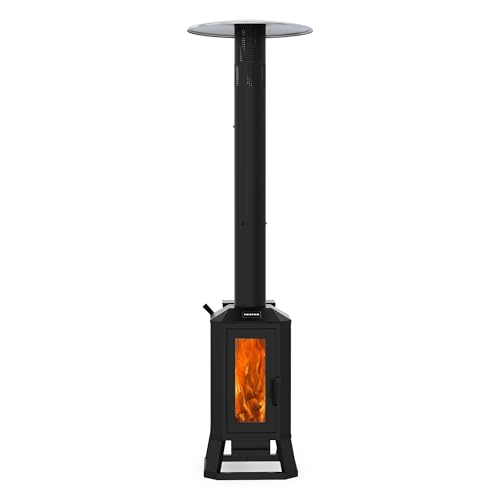 HEATAK pellet heaterA gravity-fed pellet burner with a chimney and a viewing window, and the rare pellet heater that publishes its hopper, its burn time and its coverage. Buy it for the fire and the fuel independence, not for the headline BTU number. | Live fire with no cylinder and no outlet | 70,000 BTU | 400 sq ft claimed | $349.99 · Check on Amazon |
| 2 |  Hiland HLDS01The mushroom tower the whole category is a copy of. 48,000 BTU is enough for a genuinely open patio, and the parts are the easiest in the category to replace when something eventually fails. | A full open patio | 48,000 BTU | 2,400 sq ft | $315.00 · Check on Amazon |
Reach marked “claimed” is the maker’s own published figure. Reach without that label is ours, computed from published output at 20 BTU per square foot for an open patio. Neither is a measurement we took.
Top pick · Live fire with no cylinder and no outlet
HEATAK 70,000 BTU Wood Pellet Outdoor Patio Heater with Glass Viewing Window
A gravity-fed pellet burner with a chimney and a viewing window, and the rare pellet heater that publishes its hopper, its burn time and its coverage. Buy it for the fire and the fuel independence, not for the headline BTU number.
- Fuel
- Wood
- Output
- 70,000 BTU/h
- Reach (claimed)
- 400 sq ft · 12.0 ft radius
- Cost per hour
- n/a
What works
- It publishes what the category usually hides — hopper capacity, burn time at two settings, and a coverage figure that is internally consistent (a 24 ft diameter is about 452 sq ft of circle against their stated 400-plus)
- No cylinder to run out mid-evening and no outlet to reach — the only unit here independent of both, which is why it also works away from the house
- Pellets are a commodity sold by the 40 lb bag at any hardware store, and a bag stores in a way a swapped cylinder does not
- It is an actual fire behind glass, with the light and draw of one. A propane tower is a heater; this is closer to a fire pit with a chimney
What does not
- The published output and the published burn time do not agree. 70,000 BTU/h at a standard 8,000 BTU/lb would consume about 8.75 lb of pellets an hour, but the maker's own 20 lb hopper and 4-hour high setting imply about 5 lb an hour — roughly 40,000 BTU/h. Both figures are theirs. We show the arithmetic on the comparison page
- No published safety listing. Every propane unit on this site cites a CSA or equivalent certification and this one cites none, which is a real gap rather than a formality
- It has to be lit, tended and then emptied of ash — closer to running a fire pit than flicking a propane igniter
- Four hours on high is one evening, and refilling means opening a hopper on a unit that is already burning
- A steel chimney at this size is a large object to store, and the wheels are the only concession to moving it
| Published specification | |
|---|---|
| Rated input | 70,000 BTU/h (maker's published figure) |
| Published coverage | 24 ft diameter, stated as over 400 sq ft |
| Hopper | Up to 20 lb of pellets |
| Burn time | Up to 4 hours on high, 6 hours on low (maker's figures) |
| Feed | Gravity-fed automatic pellet system |
| Construction | Steel frame and chimney, stainless reflector, high-temperature black coating |
| Mobility | Built-in dual wheels |
| Maker’s coverage claim | 400 sq ft |
| Safety listing | No safety listing published by the maker or its retailers |
Who it is for
Someone who wants live fire on an open patio without running cylinders, is comfortable tending it, and values fuel that stores in a bag in the garage.
What it is not for
Anywhere under a roof, on a covered porch or near anything overhead — it is a solid-fuel appliance with a live flame, a chimney and an ash pan. Also wrong if you want heat in ten seconds.
Sources for this entry
- Amazon listing — HEATAK 70,000 BTU wood pellet outdoor patio heater with glass viewing window
- HEATAK / retailer published specification (70,000 BTU, 20 lb hopper, 4 h high and 6 h low, 24 ft diameter coverage, gravity-fed)
- American Wood Fibers — premium hardwood pellet specification (8,000 BTU/lb, 40 lb bag)
2 · A full open patio
Hiland / AZ Patio Heaters HLDS01-CG 87 in Propane Patio Heater
The mushroom tower the whole category is a copy of. 48,000 BTU is enough for a genuinely open patio, and the parts are the easiest in the category to replace when something eventually fails.
- Fuel
- Propane
- Output
- 48,000 BTU/h
- Reach (computed)
- 2,400 sq ft · 27.6 ft radius
- Cost per hour
- $1.40
What works
- 48,000 BTU is real output — on our sizing arithmetic that is a 2,400 sq ft open patio at the rule-of-thumb rate, so it is never the unit that is undersized
- Every wear part on this platform is a stocked commodity: thermocouples, control valves, dump switches and reflectors are all available separately
- The weight bladder in the base is the single most useful anti-tip feature in the category and most rivals leave it out
What does not
- An 87 in open-flame tower is the worst possible shape in wind — this is the unit our wind guide exists for
- The maker does not publish a coverage radius, so the reach figure we show is ours, computed rather than quoted
- Full output burns a 20 lb cylinder in well under a night. See the runtime arithmetic
| Published specification | |
|---|---|
| Rated input | 48,000 BTU/h |
| Height | 87 in |
| Fuel | 20 lb propane cylinder, not included |
| Reflector | 33 in aluminum heat shield |
| Safety | Anti-tilt cutoff and thermocouple flame-failure cutoff |
| Extras | Wheels, integrated table, weight bladder for the base |
| Maker’s coverage claim | None published — the reach figure above is ours |
| Safety listing | CSA certified per the maker's product literature |
Who it is for
An open patio with no roof, where you need volume of heat and can accept swapping cylinders. Also the right answer if you want a unit whose parts you can still buy in five years.
What it is not for
A screened porch, a garage, or anywhere without open sky above it. It is an open-flame combustion appliance and needs genuine outdoor ventilation.
What each is like to live with
| Pellet (HEATAK) | Propane tower | |
|---|---|---|
| Fuel unit | 40 lb bag of pellets | 20 lb cylinder |
| Cost per 1,000 BTU | 1.6 to 2.8 cents | 2.9 cents |
| Sustained burn | 3.3 to 5 lb/h (maker's hopper figure) | About 0.5 gal/h at 46,000 BTU |
| Run time per fill | 3 to 4 hours | Around 10 hours at full output |
| Getting going | Light it and wait | Igniter, seconds |
| Shutting down | Burns out, then ash to empty | Turn the valve |
| Published reach | 10 ft radius, stated as 314 sq ft | None published |
| Safety listing | None published | CSA or equivalent, per the maker |
| Under a roof | No — solid fuel, live flame, embers | No, without the published clearance |
| Refuel mid-evening | Open a hopper on a burning unit | Swap a cold cylinder |
Published manufacturer figures and their practical consequences. The pellet reach figure is the maker's own; the propane tower's makers publish none, so no reach is quoted for it here.
The run-time row is the one buyers underestimate. Three to four hours per hopper against roughly ten hours per cylinder means the pellet unit needs attention during a normal evening and the propane one does not. Whether that is a chore or the point of the thing is genuinely personal — the same argument applies to wood fire pits.
Availability, and the honest caveat
Propane patio heaters are a commodity. Dozens of models, several established brands, and replacement parts you can still buy years later. Pellet patio heaters are effectively one mainstream product with modest retail distribution.
That matters beyond choice. A thin market means fewer spares, fewer people who have solved the problem you are having, and more risk that the model is discontinued while you still own it. It is not a reason to avoid pellets, but it is a real difference in ownership risk and nobody selling them mentions it.
Which pellets to actually buy
This is the part of pellet ownership nobody explains at the point of sale, and it matters more outdoors than it does in a stove you clean once a week. Two published numbers on the bag decide most of it.
- BTU per pound. Premium grades publish around 8,000 BTU/lb. That is the figure every cost calculation on this page uses, and a cheaper bag with a lower figure is not the saving it looks like — you burn more of it for the same heat.
- Ash content. Premium pellets publish figures around 0.5 percent. You are the one emptying the ash pan on a patio in the cold, so this is a comfort specification, not a technical one. A high-ash bargain bag roughly doubles how often you deal with it.
- Heating pellets, not grill pellets. They are sold side by side and they are not the same product. Flavored barbecue pellets cost far more per pound and exist to season food, not to heat a patio.
The practical upshot: buy a premium heating pellet with both figures printed on the bag, and treat any bag that publishes neither as an unknown. That is the same standard this site applies to coverage claims — a specification that is not published is not a specification.
Safety, and where you can put either one
Neither belongs under a roof. Propane heaters need the overhead clearance their manual specifies, which a standard patio roof frequently does not provide. A pellet heater is a solid-fuel appliance with a live flame and rising embers, and open sky above it is not a preference — see safety and clearances and, if your patio is covered, what actually works there.
One asymmetry is worth naming plainly: every propane unit on this site cites a CSA or equivalent safety certification, and this pellet heater's maker and retailers publish none we could find. That is not evidence the unit is unsafe. It does mean that for one of these you can read the certification and for the other you cannot, and on a burning appliance that is a real difference rather than paperwork.
For the pellet side read closely, our HEATAK pellet heater review checks its 70,000 BTU headline against the maker's own hopper and burn-time figures, which imply a good deal less sustained.
So which one
Buy propane if you want heat on demand with no tending, a certified appliance, an evening that does not need a refill, and a product whose parts you can still buy in five years. That is most patios, and it is why the propane tower remains our default recommendation.
Buy pellets if you want live fire on an open patio, are genuinely happy to tend and empty it, want fuel that stores in a bag rather than a cylinder, and value being independent of both the gas swap and the power outlet. The fuel is cheaper per BTU and it is the only unit here you could also take camping.
Buy neither yet if your patio is exposed. Both of these lose most of their output to moving air, and a windbreak in front of a heater you already own beats either purchase. That is the least profitable advice on this page and it is still the right first move for a lot of readers — here is why.
Common questions
Are pellet patio heaters cheaper to run than propane?
Yes, on fuel cost per unit of heat. At a published 8,000 BTU per pound, a $6 40 lb bag works out at about 1.9 cents per 1,000 BTU against 2.9 cents for propane at the current US average price — roughly a third cheaper. Pellets stay cheaper per BTU even at $9 a bag.
What happened to the Q-Stoves Q-Flame?
It is discontinued — the Amazon listing went dead in September 2026 and no Q-Stoves pellet heater is currently sold there. This page previously featured it. Our current pick is the HEATAK 70,000 BTU unit above, which publishes the same class of figures (and the same gap between its headline BTU and its hopper arithmetic).
Is a pellet patio heater really 70,000 BTU?
That is the maker's published figure, but their own 20 lb hopper and 4-hour burn time imply a sustained rate nearer 40,000 BTU/h, and about 27,000 on the low setting. The likeliest explanation is that the headline is a peak rating rather than a continuous one. Size your patio on the lower figure.
How long does a hopper of pellets last?
The maker publishes 3 to 4 hours for a full 20 lb double hopper. That is materially shorter than a 20 lb propane cylinder, which runs around 10 hours at full output on a typical 46,000 BTU tower — see the runtime arithmetic.
Can I use a pellet patio heater on a covered patio?
No. It is a solid-fuel appliance with a live flame and rising embers, and it needs open sky above it. If your patio is covered, mounted electric infrared is the option that actually fits — see heating a covered patio.
Do pellet patio heaters work in wind?
No better than propane, and for the same reason: both warm air, and wind removes warmed air before you feel it. Neither is a wind solution. Radiant infrared is the only category that genuinely ignores wind — see wind-resistant heaters.
What kind of pellets does an outdoor pellet heater use?
Standard heating pellets, the same 40 lb bags sold for pellet stoves. Premium grades publish around 8,000 BTU per pound with low ash, and ash content matters here because you empty it yourself.
Sources
- HEATAK / retailer published specification (70,000 BTU, 20 lb hopper, 4 h high and 6 h low, 24 ft diameter coverage)
- American Wood Fibers — premium hardwood pellet specification (8,000 BTU/lb, 40 lb bag)
- American Wood Fibers — premium hardwood pellet specification (8,000 BTU/lb, 40 lb bag)
- EIA — Weekly residential propane price, US average
- U.S. DOE Alternative Fuels Data Center — propane energy content
Read next
Propane patio heaters, with the cylinder arithmetic
Four propane heaters compared on published BTU, computed reach and real cylinder runtime.
Electric vs propane patio heaters
Output, cost, coverage, wind and installation compared, with the arithmetic and picks for both answers.
Patio heater vs fire pit
Output, direction, cost, wind and permitted use compared, with exits to both catalogs.
What a patio heater costs to run
Cost per hour, evening and month for electric and propane, at named prices with the formulas shown.
Patio heater BTU calculator
Your patio's BTU requirement with every multiplication shown, plus why the published rules disagree.
HEATAK pellet patio heater review
Why its own hopper and burn-time figures imply far less than 70,000 BTU sustained, and who should buy it anyway.