Fixes
Repair or replace your patio heater?
Most dead patio heaters are not dead. A few genuinely are, and the difference is usually obvious once you know which three things to check.
Repair it if the frame is sound and the part is sold. The most common failure by a wide margin is a tired thermocouple — it lights, you let go, it dies — and that is an inexpensive part and about twenty minutes of work. Replace it when the frame has rusted through, the burner is corroded, or the parts are discontinued.
The three questions
Work through these in order and the answer usually arrives before the third one.
- Is the structure sound? Not cosmetic rust — structural. Press hard on the post and the base. If anything flexes, flakes through, or has rusted at a weld, stop here. A heater whose frame is failing is a tipping hazard with a flame on top, and no gas-train part fixes it.
- Is the burner intact? Look into it for perforation, heavy scale or a burner plate that has warped. A corroded burner does not burn evenly and cannot be trusted, and it is the one component rarely sold separately.
- Is the part still made? If one and two pass, the fault is almost certainly in the gas train or the glass, and both are stocked for common designs. Where they are not, the heater is finished regardless of what is wrong with it.
One thing that is never a repair
A gas leak you cannot locate and stop. If soapy water bubbles somewhere you cannot trace to a fitting you can tighten or a part you can replace, that heater is out of service permanently. This is the one fault where cost does not come into the decision at all.
What each common fault actually means
Sorted by how often it turns up, which is roughly the reverse of how serious it is.
| Symptom | Usual cause | Verdict |
|---|---|---|
| Lights, then dies when you release the knob | Thermocouple | Repair. Cheap part, about twenty minutes, and by far the most common fault |
| Will not light at all after winter | Blocked burner tube - often a spider nest | Repair. Frequently costs nothing but a brush and patience |
| Cracked or shattered glass tube (pyramid) | Impact, or the heater went over | Repair, and fix the reason it fell |
| Yellow, sooty or uneven flame | Partial blockage, or a corroded burner | Depends. Clean it first; a burner that stays wrong after cleaning is a replacement |
| Frame flexes, rust through at a weld or the base | Structural corrosion | Replace. Not a repairable condition on this kind of appliance |
| Electric unit dead with no visible damage | Tip switch, cord or element | Depends on the brand - the electric fault tree narrows it |
The usual faults and what they mean for the decision
Quick picks
Ranked for fit, not for hype. Output is the maker’s published figure; reach is computed from it or from the maker’s own radius claim, and the table says which. Tap a row for the full write-up, or go straight to the listing.
| # | Product | Best for | Output | Reach | Price |
|---|---|---|---|---|---|
| 1 | 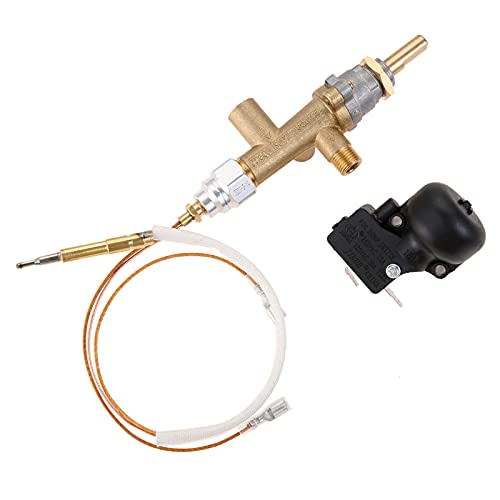 Thermocouple repair kitThe single most common patio-heater failure is a tired thermocouple, and the symptom is precise: it lights, you release the knob, it goes out. This kit is the fix, and it is cheap. | A heater that lights and dies | n/a | n/a | $19.98 · Check on Amazon |
| 2 |  Glass tube, 49.5 inA cracked flame tube makes a pyramid heater unusable and looks terminal. It is a twenty-minute repair with the right tube, and this is the standard four-sided size. | A cracked pyramid tube | n/a | n/a | $49.62 · Check on Amazon |
| 3 |  Amazon Basics 46kOne of the very few towers whose maker publishes a coverage radius rather than a vague area, and the 9 ft figure survives the arithmetic. That alone puts it ahead of most of the field. | The published-radius honesty test | 46,000 BTU | 254 sq ft claimed | $164.99 · Check on Amazon |
Reach marked “claimed” is the maker’s own published figure. Reach without that label is ours, computed from published output at 20 BTU per square foot for an open patio. Neither is a measurement we took.
Top pick · A heater that lights and dies
Propane Patio Heater Repair Kit — Thermocouple, Dump Switch and Control Valve
The single most common patio-heater failure is a tired thermocouple, and the symptom is precise: it lights, you release the knob, it goes out. This kit is the fix, and it is cheap.
- Fuel
- Accessory
- Output
- Not published
- Reach (computed)
- Not published
- Cost per hour
- n/a
What works
- It matches the exact symptom in our fault tree: flame holds while the knob is pressed, dies when released. That is a thermocouple, nearly every time
- Including the dump switch is sensible, because a heater that has fallen over often has both problems at once
- The parts cost a small fraction of a new heater, and this is the repair that keeps a five-year-old tower going
What does not
- Check the fit before ordering. The gas train is broadly standard across cheap towers but not universal — compare your existing part to the listing photographs
- Working on a gas appliance means a leak test with soapy water afterwards, every time, without exception
- If you are not comfortable disconnecting a gas line, this is the point to stop and call someone
| Published specification | |
|---|---|
| Contents | Thermocouple sensor, tilt dump switch, main control valve with pilot port |
| Fits | Common propane patio heaters using the standard gas train |
| Tools | Adjustable wrench; no gas fitting beyond the cylinder connection |
| Maker’s coverage claim | None published — the reach figure above is ours |
| Safety listing | Not applicable — replacement gas-train parts, not an appliance |
Who it is for
Anyone whose propane heater lights but will not stay lit, and who owns an adjustable wrench.
What it is not for
Electric heaters, which fail for [entirely different reasons](/troubleshooting/electric-not-working).
Sources for this entry
2 · A cracked pyramid tube
Unicoshape Replacement Quartz Glass Tube, 49.5 in x 4 in
A cracked flame tube makes a pyramid heater unusable and looks terminal. It is a twenty-minute repair with the right tube, and this is the standard four-sided size.
- Fuel
- Accessory
- Output
- Not published
- Reach (computed)
- Not published
- Cost per hour
- n/a
What works
- The connecting ring is included, which is the part people discover they need halfway through the job
- Measure before you order. Pyramid tubes come in several lengths and diameters, and this one is the 49.5 x 4 in size, not a universal fit
- Turns a written-off heater back into a working one for a fraction of a replacement
What does not
- Glass tubes are fragile in transit as well as in use; inspect on arrival before you start the job
- If the tube cracked because the heater fell over, fix the reason or you will buy another one
- Not every pyramid uses this size. Check yours with a tape measure, not with hope
| Published specification | |
|---|---|
| Length | 49.5 in |
| Diameter | 4 in |
| Fit | Four-sided pyramid flame heaters |
| Included | Neoprene rubber silicone connecting ring |
| Maker’s coverage claim | None published — the reach figure above is ours |
| Safety listing | Not applicable — replacement glass, not an appliance |
Who it is for
Anyone whose pyramid heater is intact except for the glass.
What it is not for
A mushroom-style tower, which has no flame tube at all.
Sources for this entry
3 · The published-radius honesty test
Amazon Basics 46,000 BTU Outdoor Propane Patio Heater
One of the very few towers whose maker publishes a coverage radius rather than a vague area, and the 9 ft figure survives the arithmetic. That alone puts it ahead of most of the field.
- Fuel
- Propane
- Output
- 46,000 BTU/h
- Reach (claimed)
- 254 sq ft · 9.0 ft radius
- Cost per hour
- $1.35
What works
- A published 9 ft radius is a 254 sq ft circle, and 46,000 BTU is far more than that area needs — a claim on the conservative side of its own specification, which is rare here
- The water-fill base box is a real anti-tip measure, not a sticker: filled, it is the difference between a windy evening and a repair bill
- One-touch ignition and a chain for the cylinder are both small things the cheap clones drop
What does not
- The listing does not name a safety certifying body, only the tilt valve, so we cannot tell you it is CSA listed
- 91 in tall with an open flame: the same wind exposure as every other tower of this shape
- The water box has to be emptied before a freeze or it splits
| Published specification | |
|---|---|
| Rated input | 46,000 BTU/h |
| Published reach | 9 ft radius |
| Dimensions | 32.1" L x 32.1" W x 91.3" H |
| Fuel | 20 lb propane cylinder, not included |
| Safety | Tilt auto-shutoff valve; chain to secure the cylinder |
| Base | Water-fill box for ballast, wheel kit included |
| Maker’s coverage claim | 9.0 ft radius, which is 254 sq ft |
| Safety listing | Tilt auto-shutoff valve; the listing does not name a certifying body |
Who it is for
An open patio where you want the largest honest circle of warmth per dollar and are happy to handle cylinders.
What it is not for
Anywhere enclosed, and anywhere the base cannot be filled with water — an empty ballast box makes this a tall, light, tippy object.
Sources for this entry
The arithmetic, honestly
This is where repair-or-replace decisions are usually made, and the numbers are less balanced than people assume.
A thermocouple kit is a small fraction of a new heater. So is a glass tube. Against that, a complete mainstream propane tower now sits under $200, which is low enough that the repair case is not automatic — and low enough that a lot of people replace working heaters unnecessarily.
- One cheap part on a sound frame: repair, clearly. The economics are not close, and you keep a heater you already know.
- Two or more parts at once: think about it. A heater needing a thermocouple, a valve and a glass tube is telling you something about its overall condition.
- Any structural fault: replace. There is no repair cost low enough to make a compromised frame acceptable under an open flame.
- A discontinued model missing a specific part: replace. This is the case where buyers lose the most time, hunting for something that is not made.
Worth adding: the running cost dwarfs both figures. A propane tower burns roughly $253 of fuel across a 20-week season, which is more than the heater costs either to fix or to replace. If the failed unit was propane and the patio has a roof and an outlet, the genuinely cheapest outcome may be neither repair nor a like-for-like tower but an electric unit at about a fifth of the running cost. The season-cost page has the working.
Parts availability is a brand question
Question three above decides more of these than the fault does, and it is worth knowing before you buy the replacement as well as when fixing the old one.
Some ranges have a genuine stocked parts catalog, which means a five-year-old heater is a repairable appliance. Many cheap towers do not, which means the first non-generic failure ends it. Generic gas-train parts cover a surprising amount of the field because the designs are broadly similar, but glass tubes, reflectors and burner assemblies are model-specific and that is where availability runs out. The parts page covers which ranges are which.
Before you decide, rule out the free fixes
A meaningful share of heaters written off each spring were never broken. Run through these first.
- Is the cylinder actually full? Obvious, routinely wrong, and a nearly-empty cylinder produces a weak flame that mimics a real fault.
- Is the excess-flow valve tripped? Opening the cylinder valve quickly trips the safety device and limits gas to a trickle. Close it, wait, reopen slowly.
- Is the burner tube clear? Spiders nest in them over winter. This single cause explains an enormous share of heaters that will not light in April.
- Has the tilt switch reset? If it has been knocked over, the dump switch may be latched. The fault tree walks through all of it in order.
How long one should last
Useful context for the decision, because a fault at year two means something different from the same fault at year eight.
There is no published service life for this category and we are not going to invent one. What can be said from the way these fail is that the gas train is a consumable and the structure is not. Thermocouples tire with use; frames corrode with exposure. A heater that has lived outdoors uncovered ages in the structure first, and a heater that is stored dry ages in the gas train first — which is the better failure to have, because that is the repairable end.
- An early structural failure means storage, not quality. Rust through at year two is a heater that spent two winters wet. The replacement needs a cover more than it needs a better badge.
- A gas-train failure at any age is normal. It is the part that does the work, and it is the part that is sold. This is what repairable looks like.
- Repeated failures of the same part point at something upstream — a cylinder regulator, a persistent blockage, or the heater being run somewhere it is taking weather it should not.
The practical consequence: if the frame is sound at year five, fix it and keep fixing it. If the frame is going at year two, the fault in front of you is not the real problem and replacing the heater without changing how it is stored will produce the same outcome again.
Before you take anything apart
Two things are worth doing in advance, because both are easier before the heater is in pieces than after.
- Photograph the gas train from three angles. Reassembly is where most home repairs go wrong, and the photographs are worth more than any diagram — the listings for replacement parts show the part, not how it sat in your heater.
- Measure the part you are replacing rather than trusting the model number. Thermocouples come in several lengths and glass tubes in several diameters, and a listing that says it fits your brand is not the same as one that fits your unit.
- Work with the cylinder disconnected and outdoors, and leak-test with soapy water before the first light. Every time, including the time you are confident.
None of that changes the repair-or-replace decision, but it changes how often the repair actually succeeds — and a failed repair on a sound heater is the outcome that pushes people into an unnecessary replacement.
If you are replacing
Buy for the failure you just had. If the frame rusted through, a cover and somewhere dry to store it matter more than any spec on the new one. If it fell over and broke, the fix is ballast and position rather than a sturdier heater. If parts were the problem, buy into a range that stocks them.
And if the old heater was propane under a roof, treat the replacement as an open question rather than a like-for-like. The full roundup sorts by the patio rather than by the product, which is the right way round when you are starting again.
Common questions
Is it worth repairing a patio heater?
Usually yes, if the frame is sound and the part is still made. The most common fault by a wide margin is a tired thermocouple - it lights and dies when you release the knob - and that is an inexpensive part and about twenty minutes of work. Structural rust or a corroded burner is where repair stops being sensible.
Why does my patio heater light then go out?
Almost always the thermocouple. It is the safety device that senses the pilot flame and holds the gas valve open, and when it tires it stops holding after you release the knob. It is a cheap, commonly stocked part and the single most repairable fault in the category.
When should you replace a patio heater instead of fixing it?
When the frame flexes or has rusted through at a weld or the base, when the burner is perforated or stays wrong after cleaning, when a gas leak cannot be traced and stopped, or when the specific part is discontinued. The first three are safety decisions rather than cost ones.
How much does it cost to fix a patio heater?
A thermocouple kit or a replacement glass tube is a small fraction of a new heater, so a single part on a sound frame is clearly worth doing. A heater needing several parts at once is a different calculation, because a mainstream replacement tower now sits under $200.
Can you replace a patio heater thermocouple yourself?
Yes, with an adjustable wrench and no gas fitting beyond the cylinder connection. The essential step is a soapy-water leak test afterwards, every time. If disconnecting a gas line is not something you are comfortable doing, that is the point to stop and call someone.
Why will my patio heater not light after winter?
Check the burner tube for a spider nest before anything else - it is one of the most common causes of a heater that worked in October and will not light in April. After that, check the cylinder level and whether the excess-flow valve has tripped from opening the cylinder valve too quickly.
Read next
Patio heater will not stay lit
The ordered diagnostic for a heater that lights and dies, ending in the part that fixes it.
Patio heater replacement parts
The four parts that account for nearly every dead heater, with symptoms and measuring advice.
Electric patio heater not working
GFCI, circuit load and thermal cutout — the three non-heater causes, checked in order.
The best patio heaters under $200
What $200 actually buys in outdoor heat, and why the answer differs by a factor of nine between fuels.
Patio heater covers
How to size a heater cover, what the fabric ratings mean, and the two ways cheap covers fail.