Pillar guide
Every outdoor heating option, in one page
Eight ways to heat an outdoor space, what each one is genuinely for, and the one question that eliminates most of them in about four seconds.
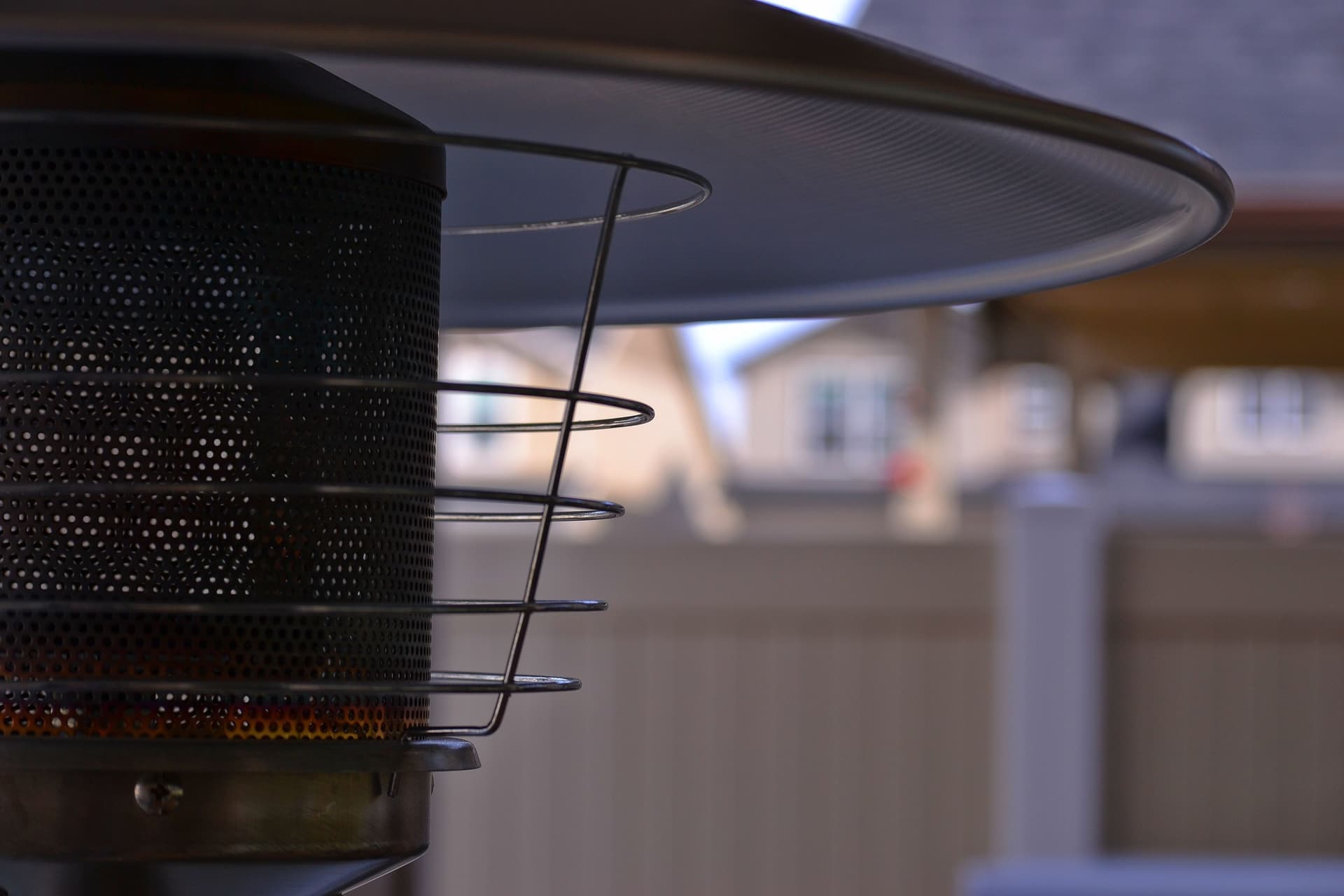
Outdoor heating comes down to eight options: propane towers, pyramid flame heaters, tabletop propane, electric infrared, wall or ceiling infrared, natural gas, fire pits or fire tables, and wood pellet heaters. Whether your space has a roof eliminates most of them immediately.
Start with the roof
Before comparing anything, answer one question. Is there something above the space — a roof, a pergola, a porch ceiling, a gazebo top?
If yes, combustion heaters become a clearance and ventilation problem, and electric radiant becomes the natural answer. If no, electric struggles to compete on output and propane becomes the natural answer. Nearly every real decision in this category resolves on that one fact, and everything below is the detail.
The eight options
1. Propane tower, mushroom style
46,000 to 48,000 BTU/h with a wide reflector that pushes heat down and out. The default for an open patio, and the option with the most warmth per dollar. Needs a 20 lb cylinder, gives roughly nine hours per cylinder at full output, and is about seven feet of sail on a small base. The propane roundup.
2. Pyramid, or flame tower
The same 40,000 to 48,000 BTU with the flame inside a tall glass tube. Beautiful, and a chimney: more of the output goes up than with a mushroom. Buy it for how it looks, knowing that. Pyramid vs mushroom.
3. Tabletop propane
10,000 to 11,000 BTU on a 38-inch stand. Heats a table and the people around it, not a patio. Excellent on a balcony, excellent as a supplement to a tower, disappointing as a sole heat source for an area. Tabletop heaters.
4. Electric infrared, portable or on a stand
1,500 W, which is 5,118 BTU/h, capped by your outlet rather than by the maker. Radiant, so wind does not affect it and there is no flue gas. About 28 cents an hour to run. Needs line of sight from a height. Electric heaters.
5. Wall or ceiling mounted infrared
The same 1,500 W element, permanently mounted and aimed. The right answer for a pergola or porch ceiling, and the version to buy if the heater is never coming indoors — which makes the published IP rating the specification that matters. Wall mounted heaters.
6. Natural gas
Never runs out and cheapest per BTU in most of the country, behind a gas line, a permit and an installer. A good decision for a permanent patio, a poor one for a first heater. Natural gas heaters.
7. Fire pits and fire tables
A different product answering a different question. A fire pit heats a ring of people gathered around it; a heater heats an area. Fire tables are the poorest heat per dollar here and the best at being furniture. The fire pit section.
8. Wood pellet heaters
The outlier. A gravity-fed stove that burns bagged heating pellets, produces a live fire, and needs neither a cylinder nor an outlet. Pellets are the cheapest fuel here per unit of heat, but you light it, tend it and empty the ash, and it wants open sky above it. Pellet vs propane, with the arithmetic.
All eight, side by side
| Option | Typical output | Cost per hour | Where it belongs |
|---|---|---|---|
| Propane tower | 46,000 to 48,000 BTU | About $1.40 | Open patios |
| Pyramid flame tower | 40,000 to 48,000 BTU | About $1.30 | Open patios, looks first |
| Tabletop propane | 11,000 BTU | About $0.32 | One table, a balcony |
| Electric infrared | 1,500 W = 5,118 BTU | About $0.28 | Covered, sheltered, screened |
| Mounted infrared | 1,500 W = 5,118 BTU | About $0.28 | Pergolas, porch ceilings |
| Natural gas | 40,000 BTU and up | Depends on your therm rate | Permanent installations |
| Propane fire pit | 35,000 to 58,000 BTU | $1.02 to $1.70 | A gathering, not a seating area |
| Wood pellet | 70,000 BTU claimed, 27,000 to 40,000 sustained | About $0.50 to $0.75 | Open patios, if you like tending a fire |
Costs computed at 18.34 cents per kWh and $2.674 per gallon of propane. Natural gas is billed per therm and varies too much by utility for a single national figure to be useful.
The prices every cost figure on this site uses
- Electricity: 18.34 cents per kWh. U.S. average residential retail price, June 2026. EIA, Electric Power Monthly, Table 5.6.A (residential, U.S. total).
- Propane: $2.674 per gallon. U.S. average residential price, week ending March 30, 2026. EIA, Weekly Heating Oil and Propane Prices (residential, U.S. average). That series only runs through the heating season, which is why the latest reading is a March one.
- Propane energy content: 91,420 BTU per gallon (higher heating value, the same basis appliance BTU ratings use). U.S. DOE Alternative Fuels Data Center, Fuel Properties Comparison.
- Conversion: 1 kWh = 3,412 BTU. Which is why a 1,500 W electric heater is a 5,118 BTU/h appliance, and why comparing it to a 48,000 BTU propane tower is not the comparison it looks like.
The shortest possible decision path
- Roof overhead? Yes, go to 4 or 5. No, continue.
- Screens or walls? Yes, electric only, no exceptions. No, continue.
- How big? Run the numbers. Under about 5,000 BTU/h, electric will do it. Above, propane.
- Windy? Read this first. It changes the answer more than the size does.
- Just want the picks? The flagship roundup has one for each of the cases above.
Common questions
What is the best type of outdoor heating?
There is no single best. For an open patio, a propane tower gives the most heat per dollar. For a covered patio, pergola or porch, a mounted electric infrared unit does more with far less output. For a gathering rather than a seating area, a fire pit. The space picks the type.
What are the best outdoor heating options for a small patio?
Under about 250 sq ft, a single 1,500 W electric infrared heater is usually enough and costs about 28 cents an hour. A tabletop propane unit works if the warmth only needs to reach one table. A full 48,000 BTU tower on a small patio is buying fuel consumption you will not feel.
What is the cheapest way to heat a patio?
In running cost, an electric infrared heater on its lower setting, at roughly 17 cents an hour at 900 W. In heat per dollar of fuel, propane, at about 2.9 cents per thousand BTU. The genuinely cheapest change is usually a windbreak, which reduces the heat you need in the first place.
Read next
How to choose a patio heater
Six questions in order — roof, enclosure, area, exposure, power, budget.
The best patio heaters, sorted by the patio
Six heaters covering every real patio case, with published output, computed reach and cost per hour.
Patio heater BTU calculator
Your patio's BTU requirement with every multiplication shown, plus why the published rules disagree.
Patio heater vs fire pit
Output, direction, cost, wind and permitted use compared, with exits to both catalogs.
Electric vs propane patio heaters
Output, cost, coverage, wind and installation compared, with the arithmetic and picks for both answers.
The best patio heaters for beginners
What to buy first, the three predictable beginner mistakes, and the ownership costs nobody mentions.
HEATAK pellet patio heater review
Why its own hopper and burn-time figures imply far less than 70,000 BTU sustained, and who should buy it anyway.