Commercial
Patio heaters for a restaurant terrace
A commercial terrace is a different problem to a back garden: more hours, more abuse, more people, and a running cost that has to come out of covers rather than out of enthusiasm.
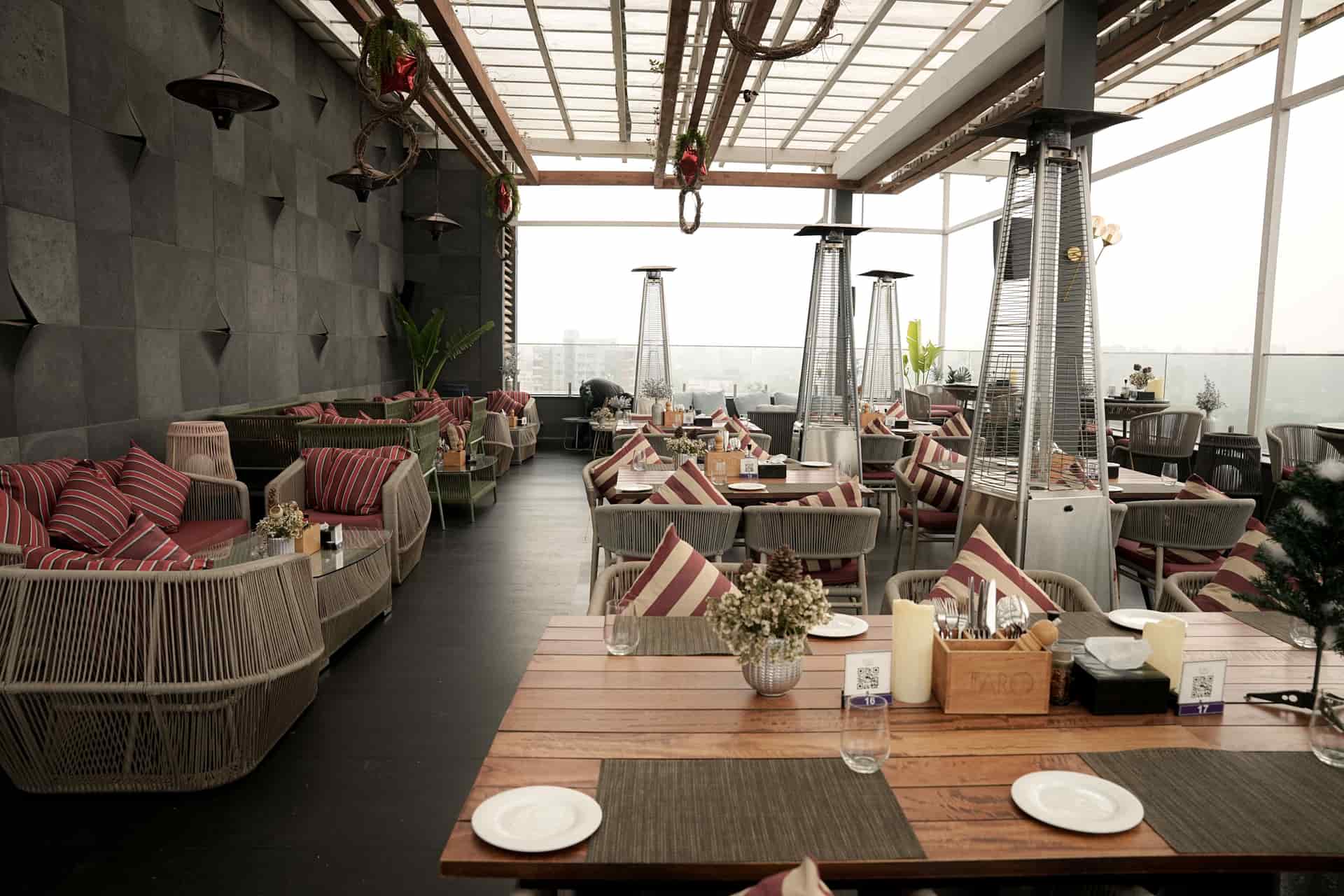
Heat the tables, not the terrace. Plan roughly one heater per two to four covers rather than one per terrace, put mounted infrared over fixed seating near the building and towers on the open sections, and budget the running cost per seated hour — it is the number that decides whether the terrace pays.
Why a terrace is a different problem
Everything on this site about sizing and wind applies here unchanged. What changes is the economics and the abuse.
- Hours. A domestic heater might run 100 hours a season. A terrace unit can run that in a month, which turns a modest hourly cost into a real line item.
- People who did not buy it. Guests knock things, staff move things at speed in the dark, and nobody treats a restaurant's equipment the way they treat their own.
- Consistency. A guest who is cold does not tell you, they just do not come back to the terrace. Uneven heating costs covers rather than complaints.
- Regulation. Fire, licensing and landlord conditions all bear on outdoor heating in a way they never do at home.
The layout rule that matters most
Radiant and convected heat both fall off sharply with distance. A tower rated for a large area is describing the whole circle it touches, not the part of that circle where somebody would happily sit through a starter — which is the coverage problem this site keeps returning to.
In practice that means planning per table. Two to four covers per heater is the working figure most terraces converge on, and it is far more units than the naive calculation suggests. The cost of getting it wrong is not a cold terrace, it is a terrace where the good tables are the ones near the heaters and the rest sit empty.
The zoning that usually works
Mounted infrared along the building wall over the fixed seating, where there is structure to fix to and no floor space to spare. Free-standing towers on the open section away from the wall, where there is nothing overhead and the extra output is genuinely needed. Two problems, two answers.
Quick picks
Ranked for fit, not for hype. Output is the maker’s published figure; reach is computed from it or from the maker’s own radius claim, and the table says which. Tap a row for the full write-up, or go straight to the listing.
| # | Product | Best for | Output | Reach | Price |
|---|---|---|---|---|---|
| 1 |  Hiland HLDS01The mushroom tower the whole category is a copy of. 48,000 BTU is enough for a genuinely open patio, and the parts are the easiest in the category to replace when something eventually fails. | A full open patio | 48,000 BTU | 2,400 sq ft | $315.00 · Check on Amazon |
| 2 |  Heat Storm TradesmanThe one electric unit here with a published IP rating, which is the difference between a heater that survives a wet winter mounted outdoors and one that is a warranty claim waiting to happen. | Leaving outside all year | 1,500 W | 256 sq ft | $99.99 · Check on Amazon-8% |
| 3 |  Amazon Basics 46kOne of the very few towers whose maker publishes a coverage radius rather than a vague area, and the 9 ft figure survives the arithmetic. That alone puts it ahead of most of the field. | The published-radius honesty test | 46,000 BTU | 254 sq ft claimed | $156.16 · Check on Amazon |
Reach marked “claimed” is the maker’s own published figure. Reach without that label is ours, computed from published output at 20 BTU per square foot for an open patio. Neither is a measurement we took.
Top pick · A full open patio
Hiland / AZ Patio Heaters HLDS01-CG 87 in Propane Patio Heater
The mushroom tower the whole category is a copy of. 48,000 BTU is enough for a genuinely open patio, and the parts are the easiest in the category to replace when something eventually fails.
- Fuel
- Propane
- Output
- 48,000 BTU/h
- Reach (computed)
- 2,400 sq ft · 27.6 ft radius
- Cost per hour
- $1.40
What works
- 48,000 BTU is real output — on our sizing arithmetic that is a 2,400 sq ft open patio at the rule-of-thumb rate, so it is never the unit that is undersized
- Every wear part on this platform is a stocked commodity: thermocouples, control valves, dump switches and reflectors are all available separately
- The weight bladder in the base is the single most useful anti-tip feature in the category and most rivals leave it out
What does not
- An 87 in open-flame tower is the worst possible shape in wind — this is the unit our wind guide exists for
- The maker does not publish a coverage radius, so the reach figure we show is ours, computed rather than quoted
- Full output burns a 20 lb cylinder in well under a night. See the runtime arithmetic
| Published specification | |
|---|---|
| Rated input | 48,000 BTU/h |
| Height | 87 in |
| Fuel | 20 lb propane cylinder, not included |
| Reflector | 33 in aluminum heat shield |
| Safety | Anti-tilt cutoff and thermocouple flame-failure cutoff |
| Extras | Wheels, integrated table, weight bladder for the base |
| Maker’s coverage claim | None published — the reach figure above is ours |
| Safety listing | CSA certified per the maker's product literature |
Who it is for
An open patio with no roof, where you need volume of heat and can accept swapping cylinders. Also the right answer if you want a unit whose parts you can still buy in five years.
What it is not for
A screened porch, a garage, or anywhere without open sky above it. It is an open-flame combustion appliance and needs genuine outdoor ventilation.
2 · Leaving outside all year
Heat Storm Tradesman HS-1500-OTR-R 1500 W Weatherproof Infrared Heater
The one electric unit here with a published IP rating, which is the difference between a heater that survives a wet winter mounted outdoors and one that is a warranty claim waiting to happen.
- Fuel
- Electric
- Output
- 1,500 W = 5,118 BTU/h
- Reach (computed)
- 256 sq ft · 9.0 ft radius
- Cost per hour
- $0.28
What works
- A published IPX4 rating. Almost nobody in this category publishes an ingress rating at all, and mounting an unrated electric heater outdoors is a gamble you cannot price
- The maker publishes its own BTU figure (5,200), which is within a rounding error of the 5,118 our watts-to-BTU conversion gives — a company doing its own arithmetic honestly
- Wall or ceiling mount puts the heat above head height where a radiant beam belongs
What does not
- IPX4 rates water only — the solids digit is X, meaning none is published. It is splashing-water protection, not immersion, and it tells you nothing about dust ingress
- Fixed mounting means fixed aim. Get the position wrong and there is no adjusting it from the chair
- Same 1,500 W ceiling as every other plug-in electric heater
| Published specification | |
|---|---|
| Rated power | 1,500 W at 120 V |
| Published output | 5,200 BTU/h per the maker |
| Element | Carbon fiber infrared, per the maker |
| Weather rating | IPX4 |
| Dimensions | 27 x 8 x 6 in |
| Control | Remote included |
| Mounting | Wall or ceiling; tripod and tri-mount combos are separate SKUs |
| Maker’s coverage claim | None published — the reach figure above is ours |
| Safety listing | IPX4 weatherproof rating published by the maker |
Who it is for
A permanently mounted heater on a pergola, porch ceiling or exterior wall that you never want to take down and store.
What it is not for
Portability, and any open patio with no structure to mount to.
3 · The published-radius honesty test
Amazon Basics 46,000 BTU Outdoor Propane Patio Heater
One of the very few towers whose maker publishes a coverage radius rather than a vague area, and the 9 ft figure survives the arithmetic. That alone puts it ahead of most of the field.
- Fuel
- Propane
- Output
- 46,000 BTU/h
- Reach (claimed)
- 254 sq ft · 9.0 ft radius
- Cost per hour
- $1.35
What works
- A published 9 ft radius is a 254 sq ft circle, and 46,000 BTU is far more than that area needs — a claim on the conservative side of its own specification, which is rare here
- The water-fill base box is a real anti-tip measure, not a sticker: filled, it is the difference between a windy evening and a repair bill
- One-touch ignition and a chain for the cylinder are both small things the cheap clones drop
What does not
- The listing does not name a safety certifying body, only the tilt valve, so we cannot tell you it is CSA listed
- 91 in tall with an open flame: the same wind exposure as every other tower of this shape
- The water box has to be emptied before a freeze or it splits
| Published specification | |
|---|---|
| Rated input | 46,000 BTU/h |
| Published reach | 9 ft radius |
| Dimensions | 32.1" L x 32.1" W x 91.3" H |
| Fuel | 20 lb propane cylinder, not included |
| Safety | Tilt auto-shutoff valve; chain to secure the cylinder |
| Base | Water-fill box for ballast, wheel kit included |
| Maker’s coverage claim | 9.0 ft radius, which is 254 sq ft |
| Safety listing | Tilt auto-shutoff valve; the listing does not name a certifying body |
Who it is for
An open patio where you want the largest honest circle of warmth per dollar and are happy to handle cylinders.
What it is not for
Anywhere enclosed, and anywhere the base cannot be filled with water — an empty ballast box makes this a tall, light, tippy object.
Sources for this entry
What we would skip
A list with no losers is a list nobody edited. These are the choices we would actively steer you away from, and why.
One large heater for the whole terrace
The single most common commercial mistake. Heat falls off with distance from the unit, so one 48,000 BTU tower in the center gives you two warm tables and a row of cold ones by the rail. Several smaller units placed at the tables beat one large one every time.
Free-standing towers on a narrow walkway terrace
A seven-foot tower on a base is a trip hazard and a tip-over risk where staff carry plates past it in the dark. On tight terraces the honest answer is wall or ceiling mounted, even though it costs more to install.
Buying before checking the lease and the local rules
Commercial outdoor heating frequently sits under fire regulations, licensing conditions and landlord terms that do not apply to a domestic patio. This is the one purchase where the paperwork genuinely comes first.
Running cost, per seat
This is the number a terrace should actually be planned on, and it is straightforward arithmetic once you have the layout.
The working
A propane tower costs about $1.40 an hour at the current US average propane price. Serving three covers, that is roughly 47 cents per cover per hour. A 1,500 W electric unit at about 28 cents an hour over the same three covers is about 9 cents. Multiply by hours open and covers served to get the season.
Those figures use national average energy prices and your commercial rates will differ — often substantially, and not always upward. The point is not the number, it is that the number is small per cover and large per season, which is exactly the shape that gets missed when nobody works it out.
The other economic fact worth stating plainly: electric is dramatically cheaper to run and dramatically less flexible, because it needs circuits where you want heat. On a terrace being fitted out anyway, that is a wiring decision made once. On an existing terrace it can be prohibitive, which is why propane towers remain standard.
Cylinders at commercial volume
A tower at full output empties a 20 lb cylinder in roughly ten hours. Two towers, five hours a night, is a cylinder a night. That is a delivery relationship and a storage plan, not a trip to the hardware store.
It is also the strongest argument for mounted electric on the sections where it is feasible: no cylinder handling, no storage, no staff member changing a bottle during service.
The staff-side problems nobody plans for
A terrace heating setup is operated by people who did not choose it, during service, in the dark, while carrying things. That changes what a good installation looks like more than any specification does.
- Cylinder changes during service. A tower run at full output needs a cylinder roughly every two nights. If that change has to happen at 8pm on a Saturday, it will be done fast by whoever is free — which is an argument for mounted electric wherever the wiring allows.
- Ignition, repeatedly. Every unit gets lit at open and shut at close, every day. Piezo igniters wear out on this duty cycle far faster than on a domestic patio, which is why replacement parts availability matters more commercially than at home.
- Somewhere to put them. Free-standing towers have to be moved and stored for cleaning and in bad weather, and a terrace with nowhere to put six of them ends up leaving them out.
- A written procedure. Which units get lit, in what order, and who checks they are off at close. This is the difference between a heater lasting five seasons and lasting two.
What guests actually notice
Two things, and neither is output. The first is inconsistency — a terrace where some tables are warm and some are not generates no complaints and a lot of empty tables at the cold end. The second is glare, because a bright quartz element at head height across a dinner table is genuinely unpleasant to sit under for two hours. The element choice is worth making deliberately on a terrace.
Safety and the paperwork
Everything on our safety and clearances page applies, and on a commercial terrace it applies with a regulator attached. Clearances come from the unit's own manual; what sits on top of that is local fire code, licensing conditions, and often the landlord's own terms.
We are a publication, not your fire officer, and this is genuinely the case where the general advice on a website is worth less than one conversation with the people who inspect your premises. Have that conversation before the purchase order, not after.
One thing that is universal: an open-flame appliance needs open sky. If your terrace is under a fixed awning or a retractable roof that is usually closed, the propane answer is off the table and the covered-space answer is the one you want.
The short version
Plan per table, not per terrace. Mount electric infrared where there is structure and power, and put towers on the open sections. Work out cost per cover per hour before you commit, and settle the fire and licensing position first — it is the only part of this that a supplier will not raise with you.
Common questions
How many patio heaters does a restaurant terrace need?
Plan roughly one per two to four covers rather than one per terrace. Heat falls off sharply with distance, so a single large unit gives you a few warm tables and a row of cold ones — which costs covers rather than generating complaints.
What does it cost to heat a restaurant terrace?
A propane tower is about $1.40 an hour at the current US average price, or roughly 47 cents per cover per hour serving three covers. A 1,500 W electric unit is about 28 cents an hour, near 9 cents per cover. Multiply by your opening hours for the season.
Are electric or propane heaters better for a commercial patio?
Electric is far cheaper to run and needs no cylinder handling during service, but it needs circuits where you want heat. Propane is flexible and needs no wiring but means a cylinder a night at volume. Most terraces end up running both, zoned.
Can a restaurant use propane heaters under an awning?
Not without the clearance the manufacturer specifies, and many awnings do not provide it. An open-flame appliance needs open sky above it. Where the terrace is genuinely covered, mounted electric infrared is the workable answer.
How often do commercial patio heaters need cylinder changes?
A tower at full output empties a 20 lb cylinder in roughly ten hours, so five-hour evenings mean a cylinder about every two nights per unit. At several units that is a delivery relationship and a storage plan, not a hardware-store trip — and it is the strongest practical argument for mounted electric where wiring allows.
Should a terrace use one large heater or several small ones?
Several, nearly always. Heat falls off sharply with distance, so one large unit produces a few warm tables and a cold perimeter. Planning at roughly one heater per two to four covers costs more up front and is the difference between a terrace that fills and one where only the middle fills.
Do commercial patio heaters need different safety approval?
Beyond the unit's own clearances, commercial outdoor heating commonly sits under local fire code, licensing conditions and landlord terms that do not apply at home. Settle that before purchase — it is the part no supplier will raise for you.
Sources
Read next
Patio heaters for a covered patio
The clearance arithmetic for a roofed patio, and the mounted heaters that actually fit.
Patio heater safety, with the published numbers
Published clearance figures, the ventilation rule, and where each heater type must never go.
Patio heater coverage area
Radius to area, why the two get confused, and how to sanity-check any coverage claim.
What a patio heater costs to run
Cost per hour, evening and month for electric and propane, at named prices with the formulas shown.
Wall mounted patio heaters, and the rating that decides
Wall and ceiling mounted electric heaters, ranked on published weather rating and mounting.
How many patio heaters do I need?
Why the count is set by reach rather than BTU, when two heaters beat one bigger one, and where to put them.