By space
Heating an apartment balcony
The constraint on a balcony is almost never heat. It is the lease, the space, and the fact that whatever you buy has to live out there in the weather.

On most apartment balconies the answer is a wall-mounted or small free-standing electric heater, because leases and fire codes commonly prohibit open flame and stored propane. Check your lease first — it is the constraint that decides this, not the heating.
Start with the lease, not the heater
This is the unusual case where the buying decision is mostly a legal one. Residential leases very commonly restrict open-flame appliances and the storage of propane cylinders on balconies, and many municipalities have fire-code provisions covering the same ground for multi-unit buildings.
We cannot tell you what your building allows and neither can any other website — the rules vary by lease, by city and by building type. What we can tell you is that this is the first thing to check and that it usually rules out the entire propane category, which is otherwise the cheapest way to buy heat.
Two things worth confirming before you buy
Whether your lease permits an open-flame appliance on the balcony, and whether it permits storing a propane cylinder there. They are separate permissions and a lease can grant one and not the other. If either is a no, you are shopping for an electric unit.
Why electric suits a balcony anyway
Even where propane is permitted, a balcony is close to the ideal case for electric infrared, for reasons that have nothing to do with the rules.
- The area is small. The 1,500 watt ceiling that makes electric inadequate on an open patio is far less binding when you are heating a space the size of a large rug and two chairs.
- There is usually structure overhead and a wall to fix to, which is exactly what a mounted infrared unit needs and what an open patio lacks.
- Balconies are frequently partly enclosed by the building on two or three sides, which cuts the heat requirement substantially and shelters the space from wind.
- No cylinder to store, which on a balcony is not a convenience point but often the whole ballgame.
- It costs about 28 cents an hour, against roughly $1.40 for a propane tower. The arithmetic.
Quick picks
Ranked for fit, not for hype. Output is the maker’s published figure; reach is computed from it or from the maker’s own radius claim, and the table says which. Tap a row for the full write-up, or go straight to the listing.
| # | Product | Best for | Output | Reach | Price |
|---|---|---|---|---|---|
| 1 | 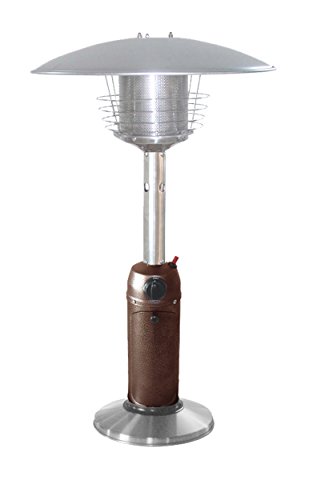 Hiland tabletop11,000 BTU heats a table, not a patio, and being clear about that is the whole point. For a bistro table on a balcony it is the right size and nothing bigger fits. | One table, four people | 11,000 BTU | 550 sq ft | $126.54 · Check on Amazon |
| 2 | 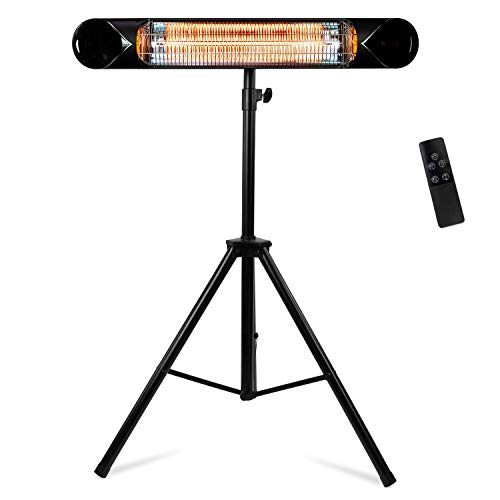 Briza 1500 WThe same 1,500 W infrared element as everything else, sold with a tripod as well as the brackets. That flexibility is the entire argument for it, and it is a decent one. | Not committing to a mounting point | 1,500 W | 256 sq ft | $199.90 · Check on Amazon |
| 3 | 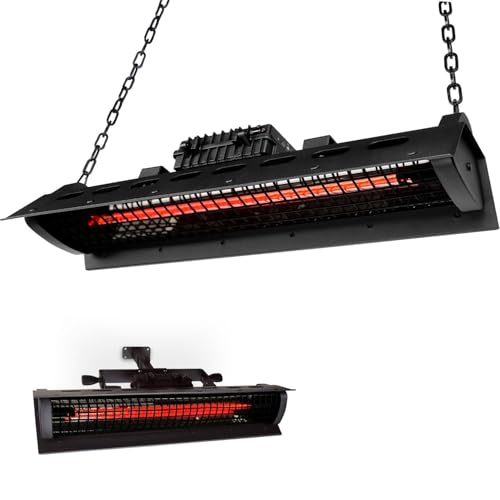 Star Patio STP2020-AOne of the very few electric units whose maker publishes a coverage area at all — 110 sq ft — and it mounts to a wall or hangs from a ceiling on chains. No ingress rating is published, so keep it somewhere sheltered. | A published coverage figure | 1,500 W | 110 sq ft claimed | $199.99 · Check on Amazon |
Reach marked “claimed” is the maker’s own published figure. Reach without that label is ours, computed from published output at 20 BTU per square foot for an open patio. Neither is a measurement we took.
Top pick · One table, four people
Hiland HLDS032-BB Portable Table Top Patio Heater, Hammered Bronze
11,000 BTU heats a table, not a patio, and being clear about that is the whole point. For a bistro table on a balcony it is the right size and nothing bigger fits.
- Fuel
- Propane
- Output
- 11,000 BTU/h
- Reach (computed)
- 550 sq ft · 13.2 ft radius
- Cost per hour
- $0.32
What works
- Runs off a 1 lb canister, which makes it the only heater here you can carry out to a table and back with one hand
- 11,000 BTU is honest for the job: our reach arithmetic puts that at roughly a table's worth of warmth, and the unit does not pretend otherwise
- A burner screen guard on a table-height heater is a genuine safety feature, not a spec-sheet line
What does not
- 1 lb canisters are the most expensive propane per BTU you can buy — get the 20 lb adapter hose if you use it regularly
- At 38 in on a table, this puts an open flame at seated head height. Placement matters more than with any other unit here
- It will not touch an open patio. Anyone expecting a room-scale effect will be disappointed
| Published specification | |
|---|---|
| Rated input | 11,000 BTU/h, adjustable |
| Height | 38 in |
| Fuel | 1 lb canister or 20 lb cylinder, per the listing |
| Finish | Hammered bronze |
| Safety | Thermocouple, anti-tilt device, burner screen guard |
| Stability | Weight plate in the base |
| Maker’s coverage claim | None published — the reach figure above is ours |
| Safety listing | Thermocouple flame-failure cutoff and anti-tilt device per the listing |
Who it is for
A balcony, a bistro table, or a second heater that warms hands at the table while a tower does the space.
What it is not for
Heating an area. And never indoors, on a covered porch with a low ceiling, or anywhere a tablecloth can reach it.
Sources for this entry
2 · Not committing to a mounting point
Briza Infrared Electric Patio Heater, 1500 W, with Stand
The same 1,500 W infrared element as everything else, sold with a tripod as well as the brackets. That flexibility is the entire argument for it, and it is a decent one.
- Fuel
- Electric
- Output
- 1,500 W = 5,118 BTU/h
- Reach (computed)
- 256 sq ft · 9.0 ft radius
- Cost per hour
- $0.28
What works
- The tripod means you can find the right position over a season before drilling anything, then mount it properly
- A 1-to-9-hour timer on the remote is the feature that stops a mounted heater running all night by accident
- Three power settings, same as the Dr Infrared unit, and the 900 W setting is the one you will actually use
What does not
- No published IP rating and no named safety listing. For a unit sold to live outdoors that is a real omission, and we would rather tell you than skip past it
- A tripod-mounted heater is a tip-over object around children and dogs in a way a wall-mounted one is not
- No published coverage figure, so the reach column is ours
| Published specification | |
|---|---|
| Rated power | 1,500 W at 120 V |
| Settings | 900 W / 1,200 W / 1,500 W |
| Timer | 1 to 9 hours, on the remote |
| Mounting | Wall and ceiling hardware plus an adjustable tripod stand |
| Maker’s coverage claim | None published — the reach figure above is ours |
| Safety listing | The listing does not publish a safety listing body or an IP rating |
Who it is for
Someone who wants electric radiant heat but does not yet know where it should live permanently.
What it is not for
A fully exposed position in wet weather — without a published ingress rating we cannot tell you it will survive one.
Sources for this entry
3 · A published coverage figure
Star Patio STP2020-A-RMN2025 Wall and Ceiling Electric Infrared Patio Heater
One of the very few electric units whose maker publishes a coverage area at all — 110 sq ft — and it mounts to a wall or hangs from a ceiling on chains. No ingress rating is published, so keep it somewhere sheltered.
- Fuel
- Electric
- Output
- 1,500 W = 5,118 BTU/h
- Reach (claimed)
- 110 sq ft · 5.9 ft radius
- Cost per hour
- $0.28
What works
- It publishes a coverage figure. 110 sq ft is a real, checkable claim, and almost nobody in this category states one at all — which is the whole subject of our coverage page
- Wall bracket and ceiling chains both in the box, with 60 degrees of tilt, so the beam can actually be aimed at the chairs rather than at whatever the bracket decided
- 5,100 BTU/h published output is within a rounding error of the 5,118 our watts-to-BTU conversion gives, which is a maker doing its own arithmetic honestly
- Remote control on a unit mounted above head height is functional rather than a luxury
What does not
- No ingress rating is published for this model. Other units in this roundup publish one, and on a permanently mounted outdoor appliance that silence means you cannot price the weather risk. Treat it as a sheltered-position heater
- 110 sq ft is a small area — roughly a 10 by 11 ft patch, which is a seating group and not a patio
- 1,500 W, like everything else that plugs into a standard socket. The ceiling applies here as everywhere
- A 6 ft cord means the outlet has to be close, or an outdoor-rated extension has to be part of the plan
| Published specification | |
|---|---|
| Rated power | 1,500 W at 110 V, 60 Hz |
| Published output | 5,100 BTU/h per the maker |
| Published coverage | Up to 110 sq ft per the maker |
| Element | Golden tube |
| Mounting | Wall bracket or ceiling chains, up to 60 degrees of tilt |
| Size and weight | 27.5 x 7 x 5.7 in, 7.7 lb |
| Element life | 5,000 hours per the maker |
| Maker’s coverage claim | 110 sq ft |
| Safety listing | No ingress rating published for this model |
Who it is for
A sheltered wall or porch ceiling over a seating group, where you want a heater whose maker will tell you what area it actually covers.
What it is not for
An exposed wall where driving rain reaches it, since nothing is published about ingress protection, or any space much larger than a seating group.
What we would skip
A list with no losers is a list nobody edited. These are the choices we would actively steer you away from, and why.
A propane tower on an apartment balcony
The default recommendation everywhere else on this site, and usually the wrong answer here. Most residential leases and many local fire codes prohibit open-flame appliances and stored propane cylinders on balconies, and the clearance a tower needs rarely exists. Check your lease before you consider it — this is not a formality.
A patio heater aimed at the wall
A balcony is small enough that aim decides everything. A radiant heater pointed across a four-foot space warms the railing and the neighbor's view. Mount it high, aim it down at where you sit, and accept that a balcony is a one-seat or two-seat heating problem.
Anything you have to bring inside every night
In practice it stops getting used by November. Either it is rated to stay out, or it is small enough to live in a cupboard by the door. A unit that needs carrying through a living room is a unit that stays off.
Mounting on a balcony you do not own
The obvious complication with the wall-mounted answer is that drilling into a rented wall is frequently not permitted either. Two honest routes around it:
- A free-standing unit on a stand. Several 1,500 W infrared heaters ship with an adjustable tripod as well as wall hardware, which gives you the mounted heater's aim without the mounted heater's holes. It costs floor space, which on a balcony is the scarce resource.
- A tabletop unit, if the balcony is genuinely small and the use is two people at a bistro table. It heats hands and the immediate table rather than the space, which on a four-by-eight balcony may be all that is needed.
Whichever route, aim matters more here than anywhere else on this site. A balcony is small enough that a heater pointed slightly wrong misses the only two chairs entirely.
Wind on a high balcony
Worth flagging because it runs against intuition: a balcony several floors up is frequently windier than the ground-level patio it overlooks, and the building itself can accelerate air around corners.
That is another argument for radiant electric over anything with a flame, since radiant output crosses moving air essentially unaffected while a flame heater's warmed air simply leaves. It is also an argument for a windbreak on the exposed side, which on a balcony can be as simple as a screen along the railing — the options.
A worked example
Take a common apartment balcony: 5 feet deep by 10 feet wide, so 50 square feet, with the building on one long side and a railing on the other three.
The arithmetic
50 sq ft at the baseline 20 BTU per square foot is 1,000 BTU/h in sheltered conditions. Even doubling that for an exposed high balcony gives 2,000 BTU/h — comfortably inside what a single 1,500 W electric unit delivers at about 5,118 BTU/h.
That is the whole case for electric on a balcony in one line. The 1,500 watt ceiling that makes plug-in heaters inadequate on a 400 square foot patio has enormous headroom on a 50 square foot balcony, and there is no scenario where you need a propane tower's 48,000 BTU in that space.
Run your own numbers with the calculator — but for almost any balcony the answer lands in the same place, which is why the lease question genuinely is the deciding one rather than the sizing.
Neighbors, smoke and shared air
A balcony sits in shared airspace in a way a garden does not. Anything that produces smoke or smell travels directly onto the balconies above and beside you, which is why wood-burning anything is almost universally prohibited in multi-unit buildings and why fire pits are not a balcony product at any size.
Electric radiant heat produces nothing to travel — no smoke, no combustion products, no smell. That is a quiet advantage worth naming, because it is the difference between a heater you can use whenever you want and one that generates a conversation with the building manager.
If propane is permitted where you are and a table heater is the plan, the Hiland HLDS032 review has the published clearances — 36 inches to a wall is the figure that catches balconies, where a table against the railing rarely leaves three feet.
Weather, and leaving it out
A balcony unit has nowhere to retreat to. There is no shed and usually no garage, so it either stays outside permanently or it lives in a cupboard indoors.
If it is staying out, the published IP rating is the specification to read — IP35 handles rain, IP55 handles rain arriving sideways, which on an exposed high balcony is the realistic case. If nothing is published, treat it as an indoor-grade unit and plan to bring it in. Covers are the other half of that answer.
Power, and the extension cord question
A balcony rarely has an outdoor outlet, so the power usually comes through a door or window from indoors. That is the part worth getting right, because a 1,500 W heater is a continuous full-load appliance rather than a lamp.
- Use an outdoor-rated cord heavy enough for the load. A thin indoor extension lead running a 1,500 W heater for four hours is the single most common electrical mistake in outdoor heating.
- Do not daisy-chain, and do not run it through a light-duty power strip. The heater should be the only thing on the cord.
- Keep the connection out of standing water, and off the floor where rain collects. A dry, raised connection point is worth arranging deliberately.
- Watch what else is on the circuit. 1,500 W continuous wants most of a circuit to itself, which indoors may already be shared with a kitchen appliance.
- Do not trap the cord in a closing door. Repeated compression on the insulation is a slow failure that nobody inspects.
If none of that is workable, that is a genuine argument for a smaller unit rather than a workaround — and on a balcony, a tabletop heater drawing far less power may be the honest answer.
Much of this applies to any tight space rather than to balconies specifically. If you have ground-level walls and a fence instead of a railing and a lease, the small patio page covers the same footprint problem with fewer restrictions on how you solve it.
The short version
Check the lease. Assume electric. Mount it high and aim it down at the chairs, or use a stand if you cannot drill. Prefer a published weather rating over a bigger number, because the unit lives outside and the space is small enough that output was never going to be the problem.
Common questions
Can you use a patio heater on an apartment balcony?
An electric one, usually yes. A propane one, often not — many residential leases and local fire codes prohibit open-flame appliances and stored propane cylinders on balconies. Check your lease first, because it decides the whole purchase.
What is the best type of heater for a balcony?
Electric infrared, wall mounted or on a stand. A balcony is small and often partly enclosed, so the 1,500 W ceiling that makes electric inadequate on an open patio is much less limiting here, and there is no cylinder to store.
Can I put a propane heater on my balcony?
Only if your lease and local fire code both permit an open-flame appliance and cylinder storage there, and only if the unit's published clearances fit the space. Those are separate permissions and a lease can grant one without the other.
How do I heat a balcony without drilling into the wall?
Use a free-standing infrared unit on an adjustable stand — several 1,500 W models ship with a tripod as well as wall hardware — or a tabletop unit if the balcony is small and you are heating a bistro table rather than a space.
How many BTU does a balcony need?
Far less than a patio. A 50 square foot balcony at the baseline 20 BTU per square foot needs about 1,000 BTU/h sheltered, or roughly 2,000 exposed — well inside the 5,118 BTU/h a single 1,500 W electric unit delivers. Sizing is almost never the constraint on a balcony; the lease is.
Can I have a fire pit on a balcony?
Effectively never in a multi-unit building. Smoke and embers travel directly into shared airspace and onto the balconies above, which is why wood burning is near-universally prohibited there. Electric radiant heat produces nothing that travels, which is a quiet but real advantage.
Are balconies windier than patios?
Often yes, several floors up, and buildings can accelerate air around corners. That favors radiant electric heat, which crosses moving air largely unaffected, over any flame heater whose warmed air simply blows away.
Sources
Read next
Tabletop patio heaters heat a table
What a tabletop heater's 11,000 BTU actually covers, and the fuel arithmetic that decides how you feed it.
Wall mounted patio heaters, and the rating that decides
Wall and ceiling mounted electric heaters, ranked on published weather rating and mounting.
Electric patio heaters, and the ceiling nobody mentions
Four electric patio heaters compared on wattage, published IP rating and cost per hour.
Patio windbreaks, and why they beat a bigger heater
Vinyl, mesh and curtains compared, with what enclosing a patio changes about your heater choice.
Patio heater safety, with the published numbers
Published clearance figures, the ventilation rule, and where each heater type must never go.
The best patio heaters for a small patio
Why floor space and clearance decide this rather than BTU, and the heaters that fit a 10x10 or 12x12.
Hiland tabletop patio heater review
The 24 in ceiling clearance that rules out umbrellas, the maker's own cold-weather limit, and the fuel choice that sets the cost per hour.