Running cost
The cheapest patio heaters to run
Per hour, electric wins easily. Per unit of heat, propane does. Here is which question you are actually asking, and the answer to both.

The cheapest patio heater to run per hour is an electric infrared unit on its lower setting: about 17 cents at 900 W. Per unit of heat delivered, propane is cheaper — about 2.9 cents per thousand BTU against 5.5 for electricity. Both are true and they answer different questions.
Two rankings, because there are two questions
The prices every cost figure on this site uses
- Electricity: 18.34 cents per kWh. U.S. average residential retail price, June 2026. EIA, Electric Power Monthly, Table 5.6.A (residential, U.S. total).
- Propane: $2.674 per gallon. U.S. average residential price, week ending March 30, 2026. EIA, Weekly Heating Oil and Propane Prices (residential, U.S. average). That series only runs through the heating season, which is why the latest reading is a March one.
- Propane energy content: 91,420 BTU per gallon (higher heating value, the same basis appliance BTU ratings use). U.S. DOE Alternative Fuels Data Center, Fuel Properties Comparison.
- Conversion: 1 kWh = 3,412 BTU. Which is why a 1,500 W electric heater is a 5,118 BTU/h appliance, and why comparing it to a 48,000 BTU propane tower is not the comparison it looks like.
| Heater | Output | Cost per hour | Cost per 1,000 BTU |
|---|---|---|---|
| Electric infrared on 900 W | 3,071 BTU/h | $0.17 | 5.5 cents |
| Electric infrared on 1,500 W | 5,118 BTU/h | $0.28 | 5.5 cents |
| Tabletop propane, 11,000 BTU | 11,000 BTU/h | $0.32 | 2.9 cents |
| Propane fire table, 50,000 BTU | 50,000 BTU/h | $1.46 | 2.9 cents |
| Propane tower, 46,000 BTU | 46,000 BTU/h | $1.35 | 2.9 cents |
| Propane tower, 48,000 BTU | 48,000 BTU/h | $1.40 | 2.9 cents |
At 18.34 cents per kWh and $2.674 per gallon. Note the last column: within a fuel it does not change, because cost per unit of heat is a property of the fuel and its price, not of the appliance.
That last column is the most useful thing on this page. Cost per thousand BTU is identical across every propane unit and identical across every electric one, because it is a property of the fuel price and the energy content, not of the heater. No brand is more efficient than another at converting fuel to heat; they all convert essentially all of it.
Which means efficiency claims in this category are almost always about heat direction rather than conversion. A heater that aims more of its output at people delivers more comfort per dollar without being more efficient in any thermodynamic sense. That is a real advantage and it is a different claim.
Quick picks
Ranked for fit, not for hype. Output is the maker’s published figure; reach is computed from it or from the maker’s own radius claim, and the table says which. Tap a row for the full write-up, or go straight to the listing.
| # | Product | Best for | Output | Reach | Price |
|---|---|---|---|---|---|
| 1 |  Dr Infrared 1500 WRadiant heat that a breeze cannot blow out, on a plug. 1,500 W is only 5,118 BTU/h, which sounds like nothing next to a propane tower and lands far more of itself on you. | Wind, and anywhere with a roof | 1,500 W | 256 sq ft | $148.98 · Check on Amazon |
| 2 |  Heat Storm TradesmanThe one electric unit here with a published IP rating, which is the difference between a heater that survives a wet winter mounted outdoors and one that is a warranty claim waiting to happen. | Leaving outside all year | 1,500 W | 256 sq ft | $99.99 · Check on Amazon-8% |
| 3 | 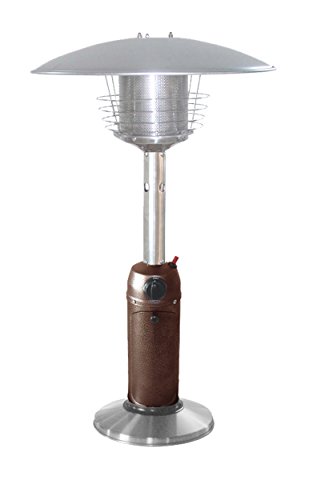 Hiland tabletop11,000 BTU heats a table, not a patio, and being clear about that is the whole point. For a bistro table on a balcony it is the right size and nothing bigger fits. | One table, four people | 11,000 BTU | 550 sq ft | $126.54 · Check on Amazon |
| 4 |  Amazon Basics 46kOne of the very few towers whose maker publishes a coverage radius rather than a vague area, and the 9 ft figure survives the arithmetic. That alone puts it ahead of most of the field. | The published-radius honesty test | 46,000 BTU | 254 sq ft claimed | $156.16 · Check on Amazon |
Reach marked “claimed” is the maker’s own published figure. Reach without that label is ours, computed from published output at 20 BTU per square foot for an open patio. Neither is a measurement we took.
Top pick · Wind, and anywhere with a roof
Dr Infrared Heater DR-238 Carbon Infrared Patio Heater with Kasa Outdoor Smart Plug
Radiant heat that a breeze cannot blow out, on a plug. 1,500 W is only 5,118 BTU/h, which sounds like nothing next to a propane tower and lands far more of itself on you.
- Fuel
- Electric
- Output
- 1,500 W = 5,118 BTU/h
- Reach (computed)
- 256 sq ft · 9.0 ft radius
- Cost per hour
- $0.28
What works
- Infrared warms objects, not air, so it is the only heat that survives a breeze — this is the single reason wind changes the whole buying decision
- No combustion means no flue gas, which is what makes it legal and sensible on a screened porch where propane is not
- Three settings matter more than they sound: 900 W costs a third less to run and is enough most evenings
What does not
- 1,500 W is 1,500 W. Nothing at this wattage heats faster than anything else at this wattage; the differences between electric heaters are beam shape and build, not power
- It heats what it points at. Step out of the beam and you are cold immediately — this is a fundamentally different experience from a tower
- A 120 V plug-in unit is capped by your circuit, not by the maker. See why 1,500 W is the ceiling
| Published specification | |
|---|---|
| Rated power | 1,500 W at 120 V |
| Settings | 900 W / 1,200 W / 1,500 W |
| Element | Carbon infrared lamp |
| Reflector | Mirror aluminum, 90% reflectivity per the maker |
| Housing | Anodized aluminum, rated for outdoor use |
| Mounting | Wall and ceiling brackets plus remote in the box |
| Bundle | Currently sold with a Kasa EP40 outdoor smart plug |
| Maker’s coverage claim | None published — the reach figure above is ours |
| Safety listing | ETL listed, per the maker's published product data |
Who it is for
A covered patio, pergola or screened porch where you can mount it overhead and point it at where people sit, and anywhere wind ruins a flame.
What it is not for
A big open patio with nowhere to mount it. Radiant heat needs a line of sight and a place to hang from.
2 · Leaving outside all year
Heat Storm Tradesman HS-1500-OTR-R 1500 W Weatherproof Infrared Heater
The one electric unit here with a published IP rating, which is the difference between a heater that survives a wet winter mounted outdoors and one that is a warranty claim waiting to happen.
- Fuel
- Electric
- Output
- 1,500 W = 5,118 BTU/h
- Reach (computed)
- 256 sq ft · 9.0 ft radius
- Cost per hour
- $0.28
What works
- A published IPX4 rating. Almost nobody in this category publishes an ingress rating at all, and mounting an unrated electric heater outdoors is a gamble you cannot price
- The maker publishes its own BTU figure (5,200), which is within a rounding error of the 5,118 our watts-to-BTU conversion gives — a company doing its own arithmetic honestly
- Wall or ceiling mount puts the heat above head height where a radiant beam belongs
What does not
- IPX4 rates water only — the solids digit is X, meaning none is published. It is splashing-water protection, not immersion, and it tells you nothing about dust ingress
- Fixed mounting means fixed aim. Get the position wrong and there is no adjusting it from the chair
- Same 1,500 W ceiling as every other plug-in electric heater
| Published specification | |
|---|---|
| Rated power | 1,500 W at 120 V |
| Published output | 5,200 BTU/h per the maker |
| Element | Carbon fiber infrared, per the maker |
| Weather rating | IPX4 |
| Dimensions | 27 x 8 x 6 in |
| Control | Remote included |
| Mounting | Wall or ceiling; tripod and tri-mount combos are separate SKUs |
| Maker’s coverage claim | None published — the reach figure above is ours |
| Safety listing | IPX4 weatherproof rating published by the maker |
Who it is for
A permanently mounted heater on a pergola, porch ceiling or exterior wall that you never want to take down and store.
What it is not for
Portability, and any open patio with no structure to mount to.
3 · One table, four people
Hiland HLDS032-BB Portable Table Top Patio Heater, Hammered Bronze
11,000 BTU heats a table, not a patio, and being clear about that is the whole point. For a bistro table on a balcony it is the right size and nothing bigger fits.
- Fuel
- Propane
- Output
- 11,000 BTU/h
- Reach (computed)
- 550 sq ft · 13.2 ft radius
- Cost per hour
- $0.32
What works
- Runs off a 1 lb canister, which makes it the only heater here you can carry out to a table and back with one hand
- 11,000 BTU is honest for the job: our reach arithmetic puts that at roughly a table's worth of warmth, and the unit does not pretend otherwise
- A burner screen guard on a table-height heater is a genuine safety feature, not a spec-sheet line
What does not
- 1 lb canisters are the most expensive propane per BTU you can buy — get the 20 lb adapter hose if you use it regularly
- At 38 in on a table, this puts an open flame at seated head height. Placement matters more than with any other unit here
- It will not touch an open patio. Anyone expecting a room-scale effect will be disappointed
| Published specification | |
|---|---|
| Rated input | 11,000 BTU/h, adjustable |
| Height | 38 in |
| Fuel | 1 lb canister or 20 lb cylinder, per the listing |
| Finish | Hammered bronze |
| Safety | Thermocouple, anti-tilt device, burner screen guard |
| Stability | Weight plate in the base |
| Maker’s coverage claim | None published — the reach figure above is ours |
| Safety listing | Thermocouple flame-failure cutoff and anti-tilt device per the listing |
Who it is for
A balcony, a bistro table, or a second heater that warms hands at the table while a tower does the space.
What it is not for
Heating an area. And never indoors, on a covered porch with a low ceiling, or anywhere a tablecloth can reach it.
Sources for this entry
4 · The published-radius honesty test
Amazon Basics 46,000 BTU Outdoor Propane Patio Heater
One of the very few towers whose maker publishes a coverage radius rather than a vague area, and the 9 ft figure survives the arithmetic. That alone puts it ahead of most of the field.
- Fuel
- Propane
- Output
- 46,000 BTU/h
- Reach (claimed)
- 254 sq ft · 9.0 ft radius
- Cost per hour
- $1.35
What works
- A published 9 ft radius is a 254 sq ft circle, and 46,000 BTU is far more than that area needs — a claim on the conservative side of its own specification, which is rare here
- The water-fill base box is a real anti-tip measure, not a sticker: filled, it is the difference between a windy evening and a repair bill
- One-touch ignition and a chain for the cylinder are both small things the cheap clones drop
What does not
- The listing does not name a safety certifying body, only the tilt valve, so we cannot tell you it is CSA listed
- 91 in tall with an open flame: the same wind exposure as every other tower of this shape
- The water box has to be emptied before a freeze or it splits
| Published specification | |
|---|---|
| Rated input | 46,000 BTU/h |
| Published reach | 9 ft radius |
| Dimensions | 32.1" L x 32.1" W x 91.3" H |
| Fuel | 20 lb propane cylinder, not included |
| Safety | Tilt auto-shutoff valve; chain to secure the cylinder |
| Base | Water-fill box for ballast, wheel kit included |
| Maker’s coverage claim | 9.0 ft radius, which is 254 sq ft |
| Safety listing | Tilt auto-shutoff valve; the listing does not name a certifying body |
Who it is for
An open patio where you want the largest honest circle of warmth per dollar and are happy to handle cylinders.
What it is not for
Anywhere enclosed, and anywhere the base cannot be filled with water — an empty ballast box makes this a tall, light, tippy object.
Sources for this entry
What we would skip
A list with no losers is a list nobody edited. These are the choices we would actively steer you away from, and why.
Ranking on cost per hour alone
It is the ranking every article in this category publishes and it is close to meaningless. A tabletop heater costs 32 cents an hour and a tower costs $1.40, and the tower produces four times as much heat. Cost per hour without output is a number about size, not efficiency.
Buying a heater to save money on heating
A patio heater is a comfort purchase. Even the cheapest here costs $17 to $33 a month at four hours a night, and the propane tower costs about $168. Choose the one that suits your space and then run it sensibly; there is no model here that pays for itself.
The four levers that actually reduce the bill
- Use the low setting. Most electric units offer 900 W, which is 40 percent cheaper per hour than 1,500 W and on a covered patio is usually enough. This is the single most under-used feature in the category.
- Block the wind. On our sizing model, moving from exposed to sheltered cuts the required output by about 36 percent — permanently, on every future evening. Windbreaks cost a fraction of a heater.
- Cover the space. A roof cuts the requirement by roughly another third and lets you use a much smaller heater. If a pergola is already there, mounted infrared is the cheap answer.
- Size it properly. Buying 48,000 BTU for a patio that needs 4,000 means running a large appliance on low forever. The calculator takes a minute and it is the cheapest minute on this site.
Electric, per hour
| Rated power | Per hour | 4-hour evening | Per month, 4 h a night |
|---|---|---|---|
| 750 W | $0.14 | $0.55 | $16.51 |
| 900 W | $0.17 | $0.66 | $19.81 |
| 1,200 W | $0.22 | $0.88 | $26.41 |
| 1,500 W | $0.28 | $1.10 | $33.01 |
| 2,000 W | $0.37 | $1.47 | $44.02 |
| 3,000 W | $0.55 | $2.20 | $66.02 |
At 18.34 cents per kWh (June 2026 U.S. residential average). Substitute your own rate: it is on your bill, and the arithmetic is watts ÷ 1000 x hours x rate.
Propane, per hour
| Rated input | Per hour | 4-hour evening | Per month, 4 h a night |
|---|---|---|---|
| 11,000 BTU/h | $0.32 | $1.29 | $38.61 |
| 40,000 BTU/h | $1.17 | $4.68 | $140.40 |
| 46,000 BTU/h | $1.35 | $5.38 | $161.46 |
| 48,000 BTU/h | $1.40 | $5.62 | $168.48 |
| 50,000 BTU/h | $1.46 | $5.85 | $175.50 |
At $2.674 per gallon (week ending March 30, 2026 U.S. residential average) and 91,420 BTU per gallon. Exchange-cage cylinders cost materially more per gallon than a bulk refill, so treat this as the floor.
How we picked
- Cost computed, never quoted. Every figure comes from the published rated output and the U.S. average residential energy prices this site names and sources.
- Ranked on cost per evening at realistic settings, because nobody runs a heater flat out for four hours and pretending otherwise distorts the comparison.
- Output stated alongside cost every time. A cheap heater that produces nothing is not cheap, it is small, and the ranking says which.
- Products that cannot be honestly priced are excluded — natural gas is billed per therm and varies too much by utility for a national figure to mean anything.
What we did not do
Everyone in this category says they tested twenty heaters. We have not tested any, and we say so. What we do instead: compile the published specs, compute the electrical and gas load from them, cite the maker’s own manual, and show the arithmetic so you can check it. The full method, including how to challenge a figure.
The honest summary
If you want the lowest possible running cost, the answer is a 1,500 W electric infrared heater on its 900 W setting, under a roof, behind a windbreak. That is about 17 cents an hour and roughly $20 a month at four hours a night. Everything above it on the list produces more heat and costs proportionally more to do it. The genuinely cheapest option on this site is not a heater at all: a battery heated blanket runs at a fraction of a cent an hour, because it warms a person rather than the outdoors.
Common questions
What is the cheapest patio heater to run?
An electric infrared heater on its lower setting, at about 17 cents an hour at 900 W. It is also the smallest output on this page, which is the trade. Per unit of heat, propane is the cheaper fuel at about 2.9 cents per thousand BTU against 5.5 for electricity.
Is electric or propane cheaper for a patio heater?
Per hour, electric, because it produces less heat. Per unit of heat delivered, propane, at roughly half the cost per thousand BTU. Which one saves you money depends on whether you actually need a propane tower's output.
Are some patio heaters more efficient than others?
Not at converting fuel into heat — they all convert nearly all of it. What differs is where the heat goes. An infrared heater aimed at people delivers more comfort per dollar than a tower warming air that rises, without being more efficient in a thermodynamic sense.
How much does it cost to run a patio heater all evening?
About $1.10 for four hours on a 1,500 W electric unit, and about $5.61 for the same evening on a 48,000 BTU propane tower, at published U.S. average energy prices. Over a five-month season at four hours a night that is roughly $165 and $842.
Sources
Read next
What a patio heater costs to run
Cost per hour, evening and month for electric and propane, at named prices with the formulas shown.
Heated blankets for the patio
Battery heated blankets cost a fraction of a cent an hour to run. The arithmetic, and the two models worth buying.
What a season of patio heating costs
A whole season costed out for each fuel at three usage levels — the number per-hour figures hide.
Patio windbreaks, and why they beat a bigger heater
Vinyl, mesh and curtains compared, with what enclosing a patio changes about your heater choice.
Electric patio heaters, and the ceiling nobody mentions
Four electric patio heaters compared on wattage, published IP rating and cost per hour.
Patio heater BTU calculator
Your patio's BTU requirement with every multiplication shown, plus why the published rules disagree.
Electric vs propane patio heaters
Output, cost, coverage, wind and installation compared, with the arithmetic and picks for both answers.