Hanging
Hanging patio heaters
A heater suspended from a pergola beam is more exposed than one bolted to a house wall, not less. Almost every listing in this category is silent about that.

Work out what you are hanging it from before you choose the heater. A beam or a joist carries it; a pergola slat does not. Then judge on the published ingress rating, because an overhead unit under open slats gets rained on and most listings in this category publish nothing at all. Standard 120 V units are capped at 1,500 W; going higher means a 240 V circuit.
Why hanging is a different problem from wall mounting
It is tempting to treat these as the same purchase, and the shops encourage it — most of the units are sold as "wall or ceiling" and the box contains hardware for both. The appliance really is the same. The installation is not.
A wall-mounted heater sits against a vertical surface, usually under an eave, usually sheltered from above by the building itself. A hung heater sits under whatever you hung it from — and the reason people hang heaters is that they have a pergola, a gazebo or an open porch frame, which is to say a structure with gaps in it.
So the hung unit is in a wetter, windier position than the wall unit, while being the one more often sold without a published weather rating. That inversion is the whole reason this page exists separately from the wall-mounted roundup, and it is worth saying plainly before any product: a pergola is not a roof.
What it hangs from
This decides more than the heater does, and it is the part that gets the least thought.
- A pergola beam — the horizontal members carrying the structure, not the slats laid across them. Find the beam, mount into the beam. If you cannot tell which is which, the beam is the one the others sit on.
- A porch or soffit joist — solid and predictable, but hidden behind the ceiling board. A stud finder and a second opinion beat a confident guess, because a fixing into board alone will hold right up until the first cold night it is actually used.
- A gazebo frame — usually the best case, since the frame is visible and the load path is obvious. Check that it is rated for anything at all first; some are aluminum sections that flex.
- A fabric canopy — no. Nothing hangs from fabric, and the answer for a table under a canopy is an umbrella heater clamped to the pole instead.
The load is not just the weight
These units are light — typically under ten pounds — and that makes the fixing feel trivial. It is not. A hung heater is a lever arm in wind, and the force at the fixing is far higher than the static weight suggests. Fix it as though it weighed several times what it does, into structure rather than into cladding.
Quick picks
Ranked for fit, not for hype. Output is the maker’s published figure; reach is computed from it or from the maker’s own radius claim, and the table says which. Tap a row for the full write-up, or go straight to the listing.
| # | Product | Best for | Output | Reach | Price |
|---|---|---|---|---|---|
| 1 | 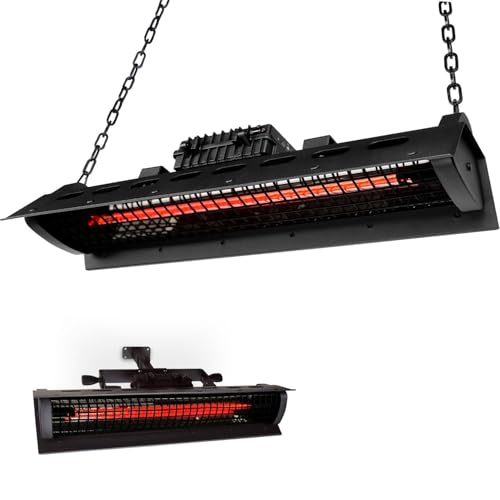 Star Patio STP2020-AOne of the very few electric units whose maker publishes a coverage area at all — 110 sq ft — and it mounts to a wall or hangs from a ceiling on chains. No ingress rating is published, so keep it somewhere sheltered. | A published coverage figure | 1,500 W | 110 sq ft claimed | $199.99 · Check on Amazon |
| 2 |  Dr Infrared 1500 WRadiant heat that a breeze cannot blow out, on a plug. 1,500 W is only 5,118 BTU/h, which sounds like nothing next to a propane tower and lands far more of itself on you. | Wind, and anywhere with a roof | 1,500 W | 256 sq ft | $148.98 · Check on Amazon |
| 3 |  Dr Infrared DR-239The rare overhead heater whose maker publishes both a safety listing and an ingress rating, at double the output a standard socket allows. The catch is in that last clause: it wants a 220-240 V circuit, so it is an electrician's job rather than a plug-in. | A ceiling mount with a published weather rating | 10,260 BTU | 513 sq ft | $293.20 · Check on Amazon-16% |
Reach marked “claimed” is the maker’s own published figure. Reach without that label is ours, computed from published output at 20 BTU per square foot for an open patio. Neither is a measurement we took.
Top pick · A published coverage figure
Star Patio STP2020-A-RMN2025 Wall and Ceiling Electric Infrared Patio Heater
One of the very few electric units whose maker publishes a coverage area at all — 110 sq ft — and it mounts to a wall or hangs from a ceiling on chains. No ingress rating is published, so keep it somewhere sheltered.
- Fuel
- Electric
- Output
- 1,500 W = 5,118 BTU/h
- Reach (claimed)
- 110 sq ft · 5.9 ft radius
- Cost per hour
- $0.28
What works
- It publishes a coverage figure. 110 sq ft is a real, checkable claim, and almost nobody in this category states one at all — which is the whole subject of our coverage page
- Wall bracket and ceiling chains both in the box, with 60 degrees of tilt, so the beam can actually be aimed at the chairs rather than at whatever the bracket decided
- 5,100 BTU/h published output is within a rounding error of the 5,118 our watts-to-BTU conversion gives, which is a maker doing its own arithmetic honestly
- Remote control on a unit mounted above head height is functional rather than a luxury
What does not
- No ingress rating is published for this model. Other units in this roundup publish one, and on a permanently mounted outdoor appliance that silence means you cannot price the weather risk. Treat it as a sheltered-position heater
- 110 sq ft is a small area — roughly a 10 by 11 ft patch, which is a seating group and not a patio
- 1,500 W, like everything else that plugs into a standard socket. The ceiling applies here as everywhere
- A 6 ft cord means the outlet has to be close, or an outdoor-rated extension has to be part of the plan
| Published specification | |
|---|---|
| Rated power | 1,500 W at 110 V, 60 Hz |
| Published output | 5,100 BTU/h per the maker |
| Published coverage | Up to 110 sq ft per the maker |
| Element | Golden tube |
| Mounting | Wall bracket or ceiling chains, up to 60 degrees of tilt |
| Size and weight | 27.5 x 7 x 5.7 in, 7.7 lb |
| Element life | 5,000 hours per the maker |
| Maker’s coverage claim | 110 sq ft |
| Safety listing | No ingress rating published for this model |
Who it is for
A sheltered wall or porch ceiling over a seating group, where you want a heater whose maker will tell you what area it actually covers.
What it is not for
An exposed wall where driving rain reaches it, since nothing is published about ingress protection, or any space much larger than a seating group.
2 · Wind, and anywhere with a roof
Dr Infrared Heater DR-238 Carbon Infrared Patio Heater with Kasa Outdoor Smart Plug
Radiant heat that a breeze cannot blow out, on a plug. 1,500 W is only 5,118 BTU/h, which sounds like nothing next to a propane tower and lands far more of itself on you.
- Fuel
- Electric
- Output
- 1,500 W = 5,118 BTU/h
- Reach (computed)
- 256 sq ft · 9.0 ft radius
- Cost per hour
- $0.28
What works
- Infrared warms objects, not air, so it is the only heat that survives a breeze — this is the single reason wind changes the whole buying decision
- No combustion means no flue gas, which is what makes it legal and sensible on a screened porch where propane is not
- Three settings matter more than they sound: 900 W costs a third less to run and is enough most evenings
What does not
- 1,500 W is 1,500 W. Nothing at this wattage heats faster than anything else at this wattage; the differences between electric heaters are beam shape and build, not power
- It heats what it points at. Step out of the beam and you are cold immediately — this is a fundamentally different experience from a tower
- A 120 V plug-in unit is capped by your circuit, not by the maker. See why 1,500 W is the ceiling
| Published specification | |
|---|---|
| Rated power | 1,500 W at 120 V |
| Settings | 900 W / 1,200 W / 1,500 W |
| Element | Carbon infrared lamp |
| Reflector | Mirror aluminum, 90% reflectivity per the maker |
| Housing | Anodized aluminum, rated for outdoor use |
| Mounting | Wall and ceiling brackets plus remote in the box |
| Bundle | Currently sold with a Kasa EP40 outdoor smart plug |
| Maker’s coverage claim | None published — the reach figure above is ours |
| Safety listing | ETL listed, per the maker's published product data |
Who it is for
A covered patio, pergola or screened porch where you can mount it overhead and point it at where people sit, and anywhere wind ruins a flame.
What it is not for
A big open patio with nowhere to mount it. Radiant heat needs a line of sight and a place to hang from.
3 · A ceiling mount with a published weather rating
Dr Infrared Heater DR-239 3000 W Wall or Ceiling Mount Infrared Patio Heater
The rare overhead heater whose maker publishes both a safety listing and an ingress rating, at double the output a standard socket allows. The catch is in that last clause: it wants a 220-240 V circuit, so it is an electrician's job rather than a plug-in.
- Fuel
- Electric
- Output
- 10,260 BTU/h
- Reach (computed)
- 513 sq ft · 12.8 ft radius
- Cost per hour
- $0.55
What works
- It publishes an ingress rating and a safety listing. IP55 and ETL together are unusual in this category and close to unheard of on something designed to hang — which matters more overhead than on a wall, because pergola slats are not a roof
- 3,000 W is double what a standard outlet allows. The 1,500 W ceiling is a property of the circuit, not the heater, and this is what stepping past it looks like
- Two power levels on the remote means the full 3,000 W is a choice rather than the only setting, which matters when the running cost is also double
- Wall and ceiling hardware both in the box, so the mounting decision does not cost extra or arrive wrong
What does not
- It needs a 220-240 V circuit. That is an electrician, a permit in many places, and a cost that can exceed the heater. If you were planning to plug something in, this is not it
- 3,000 W costs about 55 cents an hour at the national average electricity price, roughly double a standard 1,500 W unit. More heat is not free
- No coverage area is published, so any reach figure for it on this site is ours and computed rather than the maker's
- The output is genuinely more than a small covered patio needs, and oversizing an electric heater buys nothing except a larger bill
| Published specification | |
|---|---|
| Rated power | 3,000 W at 220-240 V |
| Published output | 10,260 BTU/h per the maker |
| Element | Carbon infrared |
| Ingress rating | IP55 per the maker |
| Safety listing | ETL listed per the maker |
| Mounting | Wall or ceiling, brackets and hardware in the box |
| Control | Remote, two power levels plus standby |
| Housing | Anodized aluminum |
| Maker’s coverage claim | None published — the reach figure above is ours |
| Safety listing | ETL listed and IP55 rated, both per the maker's published product data |
Who it is for
A pergola, porch ceiling or covered terrace where a new circuit is already part of the job, and where a published weather rating matters because the position is exposed.
What it is not for
Anyone without 220-240 V at the mounting point, or any space small enough that 1,500 W already does the job.
Sources for this entry
- Amazon listing — DR-239 3000 W wall or ceiling mount, IP55, 220-240 V, remote and mounting kit
- Dr. Infrared Heater — DR-239 published specification (3,000 W, 220-240 V, 10,260 BTU, carbon infrared element, IP55, ETL listed, ceiling or wall installation, remote with two power modes, anodized aluminum)
What we would skip
A list with no losers is a list nobody edited. These are the choices we would actively steer you away from, and why.
Hanging anything from a pergola slat
The single most common mistake here. Slats are decorative infill spanning between beams; they carry their own weight and nothing else. The load goes into a beam or a joist, found deliberately, or the heater comes down — usually with the slat still attached.
A long chain because it looks better
Every extra inch of chain is extra swing. A hung heater is a pendulum, and wind is what sets it moving — which changes where the heat points and how close the unit gets to whatever is beside it. Hang it as short as head clearance allows.
An indoor ceiling heater used outdoors
Bathroom and garage ceiling heaters look identical to these and are built for an environment with a roof and no rain. Outdoors they fail at the housing, not the element, and that failure is an electrical one directly above people.
Chain or bracket
The two ways these go up, and they behave completely differently once they are up.
A chain suits a high ceiling. It lets you bring the heater down to a useful height from a beam that is well above head level, and it is quick to install because a hook and a chain are more forgiving than a bracket that has to sit flat. What you accept is movement: a chain-hung unit swings, and in wind it swings continuously.
A rigid bracket holds the aim. It does not move, it does not rotate, and the heat stays pointed at the chairs rather than wandering across the patio. What you accept is that the mounting height is whatever the structure gives you, and on a high pergola that can be too high to be useful.
The practical rule: chain only as far down as you need, and never for the sake of appearance. Every extra inch is more swing and more distance between the fixing and the load. If the beam is already at a sensible height, a bracket is the better answer.
Swing, wind and where the heat actually goes
This is the failure mode that does not appear in any listing, and it connects directly to the one subject this site keeps returning to.
Radiant heat goes where the unit points. A hung heater that is swinging through even a few degrees is sweeping its beam back and forth across the patio, so the people it was aimed at get intermittent heat rather than steady heat — and the sensation of intermittent radiant heat is being cold, punctuated. The heater is working perfectly. It is just not pointing at you most of the time.
The fixes are cheap and mechanical rather than electrical: shorten the chain, add a second fixing point to triangulate the unit, or accept a rigid bracket. And, as always on this site, deal with the wind itself before buying more heater — a screen on the prevailing side stops the swing and the heat loss at the same time.
Height, aim and clearance
Three numbers to settle before you drill, in this order.
- Head clearance below. The bottom of the unit clears the tallest person who will stand under it, with margin. This sets the maximum drop, and everything else works within it.
- Clearance above and to the sides. Every one of these publishes a minimum distance to combustible material, and a pergola beam directly above a heater is combustible material. This is the figure people skip, and it is the one that matters — the clearances page has the published numbers.
- Aim at shoulders, not at the floor. A unit pointed straight down heats the paving. Angled toward where seated people are is the difference between a heater that works and one that technically operates, which is why tilt is worth more than watts here.
For the 240 V unit read in full — including what its IP55 rating actually covers and when the cheaper 120 V model is the better buy — see our Dr Infrared DR-239 review.
Power at height, and the 240 volt question
Two problems arrive together once the heater is overhead: the cable has to get there, and the outlet is rarely where the beam is.
A cord dangling from a pergola down to a socket is the worst answer available — it is in the way, it is a trip hazard across a patio, and it is the part of the installation that ages badly. The good answer is a circuit run to the mounting point, which is electrician work.
And once that is true, the usual arithmetic changes. On a plug-in heater, 1,500 W is a hard ceiling set by the circuit rather than the appliance. If an electrician is already running a new line to a beam, running a 240 V one instead is a marginal extra rather than a new project — which is the single situation where a 3,000 W unit makes sense for a domestic patio.
What each costs to run
1,500 W is about 28 cents an hour at the national average electricity price this site cites. 3,000 W is about 55 cents. Double the heat is double the bill, which is fine if the space needs it and wasteful if it does not — a covered seating group generally does not.
The rating almost nobody publishes
Of everything on this page, this is the specification we would check first and the one you will most often fail to find.
An IP rating is two digits: solids, then liquids. For a heater living under open pergola slats, the second digit is the one that matters, and the difference between a unit rated against splashing and one rated against directed water is the difference between a fitting that survives a storm and one that does not.
The honest position is that most hanging heaters do not publish one, including two of the three picks above. That does not make them bad appliances — it makes them sheltered-position appliances, and a porch ceiling is a sheltered position while an open pergola is not. Where a maker does publish a rating, it is worth paying for, and this is the clearest case on the site where you are buying documentation as much as hardware.
The short version
Find the beam first. Hang it as short as head clearance allows, on a bracket if the height suits and a chain if it does not. Check the published clearance to whatever is above it, because that is usually timber. And if the position is genuinely open to the sky, buy the one that publishes a weather rating — under a pergola that is not a specification detail, it is the whole question.
Common questions
Can you hang a patio heater from a pergola?
Yes, from a beam - not from the slats laid across it. Slats are decorative infill that carry their own weight and nothing else. Find the structural beam, fix into that, and check the heater's published minimum clearance to combustible material, because a timber beam directly above it is exactly that.
Are hanging patio heaters any good?
They put the heat where it works best - overhead, angled down at people - and they use no floor space. The catch is that the position is usually more exposed than a wall mount, under pergola slats or an open frame, while fewer of them publish a weather rating. Good product, under-documented category.
How high should a hanging patio heater be?
As low as head clearance allows. The bottom of the unit should clear the tallest person standing under it with margin, and no lower drop than that is useful - every extra inch of chain is extra swing in wind. Then check the maker's stated clearance to anything above and beside it.
Do hanging patio heaters swing in the wind?
Chain-hung ones do, and it matters more than it sounds. Radiant heat goes where the unit points, so a swinging heater sweeps its beam back and forth across the patio and the people it was aimed at get intermittent warmth. Shorten the chain, add a second fixing point, or use a rigid bracket.
Do you need an electrician for a hanging patio heater?
For a tidy job, usually - the outlet is rarely where the beam is, and a cord dangling down to a socket is the worst option available. A 120 V unit can be plugged in if a socket is genuinely close. Anything above 1,500 W needs a 220-240 V circuit, which is electrician work by definition.
What IP rating does a hanging patio heater need?
It depends on what is above it. Under a solid porch ceiling, a sheltered-position unit with no published rating is defensible. Under open pergola slats, rain reaches it, and there you want a maker that publishes an ingress rating rather than one that stays silent about it.
Read next
Wall mounted patio heaters, and the rating that decides
Wall and ceiling mounted electric heaters, ranked on published weather rating and mounting.
Patio umbrella heaters
Heaters that clamp to an umbrella pole, what the umbrella has to take, and when a tower is the better answer.
Heating a pergola
Why a pergola is ideal for mounted infrared, plus mounting height, clearance and picks.
Heating a gazebo
Open sides or zipped down — the question that decides which heater a gazebo can take.
Electric patio heaters, and the ceiling nobody mentions
Four electric patio heaters compared on wattage, published IP rating and cost per hour.
Dr Infrared DR-239 review
What leaving the 1,500 W ceiling actually buys, what IP55 and ETL cover, and when the 120 V model is the smarter purchase.