Safety switch
Resetting a patio heater tip-over switch
It fell over, you stood it up, and now it will not light at all. That is a deliberate safety latch, and it usually clears in under a minute once you know what it wants.
Stand the heater fully upright on level ground and leave it for a minute or two, then relight normally holding the knob for the full 20 to 30 seconds. Most tip-over switches reset themselves once vertical. If it still will not light, the switch or the thermocouple has failed and both are inexpensive parts.
What the switch is and why it latches
A tip-over switch is a simple device — usually a weighted ball or a mercury contact — that opens the gas circuit the moment the heater leaves vertical. Its whole purpose is to shut the fuel off before a fallen heater becomes an open flame lying against something.
Because it is simple, it is also blunt. Many designs do not reset instantly. The unit has to be genuinely upright and, on some, the mechanism has to settle. That is why the common experience is: it fell, you stood it up, it will not light, and it seems dead.
The reset, in order
- Close the cylinder valve. Before anything else. If the heater has been on its side, assume gas may have escaped and let it clear.
- Inspect the hose and regulator. Look for kinks, crushing, splits or a perished feel. A damaged hose is a replace, not a repair, and this is the moment to catch it.
- Stand the unit fully upright on level ground. Not leaning, not on a slope. The switch cares about vertical.
- Wait one to two minutes. This is the step people skip. Some switches need the mechanism to settle before the circuit closes.
- Open the cylinder valve and leak-test. Soapy water on every joint. Bubbles mean stop and fix; no bubbles means continue.
- Relight normally, holding the control knob down for the full 20 to 30 seconds so the thermocouple gets properly hot.
The leak test is not optional
A heater that has fallen has stressed every joint in its gas train. Soapy water on the cylinder connection, the regulator, the hose ends and the valve body takes ninety seconds. Do it before relighting, every single time, without exception.
If it still will not light
The reset has failed and something is actually broken. There are three realistic candidates and they are distinguishable.
| Symptom after the reset | Most likely cause | Fix |
|---|---|---|
| No pilot at all, no spark | The igniter, or the tip-over switch stuck open | Try a match at the pilot. If it lights, the igniter is the problem. If not, suspect the switch. |
| Pilot lights but dies on releasing the knob | Thermocouple — the commonest failure in the category | Replace it. Inexpensive part. |
| Pilot lights and holds, main burner will not | Control valve, or a blocked main orifice | Clean the orifice; if that fails, the valve is the part. |
| Nothing at all, and the switch rattles | Tip-over switch physically damaged in the fall | Replaceable. The repair kit includes one. |
Quick picks
Ranked for fit, not for hype. Output is the maker’s published figure; reach is computed from it or from the maker’s own radius claim, and the table says which. Tap a row for the full write-up, or go straight to the listing.
| # | Product | Best for | Output | Reach | Price |
|---|---|---|---|---|---|
| 1 | 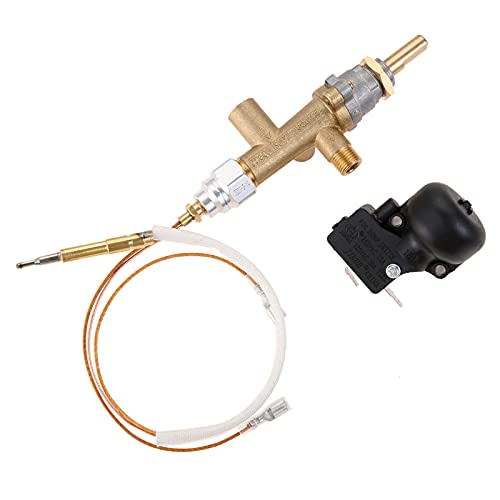 Thermocouple repair kitThe single most common patio-heater failure is a tired thermocouple, and the symptom is precise: it lights, you release the knob, it goes out. This kit is the fix, and it is cheap. | A heater that lights and dies | n/a | n/a | $19.98 · Check on Amazon |
Reach marked “claimed” is the maker’s own published figure. Reach without that label is ours, computed from published output at 20 BTU per square foot for an open patio. Neither is a measurement we took.
Top pick · A heater that lights and dies
Propane Patio Heater Repair Kit — Thermocouple, Dump Switch and Control Valve
The single most common patio-heater failure is a tired thermocouple, and the symptom is precise: it lights, you release the knob, it goes out. This kit is the fix, and it is cheap.
- Fuel
- Accessory
- Output
- Not published
- Reach (computed)
- Not published
- Cost per hour
- n/a
What works
- It matches the exact symptom in our fault tree: flame holds while the knob is pressed, dies when released. That is a thermocouple, nearly every time
- Including the dump switch is sensible, because a heater that has fallen over often has both problems at once
- The parts cost a small fraction of a new heater, and this is the repair that keeps a five-year-old tower going
What does not
- Check the fit before ordering. The gas train is broadly standard across cheap towers but not universal — compare your existing part to the listing photographs
- Working on a gas appliance means a leak test with soapy water afterwards, every time, without exception
- If you are not comfortable disconnecting a gas line, this is the point to stop and call someone
| Published specification | |
|---|---|
| Contents | Thermocouple sensor, tilt dump switch, main control valve with pilot port |
| Fits | Common propane patio heaters using the standard gas train |
| Tools | Adjustable wrench; no gas fitting beyond the cylinder connection |
| Maker’s coverage claim | None published — the reach figure above is ours |
| Safety listing | Not applicable — replacement gas-train parts, not an appliance |
Who it is for
Anyone whose propane heater lights but will not stay lit, and who owns an adjustable wrench.
What it is not for
Electric heaters, which fail for [entirely different reasons](/troubleshooting/electric-not-working).
Sources for this entry
Do not bypass it
It is worth saying plainly, because the advice exists online. A tip-over switch can be jumped out, and the heater will then light and run.
It will also keep running when it falls over. The switch is the only thing standing between a tall, top-heavy, open-flame appliance and a fire when a gust arrives. Replacing a failed one costs very little. Bypassing it removes the single most important safety feature on the unit, and it is not something we will explain how to do.
Stopping it from happening again
The switch did its job. The reason it had to is that the heater fell over, and that is the fixable part. Fill the ballast reservoir, secure the cylinder, use the anchor stakes, and put the unit against a wall rather than in the open — the full list is here.
And if the patio is exposed enough that this keeps happening, the real answer is upstream: a windbreak or a heater with no flame to protect.
Common questions
How do I reset a patio heater tip-over switch?
Close the cylinder valve, check the hose and regulator for damage, stand the heater fully upright on level ground, and wait a minute or two before reopening the gas. Then leak-test with soapy water and relight normally, holding the knob for the full 20 to 30 seconds.
Why will my patio heater not light after falling over?
The tip-over switch has cut the gas circuit, which is exactly what it is for. Most reset once the unit is genuinely vertical and has been left for a moment. If it still will not light, the switch, the igniter or the thermocouple may have been damaged in the fall.
Can you bypass a patio heater tip-over switch?
Physically yes, and you should not. It is the only thing that shuts the gas off when a tall open-flame appliance falls over. A replacement switch is inexpensive and widely available; bypassing one removes the most important safety feature the heater has.
How much does a tip-over switch cost to replace?
It is one of the cheapest parts on a patio heater, and it is commonly sold in a kit alongside a thermocouple and a control valve — which is convenient, because a heater that has fallen often needs more than one of them.
Read next
Patio heater will not stay lit
The ordered diagnostic for a heater that lights and dies, ending in the part that fixes it.
How to stop a patio heater blowing over
Ballast, anchors and placement — the three fixes, in the order they matter.
Patio heater replacement parts
The four parts that account for nearly every dead heater, with symptoms and measuring advice.
Patio windbreaks, and why they beat a bigger heater
Vinyl, mesh and curtains compared, with what enclosing a patio changes about your heater choice.