Screened porches
Heating a screened porch
This is the one space where the answer is short. Electric, mounted, and no exceptions — a screened enclosure does not have the airflow a combustion heater requires.
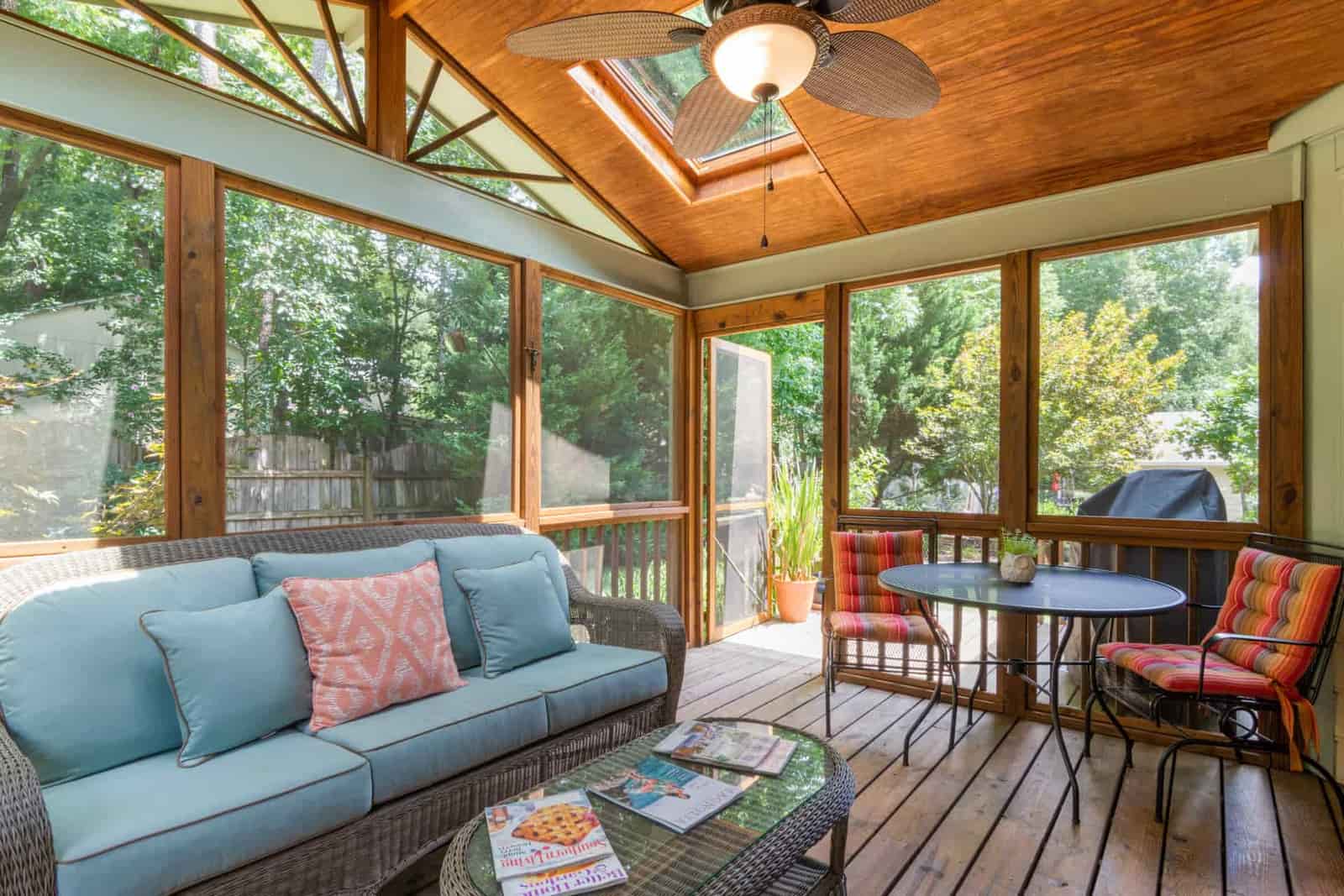
Use an electric heater, mounted on the ceiling or a wall. A screened porch does not have the airflow a gas heater requires, so propane and natural gas are out entirely. A screened porch also retains heat well — about half the output an open patio of the same size would need.
Why gas is out, stated once and clearly
A propane or natural gas heater burns fuel in the air around it. That consumes oxygen and produces combustion products, including carbon monoxide. Outdoors, air movement disperses all of it continuously and there is no issue.
A screened porch has a roof and screens on most or all sides. Screens pass some air, and considerably less than open sides do — that is what they are for. It is an enclosure, and the manuals for these appliances say outdoor use only without qualification.
There is no product that resolves this, no ventilation arrangement we would recommend, and no threshold at which it becomes acceptable. It is the one place on this site where the answer is genuinely binary. If your porch is screened, the heater is electric.
The good news about screened porches
They are the easiest outdoor space to heat, by a wide margin, and it follows from the same enclosure that rules gas out.
A roof stops warmed air rising away. Screens cut the air movement that would otherwise carry it sideways. On our sizing model that combination halves the requirement compared with an open patio of the same area — a factor of 0.5 against 1.0.
| Patio area | Open sky, no roof | Roof overhead, open sides | Roof plus screens or partial walls |
|---|---|---|---|
| 100 sq ft | 2,000 BTU/h | 1,300 BTU/h | 1,000 BTU/h |
| 150 sq ft | 3,000 BTU/h | 1,950 BTU/h | 1,500 BTU/h |
| 200 sq ft | 4,000 BTU/h | 2,600 BTU/h | 2,000 BTU/h |
| 250 sq ft | 5,000 BTU/h | 3,250 BTU/h | 2,500 BTU/h |
| 300 sq ft | 6,000 BTU/h | 3,900 BTU/h | 3,000 BTU/h |
| 400 sq ft | 8,000 BTU/h | 5,200 BTU/h | 4,000 BTU/h |
Area x 20 BTU per square foot for an open patio, then multiplied by 0.65 for a roof and 0.5 for a roof plus screens, and by 1 for average exposure. The reconciliation of where each factor comes from is on this page, not hidden.
So a 300 sq ft screened porch needs about 3,000 BTU/h, and a single 1,500 W electric unit at 5,118 BTU/h covers it with room to spare, at about 28 cents an hour. That is a genuinely comfortable space for the running cost of a lamp.
Quick picks
Ranked for fit, not for hype. Output is the maker’s published figure; reach is computed from it or from the maker’s own radius claim, and the table says which. Tap a row for the full write-up, or go straight to the listing.
| # | Product | Best for | Output | Reach | Price |
|---|---|---|---|---|---|
| 1 |  Dr Infrared 1500 WRadiant heat that a breeze cannot blow out, on a plug. 1,500 W is only 5,118 BTU/h, which sounds like nothing next to a propane tower and lands far more of itself on you. | Wind, and anywhere with a roof | 1,500 W | 256 sq ft | $148.98 · Check on Amazon |
| 2 | 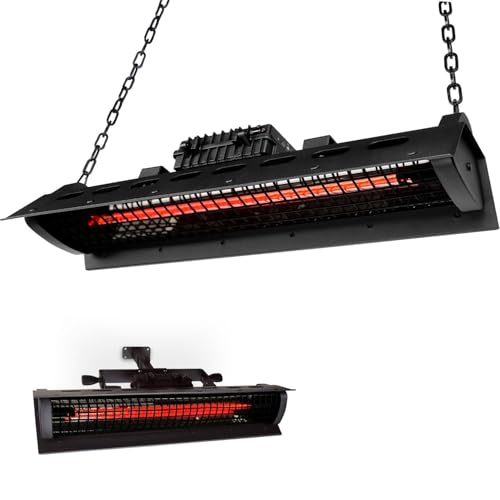 Star Patio STP2020-AOne of the very few electric units whose maker publishes a coverage area at all — 110 sq ft — and it mounts to a wall or hangs from a ceiling on chains. No ingress rating is published, so keep it somewhere sheltered. | A published coverage figure | 1,500 W | 110 sq ft claimed | $199.99 · Check on Amazon |
| 3 |  Heat Storm TradesmanThe one electric unit here with a published IP rating, which is the difference between a heater that survives a wet winter mounted outdoors and one that is a warranty claim waiting to happen. | Leaving outside all year | 1,500 W | 256 sq ft | $99.99 · Check on Amazon-8% |
Reach marked “claimed” is the maker’s own published figure. Reach without that label is ours, computed from published output at 20 BTU per square foot for an open patio. Neither is a measurement we took.
Top pick · Wind, and anywhere with a roof
Dr Infrared Heater DR-238 Carbon Infrared Patio Heater with Kasa Outdoor Smart Plug
Radiant heat that a breeze cannot blow out, on a plug. 1,500 W is only 5,118 BTU/h, which sounds like nothing next to a propane tower and lands far more of itself on you.
- Fuel
- Electric
- Output
- 1,500 W = 5,118 BTU/h
- Reach (computed)
- 256 sq ft · 9.0 ft radius
- Cost per hour
- $0.28
What works
- Infrared warms objects, not air, so it is the only heat that survives a breeze — this is the single reason wind changes the whole buying decision
- No combustion means no flue gas, which is what makes it legal and sensible on a screened porch where propane is not
- Three settings matter more than they sound: 900 W costs a third less to run and is enough most evenings
What does not
- 1,500 W is 1,500 W. Nothing at this wattage heats faster than anything else at this wattage; the differences between electric heaters are beam shape and build, not power
- It heats what it points at. Step out of the beam and you are cold immediately — this is a fundamentally different experience from a tower
- A 120 V plug-in unit is capped by your circuit, not by the maker. See why 1,500 W is the ceiling
| Published specification | |
|---|---|
| Rated power | 1,500 W at 120 V |
| Settings | 900 W / 1,200 W / 1,500 W |
| Element | Carbon infrared lamp |
| Reflector | Mirror aluminum, 90% reflectivity per the maker |
| Housing | Anodized aluminum, rated for outdoor use |
| Mounting | Wall and ceiling brackets plus remote in the box |
| Bundle | Currently sold with a Kasa EP40 outdoor smart plug |
| Maker’s coverage claim | None published — the reach figure above is ours |
| Safety listing | ETL listed, per the maker's published product data |
Who it is for
A covered patio, pergola or screened porch where you can mount it overhead and point it at where people sit, and anywhere wind ruins a flame.
What it is not for
A big open patio with nowhere to mount it. Radiant heat needs a line of sight and a place to hang from.
2 · A published coverage figure
Star Patio STP2020-A-RMN2025 Wall and Ceiling Electric Infrared Patio Heater
One of the very few electric units whose maker publishes a coverage area at all — 110 sq ft — and it mounts to a wall or hangs from a ceiling on chains. No ingress rating is published, so keep it somewhere sheltered.
- Fuel
- Electric
- Output
- 1,500 W = 5,118 BTU/h
- Reach (claimed)
- 110 sq ft · 5.9 ft radius
- Cost per hour
- $0.28
What works
- It publishes a coverage figure. 110 sq ft is a real, checkable claim, and almost nobody in this category states one at all — which is the whole subject of our coverage page
- Wall bracket and ceiling chains both in the box, with 60 degrees of tilt, so the beam can actually be aimed at the chairs rather than at whatever the bracket decided
- 5,100 BTU/h published output is within a rounding error of the 5,118 our watts-to-BTU conversion gives, which is a maker doing its own arithmetic honestly
- Remote control on a unit mounted above head height is functional rather than a luxury
What does not
- No ingress rating is published for this model. Other units in this roundup publish one, and on a permanently mounted outdoor appliance that silence means you cannot price the weather risk. Treat it as a sheltered-position heater
- 110 sq ft is a small area — roughly a 10 by 11 ft patch, which is a seating group and not a patio
- 1,500 W, like everything else that plugs into a standard socket. The ceiling applies here as everywhere
- A 6 ft cord means the outlet has to be close, or an outdoor-rated extension has to be part of the plan
| Published specification | |
|---|---|
| Rated power | 1,500 W at 110 V, 60 Hz |
| Published output | 5,100 BTU/h per the maker |
| Published coverage | Up to 110 sq ft per the maker |
| Element | Golden tube |
| Mounting | Wall bracket or ceiling chains, up to 60 degrees of tilt |
| Size and weight | 27.5 x 7 x 5.7 in, 7.7 lb |
| Element life | 5,000 hours per the maker |
| Maker’s coverage claim | 110 sq ft |
| Safety listing | No ingress rating published for this model |
Who it is for
A sheltered wall or porch ceiling over a seating group, where you want a heater whose maker will tell you what area it actually covers.
What it is not for
An exposed wall where driving rain reaches it, since nothing is published about ingress protection, or any space much larger than a seating group.
3 · Leaving outside all year
Heat Storm Tradesman HS-1500-OTR-R 1500 W Weatherproof Infrared Heater
The one electric unit here with a published IP rating, which is the difference between a heater that survives a wet winter mounted outdoors and one that is a warranty claim waiting to happen.
- Fuel
- Electric
- Output
- 1,500 W = 5,118 BTU/h
- Reach (computed)
- 256 sq ft · 9.0 ft radius
- Cost per hour
- $0.28
What works
- A published IPX4 rating. Almost nobody in this category publishes an ingress rating at all, and mounting an unrated electric heater outdoors is a gamble you cannot price
- The maker publishes its own BTU figure (5,200), which is within a rounding error of the 5,118 our watts-to-BTU conversion gives — a company doing its own arithmetic honestly
- Wall or ceiling mount puts the heat above head height where a radiant beam belongs
What does not
- IPX4 rates water only — the solids digit is X, meaning none is published. It is splashing-water protection, not immersion, and it tells you nothing about dust ingress
- Fixed mounting means fixed aim. Get the position wrong and there is no adjusting it from the chair
- Same 1,500 W ceiling as every other plug-in electric heater
| Published specification | |
|---|---|
| Rated power | 1,500 W at 120 V |
| Published output | 5,200 BTU/h per the maker |
| Element | Carbon fiber infrared, per the maker |
| Weather rating | IPX4 |
| Dimensions | 27 x 8 x 6 in |
| Control | Remote included |
| Mounting | Wall or ceiling; tripod and tri-mount combos are separate SKUs |
| Maker’s coverage claim | None published — the reach figure above is ours |
| Safety listing | IPX4 weatherproof rating published by the maker |
Who it is for
A permanently mounted heater on a pergola, porch ceiling or exterior wall that you never want to take down and store.
What it is not for
Portability, and any open patio with no structure to mount to.
What we would skip
A list with no losers is a list nobody edited. These are the choices we would actively steer you away from, and why.
Any propane or natural gas heater
This is the whole page. A gas heater consumes oxygen and produces combustion gases including carbon monoxide. A screened porch has a roof and enough enclosure that air does not move freely through it. Every manual in the category restricts these appliances to outdoor use, and a screened porch is not that.
A patio heater tower of any kind
Even setting the fuel aside, a 7-foot tower needs 36 inches of overhead clearance for gas or 24 for electric, and a porch ceiling is typically eight feet. Freestanding tall units are the wrong shape for this space regardless of what they burn.
Buying more output than the space needs
A screened porch retains heat well. On our sizing model it needs about half what the same area would need in the open, so a 200 sq ft porch comes to around 2,000 BTU/h. A single 1,500 W unit at 5,118 BTU/h is already generous.
Mounting on a porch
- Ceiling-mount if you can. A porch ceiling puts the unit above head height with nothing in the way, and a downward-angled beam covers a seating group well.
- Otherwise wall-mount at seven to nine feet, aimed across the seating rather than at the far screen.
- Watch the clearance above — 12 to 24 inches published for electric. Under a low ceiling with exposed joists, measure to the nearest surface, not to the general ceiling line.
- Screens are not structure. Fix to a rafter, a beam or a stud. A mounted heater on a screen frame is a heater on the floor eventually.
- Use a GFCI-protected circuit. A porch is an outdoor location for wiring purposes even though it feels like a room.
What about a small electric convection heater?
It is a reasonable question, because a screened porch is enclosed enough that heating the air is no longer futile the way it is outdoors.
It works, in a limited way, and it is slower and less pleasant. A convection heater has to warm the whole air volume of the porch before anyone feels much, and the screens leak that warmth continuously. An infrared unit warms the people immediately and does not care about the air volume at all. On a porch you use for a few hours in the evening, immediate is what matters.
The other consideration is the same 1,500 W circuit ceiling either way. The watts and BTU page covers why that limit is fixed, and it applies to both types equally.
How we picked
- Electric only. Not a preference or a tie-break — a screened enclosure does not provide the airflow a combustion appliance needs, so gas units were never candidates for this page.
- Ceiling-mountable, because a porch has a ceiling and mounting is what makes radiant heat work in a seating area.
- Sized against a screened porch's real requirement, which on our model is half the open-patio figure — screens and a roof together retain a lot.
- Weather rating quoted, since a screened porch is still exposed to blown rain.
What we did not do
Everyone in this category says they tested twenty heaters. We have not tested any, and we say so. What we do instead: compile the published specs, compute the electrical and gas load from them, cite the maker’s own manual, and show the arithmetic so you can check it. The full method, including how to challenge a figure.
Common questions
What is the best outdoor heater for a screened porch?
A mounted electric infrared heater. Gas heaters are not appropriate in a screened enclosure at all, and a screened porch retains heat so well that a single 1,500 W unit covers most of them comfortably.
Can I use a propane heater on a screened porch?
No. A propane heater consumes oxygen and produces combustion gases including carbon monoxide, and a screened porch does not have the airflow to disperse them. Every manual in the category restricts these appliances to outdoor use, and a screened porch is an enclosure.
How many BTU do I need for a screened porch?
About 10 BTU per square foot, which is half the open-patio figure, because a roof and screens together retain a great deal of warmth. A 200 sq ft porch comes to around 2,000 BTU/h — comfortably inside one 1,500 W electric unit's 5,118 BTU/h.
Is an infrared or a convection heater better for a screened porch?
Infrared, for an evening's use. It warms people immediately rather than warming the whole air volume first, and the screens leak warmed air continuously so a convection heater is always working against them.
Sources
Read next
Patio heater safety, with the published numbers
Published clearance figures, the ventilation rule, and where each heater type must never go.
Electric patio heaters, and the ceiling nobody mentions
Four electric patio heaters compared on wattage, published IP rating and cost per hour.
Patio heater BTU calculator
Your patio's BTU requirement with every multiplication shown, plus why the published rules disagree.
Heating a gazebo
Open sides or zipped down — the question that decides which heater a gazebo can take.
Wall mounted patio heaters, and the rating that decides
Wall and ceiling mounted electric heaters, ranked on published weather rating and mounting.