Upgrade tier
Are expensive patio heaters worth it?
The upgrade money does not go into warmth. It goes into certification, parts, weather ratings and control - and whether that is worth it depends on how long you plan to own the thing.

No, if you are buying warmth — and often yes, if you are buying years. Output is capped by physics, not by price: propane towers cluster at 46–50,000 BTU and anything on a standard outlet is stuck at 1,500 W. The premium buys certification, stocked parts, published weather ratings and finer control, which matter over seasons rather than evenings.
The ceiling that makes this question answerable
Outdoor heating is unusual among categories in that the top of the market is not much more powerful than the middle. Two hard limits do that.
On electric, the circuit decides. A standard 120 V household socket allows about 1,500 W, which is about 5,118 BTU/h. Every plug-in electric patio heater from every brand at every price produces the same amount, because none of them can draw more. Paying three times as much buys a different housing around an identical ceiling.
On propane, the format decides. Full-size towers sit between roughly 46,000 and 50,000 BTU almost without exception — a spread of under 10% across the entire price range. A tower costing double its neighbor on the shelf is not burning meaningfully more gas.
So the honest framing is not "is the expensive one better". It is: given that the heat is the same, what else is in the box?
What the money actually buys
- A named safety certification. The single most common gap in the budget bracket is a listing that describes a tilt valve and names no certifying body. CSA or ETL published by the maker is a claim you can look up, and it is disproportionately found further up the price range.
- A parts catalog. The commonest patio heater failure is a tired thermocouple somewhere around year three. On a platform whose parts are stocked that is a cheap component and twenty minutes; on an unsupported clone it ends the heater. The parts page covers which ranges are which.
- A published weather rating. Very few electric units publish an IP rating at all. On anything permanently mounted outdoors, the difference between a tested figure and the words "weatherproof housing" is the difference between a risk you can price and one you cannot.
- Control. Multiple power levels, a remote, a usable low setting. On a device costing 28 cents an hour to run, a real turn-down is worth more over a season than it looks on the spec sheet.
- Ballast and build. A fillable weight reservoir, a heavier base, stainless where the heat and weather are. These are the parts that decide whether the unit is upright and intact in year four.
Notice what is not on that list: heat. Nothing above makes the patio warmer tonight, and that is the point.
Quick picks
Ranked for fit, not for hype. Output is the maker’s published figure; reach is computed from it or from the maker’s own radius claim, and the table says which. Tap a row for the full write-up, or go straight to the listing.
| # | Product | Best for | Output | Reach | Price |
|---|---|---|---|---|---|
| 1 |  Hiland HLDS01The mushroom tower the whole category is a copy of. 48,000 BTU is enough for a genuinely open patio, and the parts are the easiest in the category to replace when something eventually fails. | A full open patio | 48,000 BTU | 2,400 sq ft | $315.00 · Check on Amazon |
| 2 |  Dr Infrared DR-239The rare overhead heater whose maker publishes both a safety listing and an ingress rating, at double the output a standard socket allows. The catch is in that last clause: it wants a 220-240 V circuit, so it is an electrician's job rather than a plug-in. | A ceiling mount with a published weather rating | 10,260 BTU | 513 sq ft | $293.20 · Check on Amazon-16% |
| 3 | 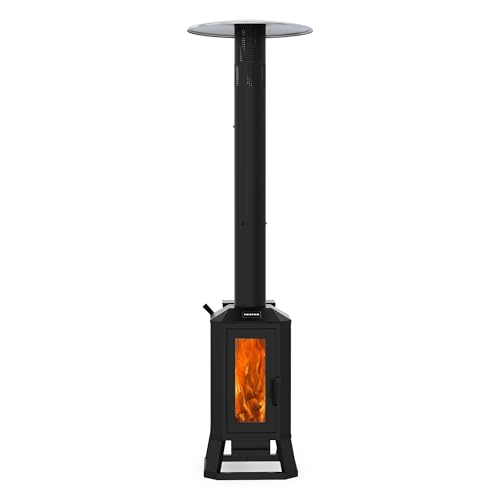 HEATAK pellet heaterA gravity-fed pellet burner with a chimney and a viewing window, and the rare pellet heater that publishes its hopper, its burn time and its coverage. Buy it for the fire and the fuel independence, not for the headline BTU number. | Live fire with no cylinder and no outlet | 70,000 BTU | 400 sq ft claimed | $349.99 · Check on Amazon |
Reach marked “claimed” is the maker’s own published figure. Reach without that label is ours, computed from published output at 20 BTU per square foot for an open patio. Neither is a measurement we took.
Top pick · A full open patio
Hiland / AZ Patio Heaters HLDS01-CG 87 in Propane Patio Heater
The mushroom tower the whole category is a copy of. 48,000 BTU is enough for a genuinely open patio, and the parts are the easiest in the category to replace when something eventually fails.
- Fuel
- Propane
- Output
- 48,000 BTU/h
- Reach (computed)
- 2,400 sq ft · 27.6 ft radius
- Cost per hour
- $1.40
What works
- 48,000 BTU is real output — on our sizing arithmetic that is a 2,400 sq ft open patio at the rule-of-thumb rate, so it is never the unit that is undersized
- Every wear part on this platform is a stocked commodity: thermocouples, control valves, dump switches and reflectors are all available separately
- The weight bladder in the base is the single most useful anti-tip feature in the category and most rivals leave it out
What does not
- An 87 in open-flame tower is the worst possible shape in wind — this is the unit our wind guide exists for
- The maker does not publish a coverage radius, so the reach figure we show is ours, computed rather than quoted
- Full output burns a 20 lb cylinder in well under a night. See the runtime arithmetic
| Published specification | |
|---|---|
| Rated input | 48,000 BTU/h |
| Height | 87 in |
| Fuel | 20 lb propane cylinder, not included |
| Reflector | 33 in aluminum heat shield |
| Safety | Anti-tilt cutoff and thermocouple flame-failure cutoff |
| Extras | Wheels, integrated table, weight bladder for the base |
| Maker’s coverage claim | None published — the reach figure above is ours |
| Safety listing | CSA certified per the maker's product literature |
Who it is for
An open patio with no roof, where you need volume of heat and can accept swapping cylinders. Also the right answer if you want a unit whose parts you can still buy in five years.
What it is not for
A screened porch, a garage, or anywhere without open sky above it. It is an open-flame combustion appliance and needs genuine outdoor ventilation.
2 · A ceiling mount with a published weather rating
Dr Infrared Heater DR-239 3000 W Wall or Ceiling Mount Infrared Patio Heater
The rare overhead heater whose maker publishes both a safety listing and an ingress rating, at double the output a standard socket allows. The catch is in that last clause: it wants a 220-240 V circuit, so it is an electrician's job rather than a plug-in.
- Fuel
- Electric
- Output
- 10,260 BTU/h
- Reach (computed)
- 513 sq ft · 12.8 ft radius
- Cost per hour
- $0.55
What works
- It publishes an ingress rating and a safety listing. IP55 and ETL together are unusual in this category and close to unheard of on something designed to hang — which matters more overhead than on a wall, because pergola slats are not a roof
- 3,000 W is double what a standard outlet allows. The 1,500 W ceiling is a property of the circuit, not the heater, and this is what stepping past it looks like
- Two power levels on the remote means the full 3,000 W is a choice rather than the only setting, which matters when the running cost is also double
- Wall and ceiling hardware both in the box, so the mounting decision does not cost extra or arrive wrong
What does not
- It needs a 220-240 V circuit. That is an electrician, a permit in many places, and a cost that can exceed the heater. If you were planning to plug something in, this is not it
- 3,000 W costs about 55 cents an hour at the national average electricity price, roughly double a standard 1,500 W unit. More heat is not free
- No coverage area is published, so any reach figure for it on this site is ours and computed rather than the maker's
- The output is genuinely more than a small covered patio needs, and oversizing an electric heater buys nothing except a larger bill
| Published specification | |
|---|---|
| Rated power | 3,000 W at 220-240 V |
| Published output | 10,260 BTU/h per the maker |
| Element | Carbon infrared |
| Ingress rating | IP55 per the maker |
| Safety listing | ETL listed per the maker |
| Mounting | Wall or ceiling, brackets and hardware in the box |
| Control | Remote, two power levels plus standby |
| Housing | Anodized aluminum |
| Maker’s coverage claim | None published — the reach figure above is ours |
| Safety listing | ETL listed and IP55 rated, both per the maker's published product data |
Who it is for
A pergola, porch ceiling or covered terrace where a new circuit is already part of the job, and where a published weather rating matters because the position is exposed.
What it is not for
Anyone without 220-240 V at the mounting point, or any space small enough that 1,500 W already does the job.
Sources for this entry
- Amazon listing — DR-239 3000 W wall or ceiling mount, IP55, 220-240 V, remote and mounting kit
- Dr. Infrared Heater — DR-239 published specification (3,000 W, 220-240 V, 10,260 BTU, carbon infrared element, IP55, ETL listed, ceiling or wall installation, remote with two power modes, anodized aluminum)
3 · Live fire with no cylinder and no outlet
HEATAK 70,000 BTU Wood Pellet Outdoor Patio Heater with Glass Viewing Window
A gravity-fed pellet burner with a chimney and a viewing window, and the rare pellet heater that publishes its hopper, its burn time and its coverage. Buy it for the fire and the fuel independence, not for the headline BTU number.
- Fuel
- Wood
- Output
- 70,000 BTU/h
- Reach (claimed)
- 400 sq ft · 12.0 ft radius
- Cost per hour
- n/a
What works
- It publishes what the category usually hides — hopper capacity, burn time at two settings, and a coverage figure that is internally consistent (a 24 ft diameter is about 452 sq ft of circle against their stated 400-plus)
- No cylinder to run out mid-evening and no outlet to reach — the only unit here independent of both, which is why it also works away from the house
- Pellets are a commodity sold by the 40 lb bag at any hardware store, and a bag stores in a way a swapped cylinder does not
- It is an actual fire behind glass, with the light and draw of one. A propane tower is a heater; this is closer to a fire pit with a chimney
What does not
- The published output and the published burn time do not agree. 70,000 BTU/h at a standard 8,000 BTU/lb would consume about 8.75 lb of pellets an hour, but the maker's own 20 lb hopper and 4-hour high setting imply about 5 lb an hour — roughly 40,000 BTU/h. Both figures are theirs. We show the arithmetic on the comparison page
- No published safety listing. Every propane unit on this site cites a CSA or equivalent certification and this one cites none, which is a real gap rather than a formality
- It has to be lit, tended and then emptied of ash — closer to running a fire pit than flicking a propane igniter
- Four hours on high is one evening, and refilling means opening a hopper on a unit that is already burning
- A steel chimney at this size is a large object to store, and the wheels are the only concession to moving it
| Published specification | |
|---|---|
| Rated input | 70,000 BTU/h (maker's published figure) |
| Published coverage | 24 ft diameter, stated as over 400 sq ft |
| Hopper | Up to 20 lb of pellets |
| Burn time | Up to 4 hours on high, 6 hours on low (maker's figures) |
| Feed | Gravity-fed automatic pellet system |
| Construction | Steel frame and chimney, stainless reflector, high-temperature black coating |
| Mobility | Built-in dual wheels |
| Maker’s coverage claim | 400 sq ft |
| Safety listing | No safety listing published by the maker or its retailers |
Who it is for
Someone who wants live fire on an open patio without running cylinders, is comfortable tending it, and values fuel that stores in a bag in the garage.
What it is not for
Anywhere under a roof, on a covered porch or near anything overhead — it is a solid-fuel appliance with a live flame, a chimney and an ash pan. Also wrong if you want heat in ten seconds.
Sources for this entry
- Amazon listing — HEATAK 70,000 BTU wood pellet outdoor patio heater with glass viewing window
- HEATAK / retailer published specification (70,000 BTU, 20 lb hopper, 4 h high and 6 h low, 24 ft diameter coverage, gravity-fed)
- American Wood Fibers — premium hardwood pellet specification (8,000 BTU/lb, 40 lb bag)
The arithmetic that decides it
There is one number that settles this argument better than any feature comparison, and most buyers have never worked it out.
A propane tower burns roughly $253 of fuel across a 20-week season at three evenings a week — more than most of these heaters cost to buy. An electric unit under cover is nearer $50. The season-cost page shows the whole calculation.
Which means the purchase price is the small number in this category, and the relevant question is not what a heater costs but how many seasons it lasts. A unit at half the price that dies in year two is not the cheaper option — and a cheap part that keeps a good platform alive for five years is the best value available anywhere on this site.
The one case where more money does buy more heat
Stepping off the standard circuit. A 240 V electric unit can draw 3,000 W — double the plug-in ceiling — because it is wired rather than plugged in. That is a real output increase, and it costs an electrician on top of the heater. It is the exception that proves the rule: the extra heat came from the circuit, not from the badge.
Three cases where paying more is right
- You need to point at a certification. A rental property, a small business, an HOA or an insurer may ask what the appliance is listed to. If that conversation is ever possible, buy the one that answers it — this is the clearest and least arguable case.
- The heater lives outdoors permanently. A mounted unit that stays up through winter needs a published ingress rating, and those are concentrated above the budget bracket.
- You intend to keep it. If the plan is five seasons, the parts catalog and the build are worth real money. If the plan is to replace it when it stops working, they are worth nothing to you.
Three cases where it is not
- An exposed, windy patio. No amount of money fixes wind, and spending it on a bigger heater instead of a windbreak is the most expensive way to lose that argument. Block the wind first, then buy whatever is left over.
- A first heater, before you know the patio. The beginner's path is to buy something movable, learn where people actually sit, and upgrade deliberately. Spending at the top on day one commits you to a guess.
- A small or sheltered space. Under $200 buys the mainstream product rather than a compromised version of it, and on a small covered patio the premium features address risks you do not have.
How to spot a supported platform before you buy
Since the parts catalog is the main thing the premium buys, it is worth knowing how to check for one from the listing rather than finding out in year three.
- Search the brand and the model number plus the word thermocouple. If replacement gas-train parts for that exact platform come up as stocked items, the heater is repairable. If the only results are the heater itself, it is not.
- Look for a model number at all. A listing that names a specific model is a listing whose parts can be matched. A generic title with no model is a heater nobody will ever sell a reflector for.
- Check whether the maker has its own site with a manual. A published PDF manual is a strong signal — it means there is a company behind the product rather than a label applied at a port.
- Note whether the gas train looks standard. Cheap towers share a broadly common gas train, so generic thermocouples and valves fit a surprising number of them. Glass tubes, reflectors and burner assemblies are model-specific, and that is where availability runs out.
That check takes about two minutes and is worth more than any feature comparison in this bracket, because it tells you which of the two purchases you are actually making — a heater for a few seasons, or a platform for several.
What the budget bracket gets right
It would be dishonest to leave this as an argument for spending more without saying what the cheap end genuinely does well, because on this site it does rather a lot.
Under $200 now buys the mainstream product in this category rather than a compromised version of it — full-size propane towers with the same output as anything above them, and standard 1,500 W electric units that hit the same ceiling as the expensive ones. Some of them publish a coverage radius that survives arithmetic, and at least one publishes a tested ingress rating, which is more than several pricier rivals manage.
So the premium bracket is not rescuing you from a bad product. It is buying documentation, support and longevity on top of a product that already works — which is a real thing to buy and a much narrower claim than the marketing makes.
How this differs from the other money question
Worth separating, because the site answers two that sound similar. Are patio heaters worth it at all is about whether to spend anything — the running cost against blankets, windbreaks and simply going inside. This page assumes you have decided to buy and asks whether to spend more.
The answers point in different directions, which is worth knowing. The first question often ends in "block the wind and buy a blanket". This one, for anyone who has already committed to owning a heater for several years, usually ends in "buy the one with parts".
The short version
Expensive patio heaters are not warmer. They are better documented, better supported and better built, and on an appliance whose fuel costs more per season than the appliance itself, that is a stronger argument than it first appears. Buy up if you need a certification, if it lives outside, or if you plan to keep it. Buy the cheap one if you are still working out where it should stand.
Common questions
Are expensive patio heaters warmer than cheap ones?
No, and the reason is structural. Plug-in electric heaters are all capped at about 1,500 W by the household circuit, and full-size propane towers cluster between roughly 46,000 and 50,000 BTU across the whole price range. The premium goes into certification, parts, weather ratings and build rather than output.
What do you actually get for paying more for a patio heater?
A named safety certification you can look up, replacement parts that are genuinely stocked, a published weather rating on anything mounted outdoors, finer control including a usable low setting, and heavier construction with real ballast. All of it matters over seasons rather than on the first evening.
Is a cheap patio heater a false economy?
Sometimes, and the arithmetic is the reason. A propane tower burns roughly $253 of fuel across a 20-week season, which is more than most of these heaters cost to buy. On that basis a platform you can keep alive for five years with cheap parts beats one you replace every two.
When is a more expensive patio heater definitely worth it?
Three cases: when someone may ask what the appliance is certified to, such as a rental, a business or an insurer; when the heater lives outdoors permanently and needs a published ingress rating; and when you genuinely intend to keep it for years, which is what makes a parts catalog valuable.
Can you get more than 1,500 watts from an electric patio heater?
Only by leaving the standard circuit. A 240 V hardwired unit can draw 3,000 W, double the plug-in ceiling, but it needs an electrician and often a permit. That is the one case where spending more genuinely buys more heat - and the heat came from the circuit rather than the brand.
Should my first patio heater be an expensive one?
Usually not. Buy something movable, spend a season finding out where people actually sit and where the wind comes from, then upgrade deliberately. Spending at the top on day one commits you to a guess about your own patio.
Read next
The best patio heaters under $200
What $200 actually buys in outdoor heat, and why the answer differs by a factor of nine between fuels.
Are patio heaters worth it?
What an extra evening outside actually costs, and the three patios where a heater is the wrong purchase.
What a season of patio heating costs
A whole season costed out for each fuel at three usage levels — the number per-hour figures hide.
Patio heater replacement parts
The four parts that account for nearly every dead heater, with symptoms and measuring advice.
The best patio heaters, sorted by the patio
Six heaters covering every real patio case, with published output, computed reach and cost per hour.