Head to head
Infrared vs propane patio heaters
One warms you; the other warms the air around you. Outdoors that distinction matters far more than the ten-to-one gap in their rated outputs suggests.
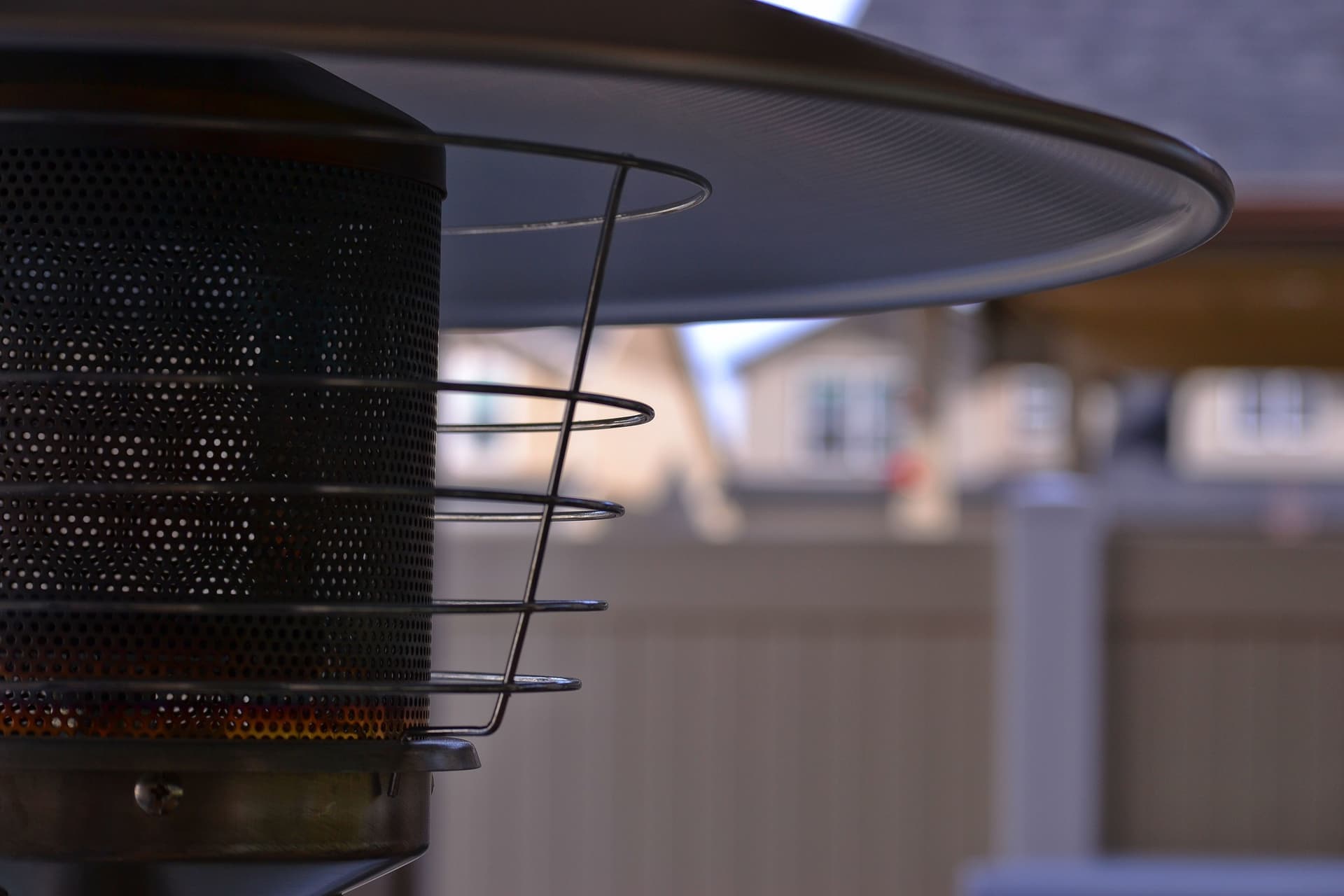
Infrared heaters warm objects directly, so nearly all their output reaches you and wind does not affect it. Propane heaters produce about ten times the output but spend much of it warming air, which then rises and leaves. Under a roof, infrared wins; on an open patio, propane does.
Two different mechanisms wearing the same category name
A propane patio heater is largely a convection appliance with a radiant component. The burner heats air and the reflector directs some radiant energy down. Both matter, but the convected share is the larger one, and outdoors it is the fragile one.
An infrared heater is essentially all radiant. It emits energy in the infrared band, that energy travels through air almost unimpeded, and it deposits itself in the first solid object it meets — a person, a chair, a table. Nothing is warmed on the way, which is exactly why nothing can carry the warmth away.
So the ten-to-one output ratio is real and it is not the ratio of warmth you feel. The right way to read it: propane delivers a large amount of heat to a general area, some fraction of which reaches you. Infrared delivers a small amount of heat almost entirely to whatever it is pointed at.
The comparison table
| Infrared (electric) | Propane | |
|---|---|---|
| Mechanism | Radiant only | Convection plus a radiant share |
| Rated output | 1,500 W = 5,118 BTU/h | 46,000 to 48,000 BTU/h |
| Warm-up | Seconds | Seconds to light, minutes to warm a space |
| Effect of wind | Essentially none | Large. Convected heat is stripped away |
| Coverage shape | A cone, aimed | A circle, roughly symmetrical |
| Under a roof | Ideal | Needs 36 in clearance and open sides |
| Cost per hour | About $0.28 | About $1.40 |
| Cost per 1,000 BTU | About 5.5 cents | About 2.9 cents |
Computed at 18.34 cents per kWh and $2.674 per gallon of propane, U.S. average residential prices.
The question that actually decides it
Not budget, and not output. It is: is there somewhere overhead to mount a heater, and is there anything above it?
Infrared needs height and line of sight. Given a pergola beam, a porch ceiling or an exterior wall at eight feet, it can be aimed at where people sit and it will work well. Given an open patio with a lawn on three sides and nothing to fix to, it cannot, and no amount of quality in the unit changes that.
Propane has the opposite profile. It needs open sky above it and it needs nothing else — no circuit, no mounting, no aim. Where there is a ceiling it becomes a clearance problem and often an impossible one.
Quick picks
Ranked for fit, not for hype. Output is the maker’s published figure; reach is computed from it or from the maker’s own radius claim, and the table says which. Tap a row for the full write-up, or go straight to the listing.
| # | Product | Best for | Output | Reach | Price |
|---|---|---|---|---|---|
| 1 |  Dr Infrared 1500 WRadiant heat that a breeze cannot blow out, on a plug. 1,500 W is only 5,118 BTU/h, which sounds like nothing next to a propane tower and lands far more of itself on you. | Wind, and anywhere with a roof | 1,500 W | 256 sq ft | $148.98 · Check on Amazon |
| 2 |  Hiland HLDS01The mushroom tower the whole category is a copy of. 48,000 BTU is enough for a genuinely open patio, and the parts are the easiest in the category to replace when something eventually fails. | A full open patio | 48,000 BTU | 2,400 sq ft | $315.00 · Check on Amazon |
Reach marked “claimed” is the maker’s own published figure. Reach without that label is ours, computed from published output at 20 BTU per square foot for an open patio. Neither is a measurement we took.
Top pick · Wind, and anywhere with a roof
Dr Infrared Heater DR-238 Carbon Infrared Patio Heater with Kasa Outdoor Smart Plug
Radiant heat that a breeze cannot blow out, on a plug. 1,500 W is only 5,118 BTU/h, which sounds like nothing next to a propane tower and lands far more of itself on you.
- Fuel
- Electric
- Output
- 1,500 W = 5,118 BTU/h
- Reach (computed)
- 256 sq ft · 9.0 ft radius
- Cost per hour
- $0.28
What works
- Infrared warms objects, not air, so it is the only heat that survives a breeze — this is the single reason wind changes the whole buying decision
- No combustion means no flue gas, which is what makes it legal and sensible on a screened porch where propane is not
- Three settings matter more than they sound: 900 W costs a third less to run and is enough most evenings
What does not
- 1,500 W is 1,500 W. Nothing at this wattage heats faster than anything else at this wattage; the differences between electric heaters are beam shape and build, not power
- It heats what it points at. Step out of the beam and you are cold immediately — this is a fundamentally different experience from a tower
- A 120 V plug-in unit is capped by your circuit, not by the maker. See why 1,500 W is the ceiling
| Published specification | |
|---|---|
| Rated power | 1,500 W at 120 V |
| Settings | 900 W / 1,200 W / 1,500 W |
| Element | Carbon infrared lamp |
| Reflector | Mirror aluminum, 90% reflectivity per the maker |
| Housing | Anodized aluminum, rated for outdoor use |
| Mounting | Wall and ceiling brackets plus remote in the box |
| Bundle | Currently sold with a Kasa EP40 outdoor smart plug |
| Maker’s coverage claim | None published — the reach figure above is ours |
| Safety listing | ETL listed, per the maker's published product data |
Who it is for
A covered patio, pergola or screened porch where you can mount it overhead and point it at where people sit, and anywhere wind ruins a flame.
What it is not for
A big open patio with nowhere to mount it. Radiant heat needs a line of sight and a place to hang from.
2 · A full open patio
Hiland / AZ Patio Heaters HLDS01-CG 87 in Propane Patio Heater
The mushroom tower the whole category is a copy of. 48,000 BTU is enough for a genuinely open patio, and the parts are the easiest in the category to replace when something eventually fails.
- Fuel
- Propane
- Output
- 48,000 BTU/h
- Reach (computed)
- 2,400 sq ft · 27.6 ft radius
- Cost per hour
- $1.40
What works
- 48,000 BTU is real output — on our sizing arithmetic that is a 2,400 sq ft open patio at the rule-of-thumb rate, so it is never the unit that is undersized
- Every wear part on this platform is a stocked commodity: thermocouples, control valves, dump switches and reflectors are all available separately
- The weight bladder in the base is the single most useful anti-tip feature in the category and most rivals leave it out
What does not
- An 87 in open-flame tower is the worst possible shape in wind — this is the unit our wind guide exists for
- The maker does not publish a coverage radius, so the reach figure we show is ours, computed rather than quoted
- Full output burns a 20 lb cylinder in well under a night. See the runtime arithmetic
| Published specification | |
|---|---|
| Rated input | 48,000 BTU/h |
| Height | 87 in |
| Fuel | 20 lb propane cylinder, not included |
| Reflector | 33 in aluminum heat shield |
| Safety | Anti-tilt cutoff and thermocouple flame-failure cutoff |
| Extras | Wheels, integrated table, weight bladder for the base |
| Maker’s coverage claim | None published — the reach figure above is ours |
| Safety listing | CSA certified per the maker's product literature |
Who it is for
An open patio with no roof, where you need volume of heat and can accept swapping cylinders. Also the right answer if you want a unit whose parts you can still buy in five years.
What it is not for
A screened porch, a garage, or anywhere without open sky above it. It is an open-flame combustion appliance and needs genuine outdoor ventilation.
The case for both
Restaurants routinely run both, and the logic transfers to a home patio. A tower does the volume on the open part of the terrace; mounted infrared handles the covered section near the building, where a tower would not fit. If your patio has a covered part and an open part, that is two problems and there is no reason to solve them with one product.
If you are choosing one, the sizing calculator will tell you whether 5,118 BTU/h is enough for your area. If it is, buy infrared and skip the cylinders. If it is not, you need propane.
Common questions
Is infrared better than propane for a patio heater?
Under a roof, pergola or porch ceiling, yes — infrared delivers almost all of its output onto people and wind does not affect it. On an open patio with nothing to mount to, no: the ten-to-one output gap matters when warmed air keeps leaving.
Why does a 1,500 W infrared heater feel as warm as a much bigger propane one?
Because you are receiving a much larger share of its output. Infrared radiation travels to you directly, while much of a propane heater's output warms air that then rises. In the beam, the small unit competes; six feet outside the beam, it does not.
Does infrared heat work in the wind?
Yes. Radiant energy crosses moving air essentially unaffected, and there is no flame to extinguish. This is the single strongest argument for infrared and the reason our wind picks are mostly electric.
Sources
Read next
Infrared patio heaters, and why wind does not touch them
Four infrared heaters and heat lamps, with what radiant heat does that a flame cannot.
Propane patio heaters, with the cylinder arithmetic
Four propane heaters compared on published BTU, computed reach and real cylinder runtime.
Propane infrared heaters
True radiant propane heaters: wind-proof like infrared, cordless like propane, and honest about looking industrial.
Wind-resistant patio heaters
The heaters that keep working in a breeze, and the physics that makes the list mostly electric.
Carbon vs quartz infrared elements
The two infrared element types compared on warm-up, glare and durability — and why output is identical.
Patio heater BTU calculator
Your patio's BTU requirement with every multiplication shown, plus why the published rules disagree.