Cold weather
Do propane patio heaters work in freezing weather?
The fuel is fine. The cylinder is the bottleneck, and it is a bottleneck with published numbers — which almost nobody quotes.
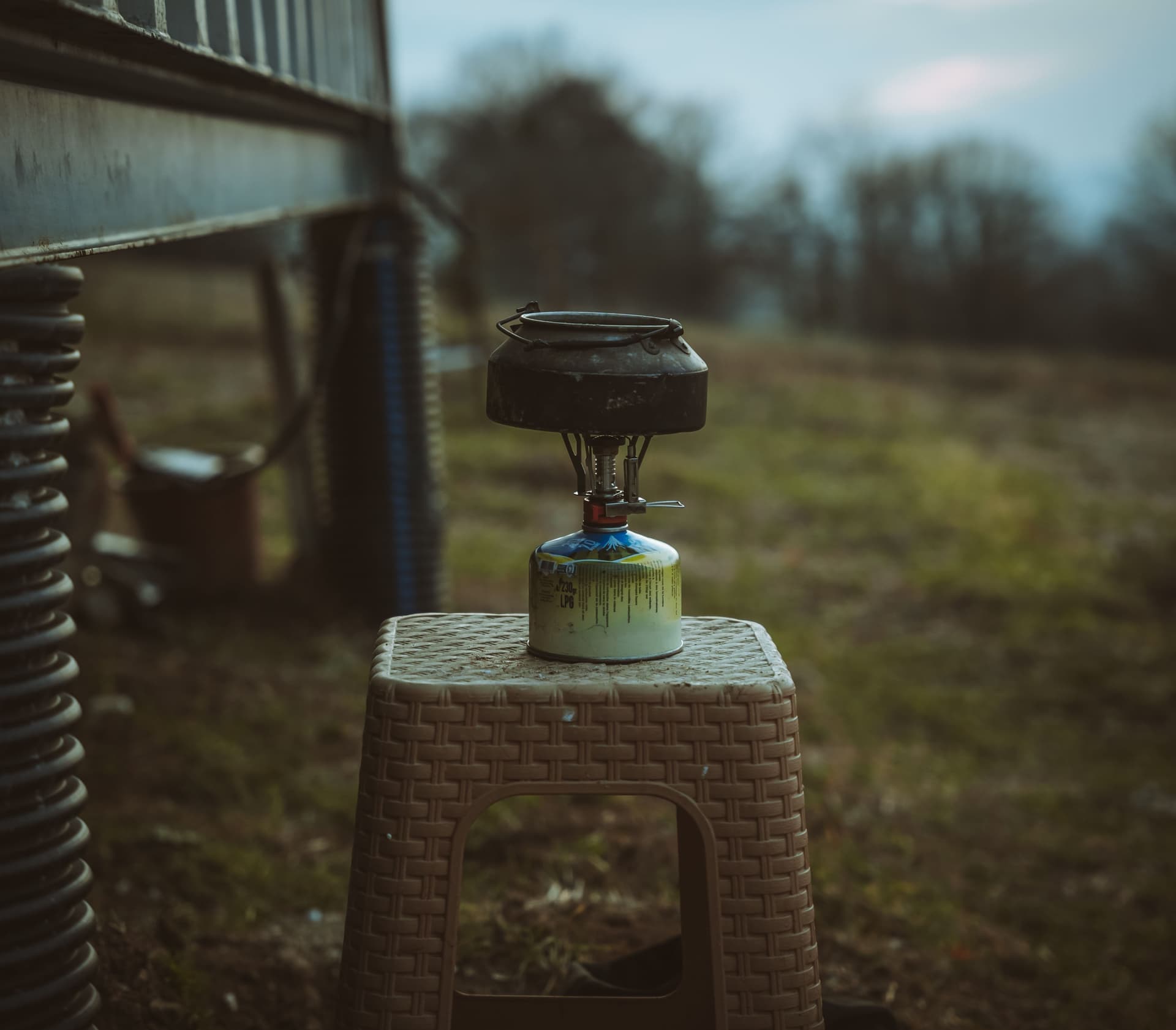
Yes — propane itself never stops working outdoors. It boils at -44F, so there is always vapor above the liquid. What falls with temperature is the *rate* at which a cylinder can turn liquid into gas, and a 46,000 BTU/h tower can ask for more than a cold cylinder can supply. The symptom is a shrinking flame and a frost line up the tank, not an empty one. If you heat below freezing and want no asterisks, an electric infrared unit delivers identical output at any air temperature.
This question gets answered badly in both directions. One camp says propane freezes, which is wrong. The other says propane is fine in winter, which is true of the fuel and misleading about the appliance. The accurate version needs one distinction: pressure is not the same thing as flow.
Propane does not freeze, and here is the number
Propane's boiling point at atmospheric pressure is -44F. Below that it would stay liquid and produce no vapor at all; above it, liquid propane in a cylinder is permanently boiling off into the vapor space above it. There is no domestic patio in the United States where the fuel itself gives up, and anyone who tells you their tank froze at 20F has described a symptom rather than a cause.
What does change with temperature is vapor pressure — the pressure the boiling liquid maintains in the top of the cylinder. It falls steeply as it gets colder:
| Temperature | Vapor pressure |
|---|---|
| 70F | 127 psig |
| 40F | 72 psig |
| 30F | 58 psig |
| 20F | 47 psig |
| 0F | 28 psig |
| -20F | 13.5 psig |
| -40F | 3.6 psig |
Approximate vapor pressure of LP gas, from the published LP gas properties table. This is the pressure available at the cylinder, before the regulator.
Read the 20F row. Forty-seven psig is still a great deal more than a patio heater regulator needs — these are low-pressure appliances. So on the pressure question alone, a freezing evening is a non-event, and this is why the "propane works fine in winter" camp sounds right. The problem is elsewhere.
The real limit: how fast a cylinder can boil
Turning liquid propane into vapor takes energy — the latent heat of vaporization, about 773 BTU per gallon at the boiling point. That energy is not supplied by the heater. It is pulled out of the liquid itself, and then replaced through the steel wall of the cylinder from the surrounding air.
That heat path is the bottleneck, and it has two inputs: how much cylinder wall is in contact with liquid (which is the fill level) and how big the temperature difference is between the air and the liquid (which is the weather). Both get worse as the evening goes on and as it gets colder.
Which is why a frost line is a diagnosis
If a band of frost or sweat forms around the cylinder, that is the liquid level, and it is telling you the liquid has been chilled below freezing by its own evaporation because the air could not resupply heat fast enough. A frosting cylinder is a cylinder being asked for more flow than it can deliver — not a cylinder running out of gas.
The industry publishes this as a capacity table. The figures below are for 100 lb cylinders, in maximum continuous draw:
| Propane in cylinder | 0F | 20F | 40F | 70F |
|---|---|---|---|---|
| 100 lb | 113,000 | 167,000 | 214,000 | 300,000 |
| 70 lb | 83,000 | 122,000 | 160,000 | 214,000 |
| 50 lb | 64,000 | 94,000 | 125,000 | 167,000 |
| 30 lb | 45,000 | 66,000 | 85,000 | 118,000 |
| 20 lb | 36,000 | 51,000 | 68,000 | 92,000 |
| 10 lb | 28,000 | 38,000 | 49,000 | 66,000 |
Published cylinder vaporization capacity for 100 lb propane cylinders, in BTU/hr of maximum continuous draw, from the LP gas properties table. Note that it falls with BOTH temperature and remaining fuel.
Now put a patio heater against it. A full-size propane tower is rated 46,000 to 48,000 BTU/h. Follow the 20 lb row — a *100 lb cylinder with 20 lb left in it* — and at 20F its capacity is 51,000 BTU/h, which the tower nearly exhausts. At 0F it is 36,000, and the tower is asking for more than the cylinder can give.
What we could not source, said plainly
We found no published vaporization capacity table for a 20 lb exchange cylinder — the common patio size — so we are not going to print one. What the mechanism and the 100 lb table together imply is ours rather than the industry's: a 20 lb cylinder is physically much smaller, so it has far less wetted wall than a 100 lb cylinder holding the same 20 lb of fuel, and its continuous capacity in the cold is therefore lower than the figures above, not equal to them. Treat the 20 lb row as a generous ceiling for a 20 lb bottle.
What it actually looks like on the patio
The failure is gradual and it mimics running out of fuel, which is why it is so often misdiagnosed. In rough order:
- The heater lights normally and runs at full output for twenty minutes to an hour.
- The flame gets smaller. Output drops noticeably but nothing has gone wrong mechanically.
- A frost or sweat line appears around the cylinder at the liquid level, and the tank is cold to the touch above it.
- On a bad night the flame drops far enough that the thermocouple no longer registers a flame and the safety shuts the gas off — which reads exactly like a heater that will not stay lit.
- An hour later, indoors-warm, the cylinder has plenty of propane in it and the heater lights perfectly. Nothing was broken.
If that sequence is familiar, the heater is fine and the diagnosis is draw rate. The fault tree is still worth walking if it happens on a mild evening, because then it genuinely is a part.
The four things that actually help
- Keep the cylinder full. This is the free fix and the most effective one. Every row of the table above says the same thing: more liquid means more wetted wall means more capacity. A cylinder swapped at half-empty is a cylinder with roughly half the cold-weather headroom.
- Use a bigger cylinder. A 30 or 40 lb bottle has more wall area in contact with liquid and sustains a higher draw at the same temperature. The runtime page covers every size; the cold is a second reason to size up beyond the obvious one.
- Turn it down. Capacity is a limit on *draw*, so reducing the draw moves you back inside it. A tower at half output on a 10F evening is a working heater; the same tower at full output is a frosting cylinder and a dying flame.
- Do not warm the cylinder with anything. No blankets, no heat tape, no hot water, nothing with a flame near it. This is the one place where the obvious fix is genuinely dangerous, and every cylinder's own labeling prohibits it.
Electric, which simply does not have this problem
A resistance element converts electricity to heat at the same rate whatever the air temperature is doing. A 1,500 W infrared heater delivers about 5,118 BTU/h at 10F exactly as it does at 60F — there is no fuel to vaporize, no regulator, no cylinder and no frost line. The conversion is here and the number does not move with the weather.
The trade is honest and it is output. 5,118 BTU/h against a tower's 46,000 is a ninefold difference on paper. But radiant heat lands on people rather than warming air that blows away, so the delivered-warmth gap is far smaller than the ratio suggests — which is the argument the infrared versus propane page works through properly. In genuine cold the comparison gets better still, because the tower you are comparing against is not delivering its rated output either.
Electric, per hour
| Rated power | Per hour | 4-hour evening | Per month, 4 h a night |
|---|---|---|---|
| 750 W | $0.14 | $0.55 | $16.51 |
| 900 W | $0.17 | $0.66 | $19.81 |
| 1,200 W | $0.22 | $0.88 | $26.41 |
| 1,500 W | $0.28 | $1.10 | $33.01 |
| 2,000 W | $0.37 | $1.47 | $44.02 |
| 3,000 W | $0.55 | $2.20 | $66.02 |
At 18.34 cents per kWh (June 2026 U.S. residential average). Substitute your own rate: it is on your bill, and the arithmetic is watts ÷ 1000 x hours x rate.
Propane, per hour
| Rated input | Per hour | 4-hour evening | Per month, 4 h a night |
|---|---|---|---|
| 11,000 BTU/h | $0.32 | $1.29 | $38.61 |
| 40,000 BTU/h | $1.17 | $4.68 | $140.40 |
| 46,000 BTU/h | $1.35 | $5.38 | $161.46 |
| 48,000 BTU/h | $1.40 | $5.62 | $168.48 |
| 50,000 BTU/h | $1.46 | $5.85 | $175.50 |
At $2.674 per gallon (week ending March 30, 2026 U.S. residential average) and 91,420 BTU per gallon. Exchange-cage cylinders cost materially more per gallon than a bulk refill, so treat this as the floor.
The prices every cost figure on this site uses
- Electricity: 18.34 cents per kWh. U.S. average residential retail price, June 2026. EIA, Electric Power Monthly, Table 5.6.A (residential, U.S. total).
- Propane: $2.674 per gallon. U.S. average residential price, week ending March 30, 2026. EIA, Weekly Heating Oil and Propane Prices (residential, U.S. average). That series only runs through the heating season, which is why the latest reading is a March one.
- Propane energy content: 91,420 BTU per gallon (higher heating value, the same basis appliance BTU ratings use). U.S. DOE Alternative Fuels Data Center, Fuel Properties Comparison.
- Conversion: 1 kWh = 3,412 BTU. Which is why a 1,500 W electric heater is a 5,118 BTU/h appliance, and why comparing it to a 48,000 BTU propane tower is not the comparison it looks like.
The low-draw propane answer, which is underrated
If you need propane — no outlet, nothing to mount to — then the conclusion from the capacity table is not "buy the biggest tower" but the opposite.
A tank-top radiant burner draws 10,000 to 15,000 BTU/h. Against the 20 lb row at 0F — 36,000 BTU/h, and our caveat above says read it as a ceiling — a 15,000 BTU/h draw has real headroom where a 46,000 BTU/h draw has none. It is also radiant rather than convective, so wind barely touches it. The propane radiant roundup covers the category, and it is a better cold-weather bet than its price suggests.
| Burn rate | 15 lb cylinder | 20 lb cylinder | 30 lb cylinder | 40 lb cylinder |
|---|---|---|---|---|
| 46,000 BTU/h | 7.0 h | 9.4 h | 14.1 h | 18.7 h |
| 15,000 BTU/h | 21.6 h | 28.7 h | 43.1 h | 57.5 h |
| 11,000 BTU/h | 29.4 h | 39.2 h | 58.8 h | 78.4 h |
Cylinder energy = pounds ÷ 4.24 lb per gallon x 91,420 BTU per gallon, divided by the burn rate. A 20 lb cylinder therefore holds 4.7 gallons and 431,226 BTU. Full output only — turn it down and every figure here stretches proportionally.
The runtime arithmetic points the same way, which is a useful cross-check: a low draw both lasts longer and stays inside the cylinder's cold-weather capacity. Those are the same fact seen from two directions.
Quick picks
Ranked for fit, not for hype. Output is the maker’s published figure; reach is computed from it or from the maker’s own radius claim, and the table says which. Tap a row for the full write-up, or go straight to the listing.
| # | Product | Best for | Output | Reach | Price |
|---|---|---|---|---|---|
| 1 |  Dr Infrared 1500 WRadiant heat that a breeze cannot blow out, on a plug. 1,500 W is only 5,118 BTU/h, which sounds like nothing next to a propane tower and lands far more of itself on you. | Wind, and anywhere with a roof | 1,500 W | 256 sq ft | $136.32 · Check on Amazon |
| 2 |  Mr. Heater MH15TThe cheapest way to buy propane heat that behaves like infrared rather than like warm air. It screws onto a cylinder, needs no outlet, and looks exactly like the job-site equipment it is. | Radiant propane heat, cheaply | 15,000 BTU | 750 sq ft | $49.99 · Check on Amazon-8% |
| 3 |  Amazon Basics 46kOne of the very few towers whose maker publishes a coverage radius rather than a vague area, and the 9 ft figure survives the arithmetic. That alone puts it ahead of most of the field. | The published-radius honesty test | 46,000 BTU | 254 sq ft claimed | $135.00 · Check on Amazon |
Reach marked “claimed” is the maker’s own published figure. Reach without that label is ours, computed from published output at 20 BTU per square foot for an open patio. Neither is a measurement we took.
Top pick · Wind, and anywhere with a roof
Dr Infrared Heater DR-238 Carbon Infrared Patio Heater with Kasa Outdoor Smart Plug
Radiant heat that a breeze cannot blow out, on a plug. 1,500 W is only 5,118 BTU/h, which sounds like nothing next to a propane tower and lands far more of itself on you.
- Fuel
- Electric
- Output
- 1,500 W = 5,118 BTU/h
- Reach (computed)
- 256 sq ft · 9.0 ft radius
- Cost per hour
- $0.28
What works
- Infrared warms objects, not air, so it is the only heat that survives a breeze — this is the single reason wind changes the whole buying decision
- No combustion means no flue gas, which is what makes it legal and sensible on a screened porch where propane is not
- Three settings matter more than they sound: 900 W costs a third less to run and is enough most evenings
What does not
- 1,500 W is 1,500 W. Nothing at this wattage heats faster than anything else at this wattage; the differences between electric heaters are beam shape and build, not power
- It heats what it points at. Step out of the beam and you are cold immediately — this is a fundamentally different experience from a tower
- A 120 V plug-in unit is capped by your circuit, not by the maker. See why 1,500 W is the ceiling
| Published specification | |
|---|---|
| Rated power | 1,500 W at 120 V |
| Settings | 900 W / 1,200 W / 1,500 W |
| Element | Carbon infrared lamp |
| Reflector | Mirror aluminum, 90% reflectivity per the maker |
| Housing | Anodized aluminum, rated for outdoor use |
| Mounting | Wall and ceiling brackets plus remote in the box |
| Bundle | Currently sold with a Kasa EP40 outdoor smart plug |
| Maker’s coverage claim | None published — the reach figure above is ours |
| Safety listing | ETL listed, per the maker's published product data |
Who it is for
A covered patio, pergola or screened porch where you can mount it overhead and point it at where people sit, and anywhere wind ruins a flame.
What it is not for
A big open patio with nowhere to mount it. Radiant heat needs a line of sight and a place to hang from.
2 · Radiant propane heat, cheaply
Mr. Heater MH15T Single Tank Top Propane Radiant Heater
The cheapest way to buy propane heat that behaves like infrared rather than like warm air. It screws onto a cylinder, needs no outlet, and looks exactly like the job-site equipment it is.
- Fuel
- Propane
- Output
- 15,000 BTU/h
- Reach (computed)
- 750 sq ft · 15.5 ft radius
- Cost per hour
- $0.44
What works
- Radiant heat with no outlet required — the one combination electric infrared cannot offer and a convective propane tower does not deliver
- Wind barely touches it, for the same reason it barely touches electric infrared: radiant energy crosses moving air largely unaffected
- Our computed runtime from the published BTU range reproduces the 28 to 43 hour figure retailers quote for a 20 lb cylinder, which is a rare case of a published claim surviving arithmetic
- 3.3 lb and no base — it goes in a truck, and there is nothing to blow over in the sense a seven-foot tower can
What does not
- It is work equipment, not patio furniture. The maker's own listed uses are construction sites, loading docks, sporting events, hunting, fishing and camping. Patios are not on that list and the thing looks it
- Outdoor use only, stated plainly by the maker. No garage with the door part-open, no screened porch, no enclosure of any kind
- Match lit on this model, which in a breeze is genuinely annoying — the spark-ignition variants exist for a reason
- It sits at cylinder height, so it radiates at knees and shins rather than at a seated upper body. Aim is fixed by wherever the cylinder stands
- No published coverage figure, so any reach number for it is computed rather than quoted
| Published specification | |
|---|---|
| Rated input | 10,000 to 15,000 BTU/h, adjustable |
| Heat type | Radiant, per the maker |
| Use | Outdoor use only, per the maker |
| Ignition | Match lit |
| Mounting | Screws directly to a cylinder; 5 lb minimum, 20 lb typical |
| Size and weight | 9 x 8 in, 3.3 lb |
| Warranty | 1 year limited |
| Maker’s coverage claim | None published — the reach figure above is ours |
| Safety listing | Tip-over safety shut-off switch per the maker; no third-party listing published |
Who it is for
Anyone who wants radiant propane heat cheaply on an open deck, a driveway, a tailgate or a work area, and does not care what it looks like.
What it is not for
A furnished patio where appearance matters, anything enclosed or partly enclosed, or a seated group wanting heat at chest height.
3 · The published-radius honesty test
Amazon Basics 46,000 BTU Outdoor Propane Patio Heater
One of the very few towers whose maker publishes a coverage radius rather than a vague area, and the 9 ft figure survives the arithmetic. That alone puts it ahead of most of the field.
- Fuel
- Propane
- Output
- 46,000 BTU/h
- Reach (claimed)
- 254 sq ft · 9.0 ft radius
- Cost per hour
- $1.35
What works
- A published 9 ft radius is a 254 sq ft circle, and 46,000 BTU is far more than that area needs — a claim on the conservative side of its own specification, which is rare here
- The water-fill base box is a real anti-tip measure, not a sticker: filled, it is the difference between a windy evening and a repair bill
- One-touch ignition and a chain for the cylinder are both small things the cheap clones drop
What does not
- The listing does not name a safety certifying body, only the tilt valve, so we cannot tell you it is CSA listed
- 91 in tall with an open flame: the same wind exposure as every other tower of this shape
- The water box has to be emptied before a freeze or it splits
| Published specification | |
|---|---|
| Rated input | 46,000 BTU/h |
| Published reach | 9 ft radius |
| Dimensions | 32.1" L x 32.1" W x 91.3" H |
| Fuel | 20 lb propane cylinder, not included |
| Safety | Tilt auto-shutoff valve; chain to secure the cylinder |
| Base | Water-fill box for ballast, wheel kit included |
| Maker’s coverage claim | 9.0 ft radius, which is 254 sq ft |
| Safety listing | Tilt auto-shutoff valve; the listing does not name a certifying body |
Who it is for
An open patio where you want the largest honest circle of warmth per dollar and are happy to handle cylinders.
What it is not for
Anywhere enclosed, and anywhere the base cannot be filled with water — an empty ballast box makes this a tall, light, tippy object.
Sources for this entry
What to expect, by temperature
Pulling it together, and keeping it to what the figures support:
| Air temperature | A 46,000 BTU/h tower | Electric infrared |
|---|---|---|
| 40F and above | Full output, no issue | Unaffected |
| 30F | Fine most of the evening; watch it late on a low cylinder | Unaffected |
| 20F | Expect output to fall as the cylinder cools. Start full | Unaffected |
| 10F | Frosting likely at full output. Turn it down or size the cylinder up | Unaffected |
| 0F and below | Not a reliable full-output appliance on a 20 lb bottle | Unaffected |
Our read, from the published capacity figures above and a 20 lb cylinder started reasonably full.
And the broader point, which this site makes everywhere: below about 25F the binding constraint stops being the heater at all. What to run at 50, 40 and 30 degrees is the page for that, and enclosing the patio beats upgrading the heater at every temperature.
How we picked
- The published figures first. Propane vaporization capacity is documented by the industry in BTU/hr against temperature and liquid level. We quote that table rather than describing the effect qualitatively.
- Draw rate compared against capacity, because that comparison is the entire answer and it is the one nobody does.
- Electric included as the unaffected option, since a resistance element delivers the same output at 10F as at 70F and that is a genuine advantage rather than a marketing one.
- Low-draw propane treated as a real answer, not a consolation — a small burner is far less likely to outrun a cold cylinder than a large one.
- What we could not source is said plainly. No 20 lb cylinder capacity table is published that we could find; the 100 lb table is, and we reason from it and label the reasoning as ours.
What we did not do
Everyone in this category says they tested twenty heaters. We have not tested any, and we say so. What we do instead: compile the published specs, compute the electrical and gas load from them, cite the maker’s own manual, and show the arithmetic so you can check it. The full method, including how to challenge a figure.
Common questions
Do propane patio heaters work in freezing weather?
Yes. Propane boils at -44F, so there is always vapor available and the fuel never fails on a domestic patio. What falls with temperature is how fast a cylinder can vaporize liquid into gas, so a large tower can ask for more flow than a cold cylinder supplies - which shows up as a shrinking flame and a frost line, not as an empty tank.
Why does my propane heater lose pressure in the cold?
It is usually losing flow rather than pressure. Vaporizing propane absorbs latent heat, which is replaced through the cylinder wall from the surrounding air. In the cold, or on a low cylinder with little wall in contact with liquid, heat cannot arrive fast enough, the liquid chills itself, and the available draw falls. A frost band around the tank at the liquid level is the confirmation.
At what temperature does a 20 lb propane tank stop keeping up?
There is no single number, because it depends on how much you are drawing and how full the bottle is. The published 100 lb cylinder table gives 51,000 BTU/hr of capacity at 20F with 20 lb remaining and 36,000 at 0F - and a 20 lb bottle has less wetted wall than that, so read those as generous ceilings. A 46,000 BTU/h tower is therefore marginal around 20F and outmatched at 0F, while a 15,000 BTU/h tank-top burner has headroom at both.
Does keeping the propane tank full help in winter?
Yes, and it is the most effective free fix. Vaporization capacity depends on how much cylinder wall is in contact with liquid, so a full cylinder sustains a much higher draw than a half-empty one at the same air temperature. The published capacity table falls steadily as fuel is used, at every temperature.
Should I put a blanket or heat tape on the propane cylinder?
No. Do not warm a propane cylinder with anything - no blankets, no heat tape, no hot water, and nothing with a flame near it. Cylinder labeling prohibits it. The safe ways to increase available flow are a fuller cylinder, a larger cylinder, or a lower draw.
Are electric patio heaters better in cold weather?
They are more predictable. A resistance element produces the same 5,118 BTU/h from 1,500 W at 10F as at 60F, with no cylinder, regulator or vaporization limit involved. Propane still wins on raw rated output, but in genuine cold a large tower is often not delivering its rated figure, which narrows the real gap considerably.
Sources
- LP Gas Properties — propane boiling point (-44F), vapor pressure table by temperature, latent heat of vaporization (773 BTU/gal at boiling point), and published cylinder vaporization capacity table for 100 lb cylinders in BTU/hr by remaining fuel and ambient temperature
- U.S. DOE Alternative Fuels Data Center, Fuel Properties Comparison — propane energy content used for every runtime and cost figure on this site
Read next
How long a propane cylinder actually lasts
The cylinder arithmetic in full: energy content, burn rate, and every size from 15 to 40 lb.
Watts, BTU, and the 1,500 watt ceiling
The watts-to-BTU conversion, and why a household circuit caps every plug-in heater at 1,500 W.
Infrared vs propane patio heaters
Radiant versus convective heat outdoors, and why the ten-to-one output gap is not the whole story.
Propane infrared heaters
True radiant propane heaters: wind-proof like infrared, cordless like propane, and honest about looking industrial.
What to run at 50, 40 and 30 degrees
Three temperature bands, and what genuinely keeps people outside in each — cheapest intervention first.
Patio heater will not stay lit
The ordered diagnostic for a heater that lights and dies, ending in the part that fixes it.