Garages
Can you use a patio heater in a garage?
One of the most-asked questions about outdoor heaters has a short answer and a long reason. The short answer splits cleanly by fuel, and opening the door does not move the line.

An electric one, yes. A propane or natural gas one, no — and not with the door open either. An electric infrared heater is the only appropriate choice for a garage, and a mounted one is the best version of it. Every gas patio heater is specified for outdoor use because burning fuel in a space with restricted air exchange is a carbon monoxide risk, and a garage with the door up is still that space.
This is the single most-asked suitability question about outdoor heaters, and most answers to it are vague in a way that is not useful. The rule is not vague. It splits by fuel, and the reason it splits by fuel is worth understanding, because it is the same reason that decides screened porches and gazebos.
Why gas is out, stated properly
There are two separate rules for where a heater can go, and conflating them is what produces bad advice. Clearance is about heat reaching combustible surfaces, and you solve it with distance. Ventilation is about what combustion produces, and you do not solve it with distance. The safety page sets both out in full.
An unvented gas burner consumes oxygen from the space it is in and releases combustion products into that same space. Outdoors this is a non-issue: the atmosphere is effectively infinite and the products disperse. In a garage the volume is finite, which means the oxygen fraction falls and combustion products accumulate — and incomplete combustion in a low-oxygen atmosphere is precisely the condition that produces carbon monoxide rather than carbon dioxide.
The CPSC guidance, in its own words
The U.S. Consumer Product Safety Commission's position is to not use portable propane space heaters indoors or in any confined space unless they are specifically designed for indoor use. A patio heater is specifically designed for the opposite — every maker in this category prints outdoor use only on the appliance and in the manual.
Carbon monoxide is the hazard rather than the heat because of what it does and how it does it. It is colorless and odorless, it binds to hemoglobin far more readily than oxygen does, and its early symptoms — headache, nausea, drowsiness — are the symptoms of being cold and tired in a garage on a winter evening. There is no point at which your senses tell you to leave.
Does opening the garage door fix it?
No, and this deserves its own section because it is the follow-up question almost everybody asks. Autocomplete will suggest it to you.
An open garage door is one opening in one wall of an otherwise sealed box. That produces some air exchange, and the amount depends entirely on conditions you are not measuring and cannot control: wind direction and speed that evening, the temperature difference between inside and out, and whether anything else in the structure is open. On a still, cold night — which is exactly when you want the heater — there is very little natural air movement through a single opening, because the driving force for it is wind or a temperature gradient and a cold garage has little of either.
The deeper problem is that the door is not a fixed state. Someone closes it because it is cold, or because it is raining, or because they are going to bed and the heater is still running. A ventilated space that one person can turn into an enclosure in ten seconds is not a ventilated space you can plan around. This is the same reasoning that rules gas out of a gazebo with zip-down sides, and it applies more strongly here because a garage door is heavier, more final and more likely to be shut out of habit.
There is also a thing a garage contains that a patio does not. Gasoline, mowers, cans of solvent, spare propane, paint, a vehicle with a tank in it. An open flame in a space with stored fuel is a second and entirely separate hazard from the carbon monoxide one, and it does not care how good the ventilation is.
What an oxygen-depletion sensor does and does not mean
Some propane heaters — the ones genuinely built for enclosed use, which are a different product category from anything on this site — carry an oxygen-depletion sensor. It is worth knowing what that device is, because it is the thing people reach for when they want permission to use gas in a garage.
An ODS is a pilot assembly arranged so that it stops working when the surrounding oxygen fraction drops, shutting off the gas supply before the atmosphere becomes dangerous. The CPSC describes the technology on portable heaters as sensing when the oxygen level drops below 18 percent. It is a real safety device and it works.
Two things follow. First, no patio heater on this site publishes one. The tank-top radiant heaters list a tip-over shut-off and nothing else, which is why the propane radiant roundup states outdoor-only as a hard line rather than a caution. Second, an ODS is not a license — it is a last-resort cutoff, and the appliances that carry one are still sold with their own specific instructions about space volume and use. Fitting that category is a property of the appliance, not something you can reason your way into with a patio heater and an open door.
What electric changes
An electric infrared heater burns nothing. There is no combustion, so there are no combustion products, so the ventilation rule simply does not apply to it. That is the whole reason the answer flips by fuel rather than by space.
What remains is ordinary electrical and clearance care, and a garage is unusually good at both. It has a ceiling and walls with findable structure, it is dry overhead, and it is the one space on this site where a mounted heater is easy rather than a project. The wall-mounted page covers the mounting and aim; the clearance figures are on the safety page.
The honest limitation is output, and it is the same one that applies everywhere a plug is involved. A standard circuit caps a plug-in heater at 1,500 W, which is about 5,118 BTU/h — the ceiling nobody mentions. That is a radiant heater for the bay you are standing in, not a furnace for the building. Which is the right expectation anyway: infrared warms you rather than the air, so the useful question in a cold garage is whether the heat lands on you, not whether the room temperature moved.
Sizing, if you want the room warmer rather than yourself
Read the enclosed column below rather than the open-patio one, because a garage retains heat better than any space in the spaces section. A single-car garage is typically 200 to 240 sq ft and a double is 400 to 500.
| Patio area | Open sky, no roof | Roof overhead, open sides | Roof plus screens or partial walls |
|---|---|---|---|
| 200 sq ft | 4,000 BTU/h | 2,600 BTU/h | 2,000 BTU/h |
| 240 sq ft | 4,800 BTU/h | 3,120 BTU/h | 2,400 BTU/h |
| 300 sq ft | 6,000 BTU/h | 3,900 BTU/h | 3,000 BTU/h |
| 400 sq ft | 8,000 BTU/h | 5,200 BTU/h | 4,000 BTU/h |
| 500 sq ft | 10,000 BTU/h | 6,500 BTU/h | 5,000 BTU/h |
Area x 20 BTU per square foot for an open patio, then multiplied by 0.65 for a roof and 0.5 for a roof plus screens, and by 1 for average exposure. The reconciliation of where each factor comes from is on this page, not hidden.
Note what that does to the arithmetic. A double garage asks for more than one 1,500 W unit can supply, and the answer is not a bigger plug-in heater — there is no such thing — but either two units on separate circuits, a 240 V unit, or accepting that you are heating the half of the space you are working in. How many heaters is the page for that decision, and the 240 V step up is the page for the other one.
Quick picks
Ranked for fit, not for hype. Output is the maker’s published figure; reach is computed from it or from the maker’s own radius claim, and the table says which. Tap a row for the full write-up, or go straight to the listing.
| # | Product | Best for | Output | Reach | Price |
|---|---|---|---|---|---|
| 1 |  Dr Infrared 1500 WRadiant heat that a breeze cannot blow out, on a plug. 1,500 W is only 5,118 BTU/h, which sounds like nothing next to a propane tower and lands far more of itself on you. | Wind, and anywhere with a roof | 1,500 W | 256 sq ft | $136.32 · Check on Amazon |
| 2 | 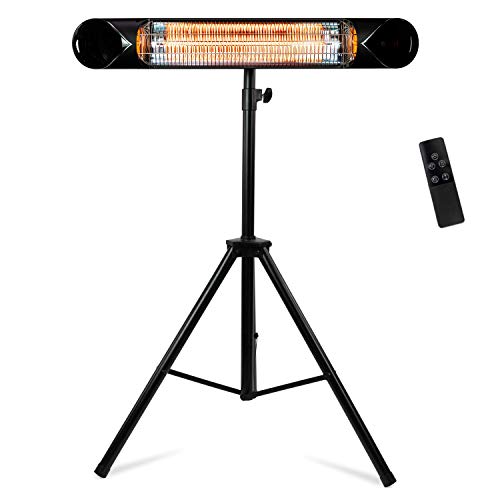 Briza 1500 WThe same 1,500 W infrared element as everything else, sold with a tripod as well as the brackets. That flexibility is the entire argument for it, and it is a decent one. | Not committing to a mounting point | 1,500 W | 256 sq ft | $198.88 · Check on Amazon |
| 3 |  Heat Storm TradesmanThe one electric unit here with a published IP rating, which is the difference between a heater that survives a wet winter mounted outdoors and one that is a warranty claim waiting to happen. | Leaving outside all year | 1,500 W | 256 sq ft | $99.99 · Check on Amazon-8% |
Reach marked “claimed” is the maker’s own published figure. Reach without that label is ours, computed from published output at 20 BTU per square foot for an open patio. Neither is a measurement we took.
Top pick · Wind, and anywhere with a roof
Dr Infrared Heater DR-238 Carbon Infrared Patio Heater with Kasa Outdoor Smart Plug
Radiant heat that a breeze cannot blow out, on a plug. 1,500 W is only 5,118 BTU/h, which sounds like nothing next to a propane tower and lands far more of itself on you.
- Fuel
- Electric
- Output
- 1,500 W = 5,118 BTU/h
- Reach (computed)
- 256 sq ft · 9.0 ft radius
- Cost per hour
- $0.28
What works
- Infrared warms objects, not air, so it is the only heat that survives a breeze — this is the single reason wind changes the whole buying decision
- No combustion means no flue gas, which is what makes it legal and sensible on a screened porch where propane is not
- Three settings matter more than they sound: 900 W costs a third less to run and is enough most evenings
What does not
- 1,500 W is 1,500 W. Nothing at this wattage heats faster than anything else at this wattage; the differences between electric heaters are beam shape and build, not power
- It heats what it points at. Step out of the beam and you are cold immediately — this is a fundamentally different experience from a tower
- A 120 V plug-in unit is capped by your circuit, not by the maker. See why 1,500 W is the ceiling
| Published specification | |
|---|---|
| Rated power | 1,500 W at 120 V |
| Settings | 900 W / 1,200 W / 1,500 W |
| Element | Carbon infrared lamp |
| Reflector | Mirror aluminum, 90% reflectivity per the maker |
| Housing | Anodized aluminum, rated for outdoor use |
| Mounting | Wall and ceiling brackets plus remote in the box |
| Bundle | Currently sold with a Kasa EP40 outdoor smart plug |
| Maker’s coverage claim | None published — the reach figure above is ours |
| Safety listing | ETL listed, per the maker's published product data |
Who it is for
A covered patio, pergola or screened porch where you can mount it overhead and point it at where people sit, and anywhere wind ruins a flame.
What it is not for
A big open patio with nowhere to mount it. Radiant heat needs a line of sight and a place to hang from.
2 · Not committing to a mounting point
Briza Infrared Electric Patio Heater, 1500 W, with Stand
The same 1,500 W infrared element as everything else, sold with a tripod as well as the brackets. That flexibility is the entire argument for it, and it is a decent one.
- Fuel
- Electric
- Output
- 1,500 W = 5,118 BTU/h
- Reach (computed)
- 256 sq ft · 9.0 ft radius
- Cost per hour
- $0.28
What works
- The tripod means you can find the right position over a season before drilling anything, then mount it properly
- A 1-to-9-hour timer on the remote is the feature that stops a mounted heater running all night by accident
- Three power settings, same as the Dr Infrared unit, and the 900 W setting is the one you will actually use
What does not
- No published IP rating and no named safety listing. For a unit sold to live outdoors that is a real omission, and we would rather tell you than skip past it
- A tripod-mounted heater is a tip-over object around children and dogs in a way a wall-mounted one is not
- No published coverage figure, so the reach column is ours
| Published specification | |
|---|---|
| Rated power | 1,500 W at 120 V |
| Settings | 900 W / 1,200 W / 1,500 W |
| Timer | 1 to 9 hours, on the remote |
| Mounting | Wall and ceiling hardware plus an adjustable tripod stand |
| Maker’s coverage claim | None published — the reach figure above is ours |
| Safety listing | The listing does not publish a safety listing body or an IP rating |
Who it is for
Someone who wants electric radiant heat but does not yet know where it should live permanently.
What it is not for
A fully exposed position in wet weather — without a published ingress rating we cannot tell you it will survive one.
Sources for this entry
3 · Leaving outside all year
Heat Storm Tradesman HS-1500-OTR-R 1500 W Weatherproof Infrared Heater
The one electric unit here with a published IP rating, which is the difference between a heater that survives a wet winter mounted outdoors and one that is a warranty claim waiting to happen.
- Fuel
- Electric
- Output
- 1,500 W = 5,118 BTU/h
- Reach (computed)
- 256 sq ft · 9.0 ft radius
- Cost per hour
- $0.28
What works
- A published IPX4 rating. Almost nobody in this category publishes an ingress rating at all, and mounting an unrated electric heater outdoors is a gamble you cannot price
- The maker publishes its own BTU figure (5,200), which is within a rounding error of the 5,118 our watts-to-BTU conversion gives — a company doing its own arithmetic honestly
- Wall or ceiling mount puts the heat above head height where a radiant beam belongs
What does not
- IPX4 rates water only — the solids digit is X, meaning none is published. It is splashing-water protection, not immersion, and it tells you nothing about dust ingress
- Fixed mounting means fixed aim. Get the position wrong and there is no adjusting it from the chair
- Same 1,500 W ceiling as every other plug-in electric heater
| Published specification | |
|---|---|
| Rated power | 1,500 W at 120 V |
| Published output | 5,200 BTU/h per the maker |
| Element | Carbon fiber infrared, per the maker |
| Weather rating | IPX4 |
| Dimensions | 27 x 8 x 6 in |
| Control | Remote included |
| Mounting | Wall or ceiling; tripod and tri-mount combos are separate SKUs |
| Maker’s coverage claim | None published — the reach figure above is ours |
| Safety listing | IPX4 weatherproof rating published by the maker |
Who it is for
A permanently mounted heater on a pergola, porch ceiling or exterior wall that you never want to take down and store.
What it is not for
Portability, and any open patio with no structure to mount to.
What to run it on
- Its own circuit, ideally. 1,500 W continuous is most of what a 15 A circuit should carry — the continuous-load rule gives 1,440 W — so sharing with a compressor, a freezer or a second heater is how you find the breaker. The electrical fault tree explains why resetting it repeatedly is not the fix.
- Mounted, not standing. A garage floor is where things get knocked over, and a mounted unit aims down at where you actually are. The ceiling and studs are right there.
- Clear of stored fuel and the car. No combustion means no ignition source at the burner, but an element is still hot, and published clearances still apply to whatever is stacked against the wall.
- Accept the cord limit. Most of these ship with a short lead. An outdoor-rated, correctly gauged extension is part of the plan or the outlet has to be close.
If the garage is the only space you have
Worth saying plainly, because people arrive at this question from two directions. If you are trying to extend patio season and the garage is a wet-weather fallback, a mounted electric unit is a genuinely good buy and it will also serve the patio side if you mount it near the opening.
If you are trying to heat a garage as a workshop for long sessions in genuine cold, you are no longer shopping for a patio heater. That is a garage-heating purchase — a different category with vented options, thermostats and sizing conventions this site does not cover. The electric picks above are honest about being radiant spot heat, and for a workshop you should weigh that against equipment built for the job.
How we picked
- Electric only, with no partial case for gas. This is a ventilation question rather than a clearance question, and ventilation does not improve by degrees in a space with one opening.
- Units a garage can actually mount. A garage has studs, joists and a flat ceiling, which makes it the easiest structure on this site to fix to — so the picks are mounted rather than freestanding.
- Nothing with a cylinder. A propane cylinder does not belong in a garage whether or not it is connected, which rules out the whole propane catalog here twice over.
- Rated for a damp, cold, unheated space, because that is what a garage is for most of the year.
What we did not do
Everyone in this category says they tested twenty heaters. We have not tested any, and we say so. What we do instead: compile the published specs, compute the electrical and gas load from them, cite the maker’s own manual, and show the arithmetic so you can check it. The full method, including how to challenge a figure.
For the adjacent spaces where the same ventilation rule decides the answer, the screened porch page and the gazebo page work through it for structures that are only partly enclosed.
Common questions
Can you use a patio heater in a garage?
An electric one, yes — ideally wall or ceiling mounted, on a circuit it does not share. A propane or natural gas patio heater, no. Every gas patio heater is specified outdoor use only because unvented combustion in a space with restricted air exchange is a carbon monoxide risk.
Can you use a propane heater in a garage with the door open?
No. One opening in one wall gives you air exchange that depends on wind and temperature difference, and on a still cold evening there is very little of either. The door is also not a fixed state - anyone can close it while the heater is running. A garage additionally stores fuel, which is a separate hazard from the carbon monoxide one.
Are patio heaters safe indoors?
Gas ones are not, anywhere indoors - not a garage, not a basement, not a screened porch, not a tent. Electric patio heaters produce no combustion products, so the ventilation rule does not apply to them, and many are rated for indoor or outdoor use. Check the specific model's rating rather than assuming.
What about a heater with an oxygen depletion sensor?
An ODS shuts off the gas when the oxygen fraction falls - the CPSC describes it as sensing when oxygen drops below 18 percent. It is a real device, but no patio heater on this site publishes one; the tank-top models list a tip-over shut-off only. Appliances built for enclosed use are a separate product category with their own instructions, and an ODS is a last-resort cutoff rather than permission.
How big a heater do I need for a garage?
Less than you would think if you want to be warm, and more than a plug can give if you want the room warm. A single-car garage of about 220 sq ft reads as a well-retained space on our sizing model; a double garage asks for more than one 1,500 W unit can supply, which means two units on separate circuits, a 240 V unit, or heating only the bay you are in.
Can I store the propane cylinder in the garage over winter?
No. Cylinders belong outdoors, upright, valve closed, out of direct sun - never in a house, basement or attached garage, connected or not. The heater body can come inside once the cylinder is off and removed. The off-season storage page has the full routine.
Sources
- U.S. Consumer Product Safety Commission — winter heating caution (do not use portable propane space heaters indoors or in any confined space unless specifically designed for indoor use)
- U.S. Consumer Product Safety Commission — oxygen depletion sensor technology on portable propane heaters (ODS senses when the oxygen level drops below 18 percent)
- U.S. Consumer Product Safety Commission — proposed safety standard for unvented gas heaters, describing the oxygen-sensing device that shuts off the gas supply before carbon monoxide reaches a life-threatening level
Read next
Patio heater safety, with the published numbers
Published clearance figures, the ventilation rule, and where each heater type must never go.
Heating a screened porch
Why a screened porch is electric-only, and the mounted units that suit it.
Heating a gazebo
Open sides or zipped down — the question that decides which heater a gazebo can take.
Wall mounted patio heaters, and the rating that decides
Wall and ceiling mounted electric heaters, ranked on published weather rating and mounting.
Electric patio heaters, and the ceiling nobody mentions
Four electric patio heaters compared on wattage, published IP rating and cost per hour.
Electric patio heater not working
GFCI, circuit load and thermal cutout — the three non-heater causes, checked in order.