Kids and pets
Patio heaters with kids and pets
Every hazard that matters here is a hazard of geometry rather than of output. Get the heat source off the floor and most of the problem stops existing.

Mount it. A wall or ceiling mounted electric infrared heater — the Star Patio STP2020-A is the one we would fix up first — has no cylinder, no flame, no hot surface at toddler height and nothing to pull over. Best for a family patio where the heater has to be safe when nobody is watching it. Every other choice here asks you to supervise a hazard instead of removing it.
This page exists because the usual advice is to supervise, and supervision is not a specification. The useful version of the question is which design has the fewest hazards at child and dog height, and that question has a clear answer.
The four hazards, ranked by how often they matter
Worth being specific, because they are not equally likely and the fixes are different.
- Contact burns. The most common and the least dramatic. A reflector, a burner screen, a glass tube or an element housing gets hot enough to burn on contact, and on a floor-standing unit a good deal of that is below four feet.
- Tipping. A 7-foot propane tower carries its mass high over a narrow base. Children lean on things and dogs run into them. The page on stopping one blowing over is about wind, and the fixes are the same, but a child is a more reliable force than a gust.
- The cylinder. A valve at knee height that turns by hand. This is rarely discussed and it is a genuine attractive nuisance.
- The cord. A 1,500 W electric unit on a floor stand has a lead running across a patio to an outlet, which is a trip hazard for a toddler and a chew hazard for a puppy.
What mounting removes, in one line
Fixing an electric unit above head height removes all four at once: nothing reachable is hot, nothing can tip, there is no cylinder, and the cord runs along a wall rather than across a floor. That is the entire argument of this page.
Why the fuel question answers itself here
On an open patio, propane is perfectly safe in the ventilation sense — the rule that rules it out of a garage and a screened porch does not apply outdoors. So this is not a carbon monoxide argument, and it would be dishonest to dress it up as one.
It is a geometry argument. Propane heat arrives from a burner you cannot mount out of reach, on a base that can fall, fed by a cylinder a child can touch. Electric infrared heat can be fixed to a wall or a joist and aimed down. Given a family patio, that difference decides it, and it decides it without anyone needing to be worse at supervision than they actually are.
You also get the thing that makes radiant heat work outdoors anyway: it warms people rather than air, so an overhead unit aimed at the seating is both safer and more effective than a floor-level one. The infrared page covers that physics, and whether infrared itself is safe to sit under is a separate question with a reassuring answer.
Mounting height, which is the one number to get right
High enough to be out of reach, low enough to still deliver heat. Those pull in opposite directions and the resolution is narrower than people expect.
| Mounting height | Out of reach of | What it costs you |
|---|---|---|
| 7 ft | A standing toddler and most dogs | Nothing — this is the usual recommendation anyway |
| 8 ft | A standing child and a jumping dog | Little; the beam spreads and softens slightly |
| 9 ft + | Essentially everyone | Real. Radiant intensity falls off with distance and a 1,500 W unit does not have the output to spare |
| Under 6 ft | Nobody who matters here | Not a mounting height with children around. A reaching hand gets there |
Our guidance, from the published clearance figures and the reach arithmetic this site uses throughout. Your own unit's manual takes precedence over any general figure.
Eight feet is the sweet spot on a domestic patio, which is convenient because a standard porch ceiling is eight feet. The wall-mounted page covers fixings and aim, and the pergola page is the best worked example of getting the angle right.
Quick picks
Ranked for fit, not for hype. Output is the maker’s published figure; reach is computed from it or from the maker’s own radius claim, and the table says which. Tap a row for the full write-up, or go straight to the listing.
| # | Product | Best for | Output | Reach | Price |
|---|---|---|---|---|---|
| 1 | 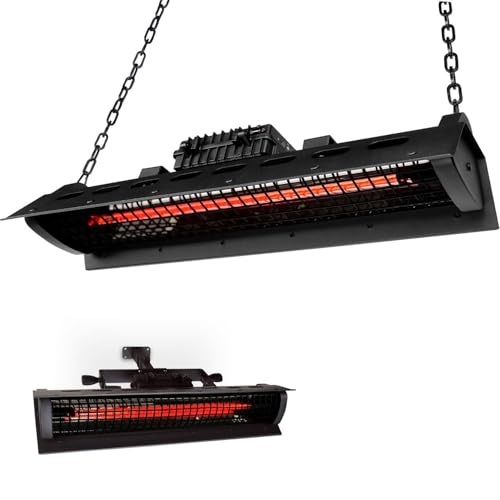 Star Patio STP2020-AOne of the very few electric units whose maker publishes a coverage area at all — 110 sq ft — and it mounts to a wall or hangs from a ceiling on chains. No ingress rating is published, so keep it somewhere sheltered. | A published coverage figure | 1,500 W | 110 sq ft claimed | $199.99 · Check on Amazon |
| 2 |  Heat Storm TradesmanThe one electric unit here with a published IP rating, which is the difference between a heater that survives a wet winter mounted outdoors and one that is a warranty claim waiting to happen. | Leaving outside all year | 1,500 W | 256 sq ft | $99.99 · Check on Amazon-8% |
| 3 |  Dr Infrared 1500 WRadiant heat that a breeze cannot blow out, on a plug. 1,500 W is only 5,118 BTU/h, which sounds like nothing next to a propane tower and lands far more of itself on you. | Wind, and anywhere with a roof | 1,500 W | 256 sq ft | $136.32 · Check on Amazon |
Reach marked “claimed” is the maker’s own published figure. Reach without that label is ours, computed from published output at 20 BTU per square foot for an open patio. Neither is a measurement we took.
Top pick · A published coverage figure
Star Patio STP2020-A-RMN2025 Wall and Ceiling Electric Infrared Patio Heater
One of the very few electric units whose maker publishes a coverage area at all — 110 sq ft — and it mounts to a wall or hangs from a ceiling on chains. No ingress rating is published, so keep it somewhere sheltered.
- Fuel
- Electric
- Output
- 1,500 W = 5,118 BTU/h
- Reach (claimed)
- 110 sq ft · 5.9 ft radius
- Cost per hour
- $0.28
What works
- It publishes a coverage figure. 110 sq ft is a real, checkable claim, and almost nobody in this category states one at all — which is the whole subject of our coverage page
- Wall bracket and ceiling chains both in the box, with 60 degrees of tilt, so the beam can actually be aimed at the chairs rather than at whatever the bracket decided
- 5,100 BTU/h published output is within a rounding error of the 5,118 our watts-to-BTU conversion gives, which is a maker doing its own arithmetic honestly
- Remote control on a unit mounted above head height is functional rather than a luxury
What does not
- No ingress rating is published for this model. Other units in this roundup publish one, and on a permanently mounted outdoor appliance that silence means you cannot price the weather risk. Treat it as a sheltered-position heater
- 110 sq ft is a small area — roughly a 10 by 11 ft patch, which is a seating group and not a patio
- 1,500 W, like everything else that plugs into a standard socket. The ceiling applies here as everywhere
- A 6 ft cord means the outlet has to be close, or an outdoor-rated extension has to be part of the plan
| Published specification | |
|---|---|
| Rated power | 1,500 W at 110 V, 60 Hz |
| Published output | 5,100 BTU/h per the maker |
| Published coverage | Up to 110 sq ft per the maker |
| Element | Golden tube |
| Mounting | Wall bracket or ceiling chains, up to 60 degrees of tilt |
| Size and weight | 27.5 x 7 x 5.7 in, 7.7 lb |
| Element life | 5,000 hours per the maker |
| Maker’s coverage claim | 110 sq ft |
| Safety listing | No ingress rating published for this model |
Who it is for
A sheltered wall or porch ceiling over a seating group, where you want a heater whose maker will tell you what area it actually covers.
What it is not for
An exposed wall where driving rain reaches it, since nothing is published about ingress protection, or any space much larger than a seating group.
2 · Leaving outside all year
Heat Storm Tradesman HS-1500-OTR-R 1500 W Weatherproof Infrared Heater
The one electric unit here with a published IP rating, which is the difference between a heater that survives a wet winter mounted outdoors and one that is a warranty claim waiting to happen.
- Fuel
- Electric
- Output
- 1,500 W = 5,118 BTU/h
- Reach (computed)
- 256 sq ft · 9.0 ft radius
- Cost per hour
- $0.28
What works
- A published IPX4 rating. Almost nobody in this category publishes an ingress rating at all, and mounting an unrated electric heater outdoors is a gamble you cannot price
- The maker publishes its own BTU figure (5,200), which is within a rounding error of the 5,118 our watts-to-BTU conversion gives — a company doing its own arithmetic honestly
- Wall or ceiling mount puts the heat above head height where a radiant beam belongs
What does not
- IPX4 rates water only — the solids digit is X, meaning none is published. It is splashing-water protection, not immersion, and it tells you nothing about dust ingress
- Fixed mounting means fixed aim. Get the position wrong and there is no adjusting it from the chair
- Same 1,500 W ceiling as every other plug-in electric heater
| Published specification | |
|---|---|
| Rated power | 1,500 W at 120 V |
| Published output | 5,200 BTU/h per the maker |
| Element | Carbon fiber infrared, per the maker |
| Weather rating | IPX4 |
| Dimensions | 27 x 8 x 6 in |
| Control | Remote included |
| Mounting | Wall or ceiling; tripod and tri-mount combos are separate SKUs |
| Maker’s coverage claim | None published — the reach figure above is ours |
| Safety listing | IPX4 weatherproof rating published by the maker |
Who it is for
A permanently mounted heater on a pergola, porch ceiling or exterior wall that you never want to take down and store.
What it is not for
Portability, and any open patio with no structure to mount to.
3 · Wind, and anywhere with a roof
Dr Infrared Heater DR-238 Carbon Infrared Patio Heater with Kasa Outdoor Smart Plug
Radiant heat that a breeze cannot blow out, on a plug. 1,500 W is only 5,118 BTU/h, which sounds like nothing next to a propane tower and lands far more of itself on you.
- Fuel
- Electric
- Output
- 1,500 W = 5,118 BTU/h
- Reach (computed)
- 256 sq ft · 9.0 ft radius
- Cost per hour
- $0.28
What works
- Infrared warms objects, not air, so it is the only heat that survives a breeze — this is the single reason wind changes the whole buying decision
- No combustion means no flue gas, which is what makes it legal and sensible on a screened porch where propane is not
- Three settings matter more than they sound: 900 W costs a third less to run and is enough most evenings
What does not
- 1,500 W is 1,500 W. Nothing at this wattage heats faster than anything else at this wattage; the differences between electric heaters are beam shape and build, not power
- It heats what it points at. Step out of the beam and you are cold immediately — this is a fundamentally different experience from a tower
- A 120 V plug-in unit is capped by your circuit, not by the maker. See why 1,500 W is the ceiling
| Published specification | |
|---|---|
| Rated power | 1,500 W at 120 V |
| Settings | 900 W / 1,200 W / 1,500 W |
| Element | Carbon infrared lamp |
| Reflector | Mirror aluminum, 90% reflectivity per the maker |
| Housing | Anodized aluminum, rated for outdoor use |
| Mounting | Wall and ceiling brackets plus remote in the box |
| Bundle | Currently sold with a Kasa EP40 outdoor smart plug |
| Maker’s coverage claim | None published — the reach figure above is ours |
| Safety listing | ETL listed, per the maker's published product data |
Who it is for
A covered patio, pergola or screened porch where you can mount it overhead and point it at where people sit, and anywhere wind ruins a flame.
What it is not for
A big open patio with nowhere to mount it. Radiant heat needs a line of sight and a place to hang from.
What we would skip
A list with no losers is a list nobody edited. These are the choices we would actively steer you away from, and why.
A freestanding propane tower, if it can be reached
Three problems at once. The mesh burner screen and the reflector get hot and sit within reach of a standing child; the base is a 7-foot lever over a 20 lb cylinder; and the cylinder itself is a valve a curious child can turn. None of these is a reason nobody should own a tower — they are the right buy for plenty of patios — but with small children on the same deck, the hazards are at the wrong height. If it is the only option, weight the base, fix it to something, and treat the heater as off-limits rather than as furniture.
A tabletop heater within arm's reach of a seated child
A tabletop unit puts an open flame and a hot glass tube in the middle of the surface people eat at, about 18 inches from a child in a booster seat. It is a good product in the wrong company. The published 24-inch overhead clearance is also frequently the thing a reaching arm occupies.
A fire pit as the heat source, with a toddler on the patio
Open fire at knee height with no barrier and no shut-off. Fire pits earn their place and this is not a judgment on them, but a fire pit demands continuous adult attention in a way a mounted heater does not, and the surround stays hot long after the fire is out.
A tank-top radiant heater, anywhere children go
It is match-lit, has no enclosure around the burner, and sits at knee-to-thigh height on top of a cylinder. The MH15T review is positive about it as job-site equipment, which is what it is.
Patio heater covers as a safety measure
A cover protects the heater from weather. It is not a guard, it does not go on a warm unit, and it should never be treated as the thing between a child and a hot element.
If you already own a tower
Most people reading this did not buy their heater before they had children, and replacing a working appliance is a poor answer. The practical mitigations, in the order they help:
- Fix the base. Ballast it or anchor it so that leaning on it does nothing. The anchoring page has the methods and they work identically against a child.
- Give it a footprint. Put it where the seating is between the heater and the open patio, not where it is on the route between the door and the steps.
- Check the tip-over switch works rather than assuming. Resetting and testing it takes a minute.
- Close and cap the cylinder every time, so an open valve is never one turn away. The off-season rule — cylinder outdoors, upright, valve closed — is the in-season rule too.
- Treat the hot zone as a rule, not a hope. The reflector and screen stay hot for a long while after shut-off, which is the part that catches people out.
Pets specifically, which differ from children
Two differences worth naming. A dog will lie closer to a heat source than a person finds comfortable, for longer, and will not move away as readily — which makes a floor-level radiant heater aimed horizontally a genuine burn risk rather than a theoretical one. An overhead unit avoids this by geometry again: the intensity at floor level is a fraction of the intensity at seat level.
The second is the cord, and it is the one that actually causes incidents. A 1,500 W lead is a chewable object carrying a continuous 12.5 A. Run it along a wall, clip it, and do not improvise with an indoor extension — the electrical page explains why a correctly gauged outdoor-rated cord is not optional on a continuous load.
How we picked
- Height first, everything else second. A toddler reaches about waist height on an adult and a dog's tail clears a floor-standing base easily. A heater fixed above head height removes contact, tipping and cylinder access in one decision.
- Electric only. Not for the ventilation reason that decides a garage — an open patio is fine for gas — but because a cylinder, a flame and a tall unstable base are three hazards a mounted electric unit simply does not have.
- Enclosed elements preferred. A grille or housing in front of the element is the difference between a hot appliance and a touchable one, and it matters for a thrown ball as much as for a hand.
- No glass flame tubes. A pyramid heater's selling point is a visible flame column at standing height, which is an attractive, breakable, very hot cylinder at exactly the wrong elevation.
- Tip-over protection treated as a backstop, not a solution. Every heater here that can fall has it; the point of mounting is that falling is not on the list.
What we did not do
Everyone in this category says they tested twenty heaters. We have not tested any, and we say so. What we do instead: compile the published specs, compute the electrical and gas load from them, cite the maker’s own manual, and show the arithmetic so you can check it. The full method, including how to challenge a figure.
For the small-patio version of this problem, where floor space is the binding constraint rather than reach, the small patio page works through it — and the answer is the same mounted unit for a different reason.
Common questions
What is the safest patio heater for a family with young children?
A wall or ceiling mounted electric infrared unit, fixed at around eight feet. It has no cylinder, no open flame, no reachable hot surface and nothing to pull over, which removes contact burns, tipping, cylinder access and a trailing cord in one decision. Freestanding propane towers put all four hazards at child height.
Are propane patio heaters safe around kids?
On an open patio the ventilation question does not arise, so the issue is geometry rather than fumes. A tower's burner screen and reflector are hot and within reach, the base is a tall lever over a cylinder, and the cylinder valve turns by hand. If you already own one, ballast or anchor the base, close and cap the cylinder every time, and treat the hot zone as off-limits.
How high should a patio heater be mounted with children around?
Around eight feet is the sweet spot, which is also a standard porch ceiling height. Seven feet is out of reach of a standing toddler and most dogs. Below six feet a reaching hand gets to it, and above nine feet a 1,500 W unit starts losing useful intensity at the seating.
Can a patio heater burn a dog?
A floor-level or tabletop one can. Dogs lie closer to heat than people do, for longer, and do not move away as readily, so a radiant heater aimed horizontally at lying-down height is a real risk. An overhead unit largely avoids it, because intensity at floor level is a fraction of intensity at seat level. The other pet hazard is the power lead, which is chewable and carries a continuous load.
Is a tip-over switch enough protection?
It is a backstop, not a solution. Every freestanding heater that can fall has one, and it should be tested rather than assumed - but it acts after the heater has already gone over. Mounting removes falling from the list of things that can happen, which is a better answer than catching it afterwards.
Do patio heater covers make a heater child-safe?
No. A cover is weather protection for a cold unit. It does not go on a warm heater, it is not a guard, and it should never be the thing between a child and a hot element.
Read next
Patio heater safety, with the published numbers
Published clearance figures, the ventilation rule, and where each heater type must never go.
Wall mounted patio heaters, and the rating that decides
Wall and ceiling mounted electric heaters, ranked on published weather rating and mounting.
Are infrared patio heaters safe?
Non-ionizing thermal radiation, the same as a wood fire gives off. What the real hazards are, and the gentlest units.
The best patio heaters for a small patio
Why floor space and clearance decide this rather than BTU, and the heaters that fit a 10x10 or 12x12.
How to stop a patio heater blowing over
Ballast, anchors and placement — the three fixes, in the order they matter.
Can you use a patio heater in a garage?
Electric yes, gas no — not even with the door open. The ventilation rule, and the mounted units that suit a garage.