Deep review
Star Patio STP2020-A review
A 1,500 W mounted infrared bar that does something unusual for this category — it tells you what area it covers, and its own arithmetic checks out. What it will not tell you is how it handles rain.

A 1,500 W golden-tube infrared bar that mounts to a wall or hangs from a ceiling, and the rare unit in this category whose maker publishes a coverage area: 110 sq ft. Best for a sheltered wall or porch ceiling over one seating group, where you want a heater that states what it covers instead of implying it. Its published 5,100 BTU/h is within a rounding error of the honest arithmetic, which is a good sign about everything else on the spec sheet. The catch is that no ingress rating is published — so keep it under cover.
We have not run this heater. What follows reads Star Patio's published specification, does the arithmetic those figures imply, and keeps the maker's numbers and ours clearly separated. That is the standard our methodology commits to on every unit here.
What it is
A slim steel bar, 27.5 by 7 by 5.7 inches and 7.7 lb, holding a golden-tube infrared element behind a grille, with a remote. It ships with both a wall bracket and ceiling chains, and the bracket allows up to 60 degrees of tilt. Star Patio publishes 1,500 W at 110 V, 60 Hz, a 5,100 BTU/h output figure, coverage of up to 110 sq ft, and an element life of 5,000 hours.
In the catalog here it is the unit that turns up whenever the answer is "mount something electric" — a screened porch, a gazebo, a small patio, a balcony. This page is the long version of why.
Quick picks
Ranked for fit, not for hype. Output is the maker’s published figure; reach is computed from it or from the maker’s own radius claim, and the table says which. Tap a row for the full write-up, or go straight to the listing.
| # | Product | Best for | Output | Reach | Price |
|---|---|---|---|---|---|
| 1 | 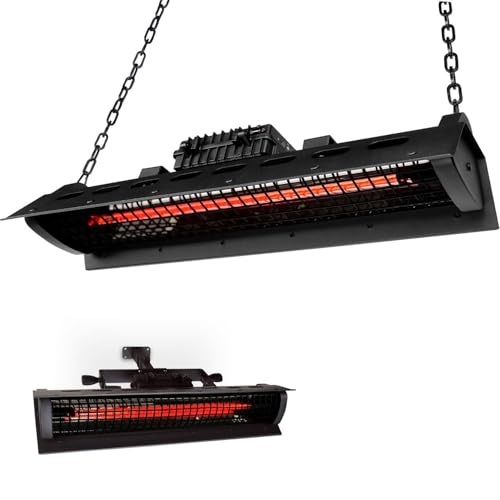 Star Patio STP2020-AOne of the very few electric units whose maker publishes a coverage area at all — 110 sq ft — and it mounts to a wall or hangs from a ceiling on chains. No ingress rating is published, so keep it somewhere sheltered. | A published coverage figure | 1,500 W | 110 sq ft claimed | $199.99 · Check on Amazon |
Reach marked “claimed” is the maker’s own published figure. Reach without that label is ours, computed from published output at 20 BTU per square foot for an open patio. Neither is a measurement we took.
Top pick · A published coverage figure
Star Patio STP2020-A-RMN2025 Wall and Ceiling Electric Infrared Patio Heater
One of the very few electric units whose maker publishes a coverage area at all — 110 sq ft — and it mounts to a wall or hangs from a ceiling on chains. No ingress rating is published, so keep it somewhere sheltered.
- Fuel
- Electric
- Output
- 1,500 W = 5,118 BTU/h
- Reach (claimed)
- 110 sq ft · 5.9 ft radius
- Cost per hour
- $0.28
What works
- It publishes a coverage figure. 110 sq ft is a real, checkable claim, and almost nobody in this category states one at all — which is the whole subject of our coverage page
- Wall bracket and ceiling chains both in the box, with 60 degrees of tilt, so the beam can actually be aimed at the chairs rather than at whatever the bracket decided
- 5,100 BTU/h published output is within a rounding error of the 5,118 our watts-to-BTU conversion gives, which is a maker doing its own arithmetic honestly
- Remote control on a unit mounted above head height is functional rather than a luxury
What does not
- No ingress rating is published for this model. Other units in this roundup publish one, and on a permanently mounted outdoor appliance that silence means you cannot price the weather risk. Treat it as a sheltered-position heater
- 110 sq ft is a small area — roughly a 10 by 11 ft patch, which is a seating group and not a patio
- 1,500 W, like everything else that plugs into a standard socket. The ceiling applies here as everywhere
- A 6 ft cord means the outlet has to be close, or an outdoor-rated extension has to be part of the plan
| Published specification | |
|---|---|
| Rated power | 1,500 W at 110 V, 60 Hz |
| Published output | 5,100 BTU/h per the maker |
| Published coverage | Up to 110 sq ft per the maker |
| Element | Golden tube |
| Mounting | Wall bracket or ceiling chains, up to 60 degrees of tilt |
| Size and weight | 27.5 x 7 x 5.7 in, 7.7 lb |
| Element life | 5,000 hours per the maker |
| Maker’s coverage claim | 110 sq ft |
| Safety listing | No ingress rating published for this model |
Who it is for
A sheltered wall or porch ceiling over a seating group, where you want a heater whose maker will tell you what area it actually covers.
What it is not for
An exposed wall where driving rain reaches it, since nothing is published about ingress protection, or any space much larger than a seating group.
The coverage figure, and why it is the headline
Almost nothing in this category publishes a coverage area. Propane towers advertise a radius in feet, which is a different and much more slippery claim, and most electric units publish wattage and stop. A stated square footage is checkable, and being checkable is the whole point.
So let us check it. 110 sq ft as a circle is a radius of a little under 6 feet — our arithmetic, from the maker's figure. That is a seating group: a loveseat and two chairs, or a bistro table for four. The coverage area page explains why radius and area get confused so often and why the area figure is the more honest of the two.
Then check the output claim against physics. 1,500 W converts to 5,118 BTU/h by the exact conversion. Star Patio publishes 5,100. That is a maker rounding its own honest arithmetic down slightly rather than inflating it — and in a field where a 1,500 W unit is routinely marketed beside a 46,000 BTU tower as though the numbers were comparable, it is worth noticing.
Why one honest number raises our confidence in the others
A spec sheet that publishes a coverage figure which survives checking, and an output figure that matches the conversion to within 18 BTU/h, is a spec sheet written by someone doing arithmetic rather than marketing. That does not make the heater better than a rival with the same element. It does make the rest of its published claims more credible, and on a product nobody can test from a desk, credibility of the published figures is most of what there is to assess.
The 60 degrees of tilt, which matter more than they sound
Radiant heat only warms what it is pointed at. That sentence is the whole reason infrared works outdoors and the whole reason a badly aimed infrared heater disappoints, and it makes the mounting hardware a performance specification rather than an accessory.
A fixed bracket aims the beam wherever the manufacturer decided, which on a wall is usually straight out — across the patio at head height, warming the fence. Sixty degrees of adjustment means you can put the beam on the chairs from a wall mount, or angle it down and outward from a porch ceiling. The pergola page is the best worked example of what getting that angle right is worth; the wall-mounted page covers the fixings.
Shipping both a wall bracket and ceiling chains is the other practical note. It means you do not have to decide before the box arrives, and a 7.7 lb appliance is light enough that a single joist or two wall fixings are ample — which is not true of every mounted heater.
What it costs to run
1,500 W is 1,500 W, so this is the same figure as every other plug-in heater on the site, and it is the cheap end of outdoor heating:
Electric, per hour
| Rated power | Per hour | 4-hour evening | Per month, 4 h a night |
|---|---|---|---|
| 750 W | $0.14 | $0.55 | $16.51 |
| 900 W | $0.17 | $0.66 | $19.81 |
| 1,200 W | $0.22 | $0.88 | $26.41 |
| 1,500 W | $0.28 | $1.10 | $33.01 |
| 2,000 W | $0.37 | $1.47 | $44.02 |
| 3,000 W | $0.55 | $2.20 | $66.02 |
At 18.34 cents per kWh (June 2026 U.S. residential average). Substitute your own rate: it is on your bill, and the arithmetic is watts ÷ 1000 x hours x rate.
Propane, per hour
| Rated input | Per hour | 4-hour evening | Per month, 4 h a night |
|---|---|---|---|
| 11,000 BTU/h | $0.32 | $1.29 | $38.61 |
| 40,000 BTU/h | $1.17 | $4.68 | $140.40 |
| 46,000 BTU/h | $1.35 | $5.38 | $161.46 |
| 48,000 BTU/h | $1.40 | $5.62 | $168.48 |
| 50,000 BTU/h | $1.46 | $5.85 | $175.50 |
At $2.674 per gallon (week ending March 30, 2026 U.S. residential average) and 91,420 BTU per gallon. Exchange-cage cylinders cost materially more per gallon than a bulk refill, so treat this as the floor.
The prices every cost figure on this site uses
- Electricity: 18.34 cents per kWh. U.S. average residential retail price, June 2026. EIA, Electric Power Monthly, Table 5.6.A (residential, U.S. total).
- Propane: $2.674 per gallon. U.S. average residential price, week ending March 30, 2026. EIA, Weekly Heating Oil and Propane Prices (residential, U.S. average). That series only runs through the heating season, which is why the latest reading is a March one.
- Propane energy content: 91,420 BTU per gallon (higher heating value, the same basis appliance BTU ratings use). U.S. DOE Alternative Fuels Data Center, Fuel Properties Comparison.
- Conversion: 1 kWh = 3,412 BTU. Which is why a 1,500 W electric heater is a 5,118 BTU/h appliance, and why comparing it to a 48,000 BTU propane tower is not the comparison it looks like.
About 28 cents an hour at the electricity price this site cites. For comparison, a 46,000 BTU/h propane tower runs about $1.35 an hour — roughly five times as much — which is the trade the whole electric versus propane decision turns on. You give up raw output and you get a fifth of the running cost and no cylinder to manage.
The element-life figure is worth converting too. 5,000 hours, per the maker, is about 1,250 four-hour evenings. At sixty evenings a season that is a very long time — long enough that the element is unlikely to be what ends this heater's life, which is a point in favor of a product in a category where parts availability is a real concern.
The ingress rating it does not publish
This is the genuine weakness and it deserves to be stated as plainly as the strengths.
No IP rating appears in Star Patio's published specification for this model. For a permanently mounted outdoor electrical appliance that is the one number you most want, because it is the difference between a unit you can fix under an open sky and one that needs to stay under cover. Competing units in the same roundup do publish one — the Heat Storm Tradesman publishes IPX4, and its review goes into what the X leaves out — so this is not an unmeetable standard for the category.
The honest consequence is a restriction rather than a verdict. Mount it somewhere sheltered: a porch ceiling, a soffit, a wall under an overhang, the inside of a pergola with a cover. Do not mount it on an exposed wall that takes driving rain, because nothing published tells you it will survive one, and we are not going to guess on your behalf.
The silence is the problem, not a known failure
We have no evidence this unit handles water badly. We have no evidence it handles water well either, and on a mains appliance screwed to a wall outdoors, that absence is the thing to weigh rather than something to read optimistically. If your mounting position is genuinely exposed, buy a unit that publishes a rating.
Golden tube, and what that means to sit under
The element is a golden tube — a coated quartz lamp sold on reduced glare. That places it between the two ends of the spectrum this site covers: brighter and faster to temperature than a carbon element, dimmer and softer than a bare quartz or halogen bar.
Heat output is unaffected by any of this. Every 1,500 W element produces the same 5,118 BTU/h, so the element choice is purely about what the thing is like to sit beneath for three hours — which is a comfort question and a real one. Carbon versus quartz is the full comparison, and whether infrared is safe to sit under at all answers the question underneath that one. Short version: the radiation is thermal and non-ionizing, and glare is the only thing the element type actually changes.
Who should buy it
- Anyone with a sheltered wall or porch ceiling over one seating group. This is the design center and the unit is very well matched to it.
- Anyone who wants to aim the heat. Sixty degrees of tilt plus a choice of wall or ceiling mounting covers nearly every geometry a domestic patio presents.
- Anyone sizing honestly. A maker that publishes a coverage figure lets you check its claim against the BTU calculator before buying rather than after.
- Anyone who has ruled out gas for ventilation reasons — a screened porch, a gazebo or a garage — where electric is not a preference but the only appropriate choice.
- Anyone with children or pets on the patio, because a mounted unit puts the hot part out of reach, which is the argument that decides that case.
Who should not
- Anyone mounting it somewhere genuinely exposed. No published ingress rating. Buy something that states one.
- Anyone trying to heat a patio rather than a seating group. 110 sq ft is about a 12 ft circle. A 300 sq ft patio is a two-heater problem — how many heaters sets out why the count is governed by reach rather than output.
- Anyone expecting to escape the 1,500 W ceiling. Nothing that plugs into a standard socket does. If you need more from one unit, that is the 240 V conversation.
- Anyone whose nearest outlet is far away. The cord is short, so an outdoor-rated and correctly gauged extension is part of the plan or the outlet has to be close.
- Anyone who wants a flame. This is a heat appliance with no visual warmth to it at all. A pyramid heater is the opposite trade — much more spectacle, much less heat per dollar.
The verdict
The best-documented unit in a poorly documented category. A published coverage figure that survives checking, an output claim that matches the conversion, generous mounting hardware with real adjustment, and a quoted element life long enough to stop being a concern — all at the running cost every 1,500 W heater shares.
What you accept is a restriction and a size. It needs to live somewhere sheltered, because its maker will not tell you otherwise, and it covers a seating group rather than a patio. Inside those two limits it is the mounted electric heater we would reach for first, and the reason it appears on so many of the space-specific pages here is that a great many patios are exactly a sheltered wall over a seating group.
Common questions
How much area does the Star Patio STP2020-A cover?
Star Patio publishes up to 110 sq ft, which is unusual - most of this category publishes no coverage figure at all. As a circle that is a radius of a little under 6 feet, our arithmetic from the maker's number: a seating group rather than a whole patio. A 300 sq ft patio needs more than one unit.
Is the Star Patio STP2020-A weatherproof?
No ingress rating is published for this model, which is its main weakness. That is not evidence it handles water badly - it is an absence of evidence either way, and on a mains appliance mounted outdoors that absence is the thing to weigh. Mount it somewhere sheltered such as a porch ceiling or a wall under an overhang, and choose a unit that publishes an IP rating if your position is exposed.
What does the Star Patio STP2020-A cost to run?
About 28 cents an hour at the national average residential electricity price this site cites, like every other 1,500 W plug-in heater. A 46,000 BTU/h propane tower costs roughly $1.35 an hour, so this is about a fifth of the running cost - the trade being far lower rated output.
Can it be mounted on a ceiling?
Yes. It ships with both a wall bracket and ceiling chains, and the bracket allows up to 60 degrees of tilt. At 7.7 lb it is light enough that a single joist or two wall fixings are ample. The tilt is the specification that matters most, because radiant heat only warms what it is aimed at.
How long does the element last?
Star Patio publishes 5,000 hours, which is about 1,250 four-hour evenings - at sixty evenings a season, a very long time. On this product the element is unlikely to be the part that ends its life.
Is the published 5,100 BTU/h figure accurate?
It is slightly conservative, which is a good sign. 1,500 W converts to 5,118 BTU/h exactly, so the maker has rounded its own honest arithmetic down by 18 BTU/h rather than inflating it. In a category where 1,500 W units are routinely advertised next to 46,000 BTU towers, that is worth noticing.
Sources
Read next
Wall mounted patio heaters, and the rating that decides
Wall and ceiling mounted electric heaters, ranked on published weather rating and mounting.
Electric patio heaters, and the ceiling nobody mentions
Four electric patio heaters compared on wattage, published IP rating and cost per hour.
Hanging patio heaters
Ceiling and chain-hung heaters judged on what they hang from, how they behave in wind, and the weather rating most listings omit.
Carbon vs quartz infrared elements
The two infrared element types compared on warm-up, glare and durability — and why output is identical.
Patio heater coverage area
Radius to area, why the two get confused, and how to sanity-check any coverage claim.
Heating a screened porch
Why a screened porch is electric-only, and the mounted units that suit it.